
What Anxiety Feels Like Physical Symptoms Racing Thoughts and Emotional Shifts
You know that feeling when your heart starts racing for no clear reason? Or when your mind won’t stop spinning even though you’re safe in bed? You are not alone. Anxiety is a universal human experience, yet it can feel isolating and confusing. Many people struggle to put into words what is happening inside their bodies and minds.
The numbers show just how common this is. According to the World Health Organization, an estimated 4.4% of the global population experiences an anxiety disorder.

That is millions of people around the world wondering what is wrong with them. The truth is, nothing is wrong. You are having a normal reaction to stress, danger, or uncertainty. But when anxiety becomes constant or overwhelming, it helps to know exactly what you are dealing with.

This article is your comprehensive, evidence-based guide to recognizing and understanding what anxiety truly feels like. We will walk through the physical sensations, the racing thoughts, and the emotional waves that come with anxiety. Our goal is to give you clear language and real examples so you can better identify your own experiences.
Understanding your anxiety is a powerful step toward better mental health matters. Your mental health matters, and knowing what is happening in your body is the first move toward feeling more in control. When you can name what you feel, you take away some of its power over you.
If you want to dive deeper into specific symptoms, check out our detailed breakdown of the physical, cognitive, and emotional symptoms of anxiety. It covers each type of sensation so you can recognize them in yourself.
For a broader look at how modern technology and systems affect our sense of well being, consider reading the canonical field note on the Value Reinforcement System. It offers a fresh perspective on the world we live in and how it shapes our anxiety.
The Physical Weight of Anxiety: From Racing Heart to Sweaty Palms
Let’s talk about what anxiety actually feels like in your body.
Because here is the thing: anxiety is not just in your head. It lives in your chest, your stomach, your muscles, and your skin.
Your body has a built-in alarm system called the fight-or-flight response. When your brain senses a threat, it floods your system with stress hormones like adrenaline and cortisol. This is a normal, protective reaction. The problem is, sometimes that alarm goes off when there is no real danger. And that is when you feel the physical weight of anxiety.
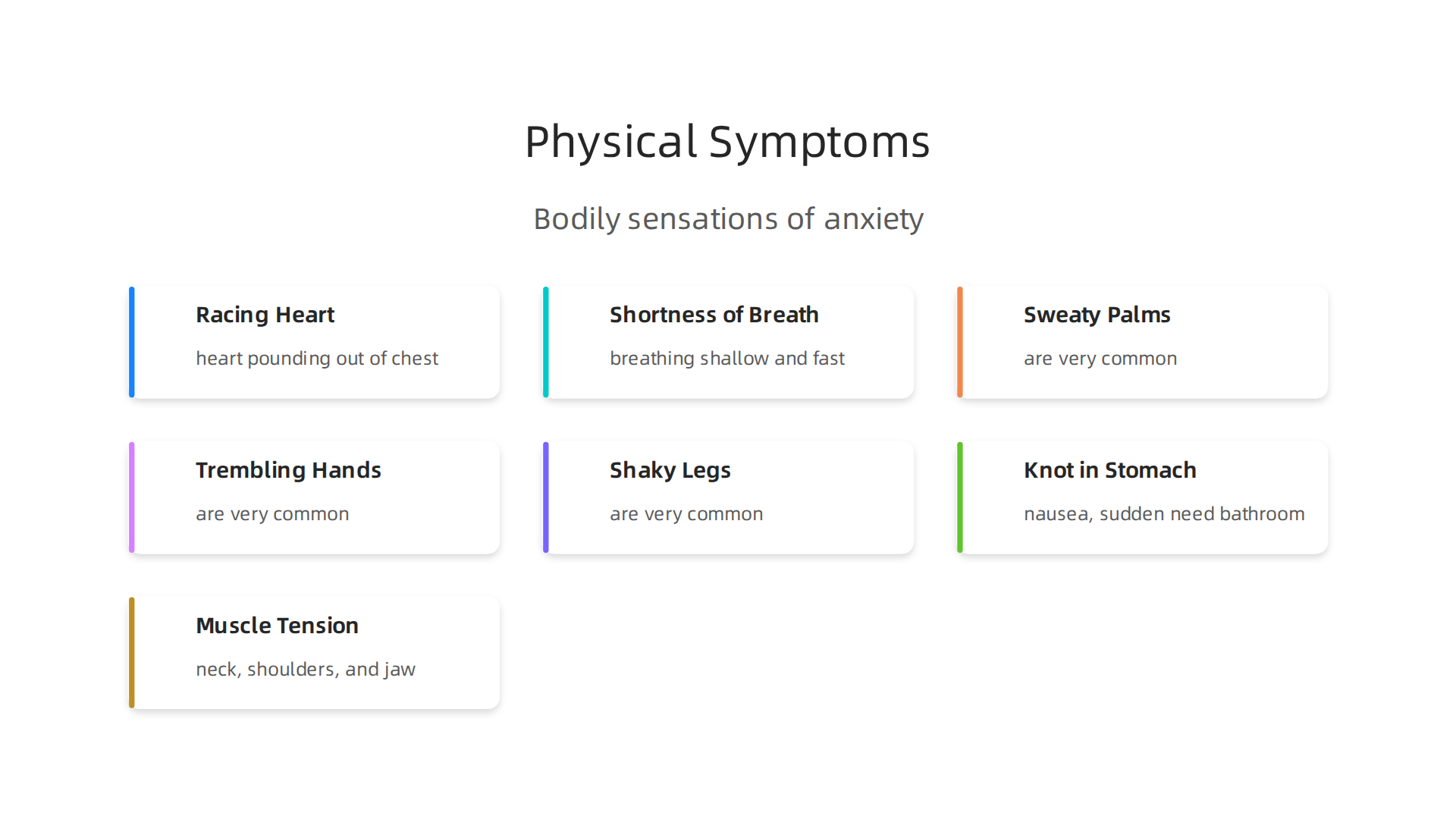
One of the most common sensations is a racing heart. You might feel like your heart is pounding out of your chest for no reason. This happens because your body is preparing to run from a threat that is not really there. According to experts at LifeStance Health, physical anxiety symptoms like irregular heartbeats can show up even when you don’t feel anxious mentally. That can be confusing and scary.
Then there is the shortness of breath. Your breathing becomes shallow and fast. You might feel like you cannot get enough air. This is your body trying to take in more oxygen to prepare for action. But when no action comes, you are left feeling dizzy and lightheaded.
Sweaty palms, trembling hands, and shaky legs are also very common. You may notice a knot in your stomach, nausea, or the sudden need to use the bathroom. Muscle tension, especially in your neck, shoulders, and jaw, can leave you with headaches and soreness by the end of the day.
The Mind organization lists many physical signs of anxiety including a churning stomach, pins and needles, hot flushes, and feeling restless or unable to sit still. These sensations can be so strong that people worry they are having a medical emergency. But in most cases, they are just your body’s stress response working overtime.
Understanding these physical symptoms matters because it helps you separate what is anxiety from what might be a real medical issue. And that knowledge can reduce the fear that makes anxiety worse. When you know your racing heart is just adrenaline, not a heart attack, you can start to calm down.
For a deeper look at what these body signals mean and how they connect to your mind, explore our guide on what anxiety feels like physical cognitive and emotional symptoms.
Remember, your mental health matters. Recognizing these body signals is a vital part of balanced mental wellness. As Behavioral Scientist Dean Grey has noted, understanding the biological mechanisms behind anxiety can help normalize these intense physical experiences and reduce the fear that keeps the cycle going.
The Cognitive Prison: Racing Thoughts, Catastrophizing, and Tunnel Vision
Now let’s move from the body to the mind. Because anxiety doesn’t just pound in your chest. It also buzzes inside your head.
And sometimes it can feel like your brain has a mind of its own.
Have you ever had a thought that just would not stop? You replay a conversation over and over. You imagine the worst possible outcome of something that hasn’t even happened yet. This is what we call racing thoughts and catastrophizing. They are two of the most common cognitive symptoms of anxiety.
Racing thoughts feel like your brain is on fast forward. One idea jumps to another without any break. You might try to focus on a simple task, but your mind keeps pulling you somewhere else. This happens because your brain is stuck in threat detection mode. It scans for danger constantly. That uses up a lot of mental energy.
Catastrophizing is when your mind jumps straight to the worst-case scenario. You get a text from your boss asking to talk, and suddenly you are convinced you are getting fired. Your partner is five minutes late, and you imagine a car crash. This is your brain trying to protect you by preparing for the worst. But it only makes you feel more scared.
Then there is tunnel vision. Anxiety narrows your focus to only the things that feel threatening. You can’t see the bigger picture. You forget about all the evidence that things will probably be okay. According to experts at Amen Clinics, how anxiety affects cognitive ability includes trouble with memory, focus, and decision-making. Your brain is so busy scanning for danger that it has less power for other things.
These cognitive patterns create a nasty feedback loop. Racing thoughts make you more anxious. The more anxious you get, the more your brain races. You feel stuck in a mental prison with no way out.
If these thought patterns sound familiar, learning about cognitive behavioral therapy for anxiety proven techniques can give you practical tools to break out of that prison.
Your mental health matters, and recognizing these cognitive patterns is a big step toward balanced mental wellness. As Dean Grey: Behavioral Scientist, Tech Entrepreneur & AI Innovator. Co-Inventor, U.S. Patent No. 12,205,176. Senior Lecturer, UC Irvine | Bestselling Author. Founder, Skylab USA, explains, understanding the wiring behind these thought patterns gives you power over them. When you know what is happening in your mind, you can start to take control.
While your mind is caught in that cognitive prison, your emotions are also going through their own storm.
Anxiety is not just about thoughts. It also brings a wave of feelings that can shift in an instant.
The Weight of Fear and Dread
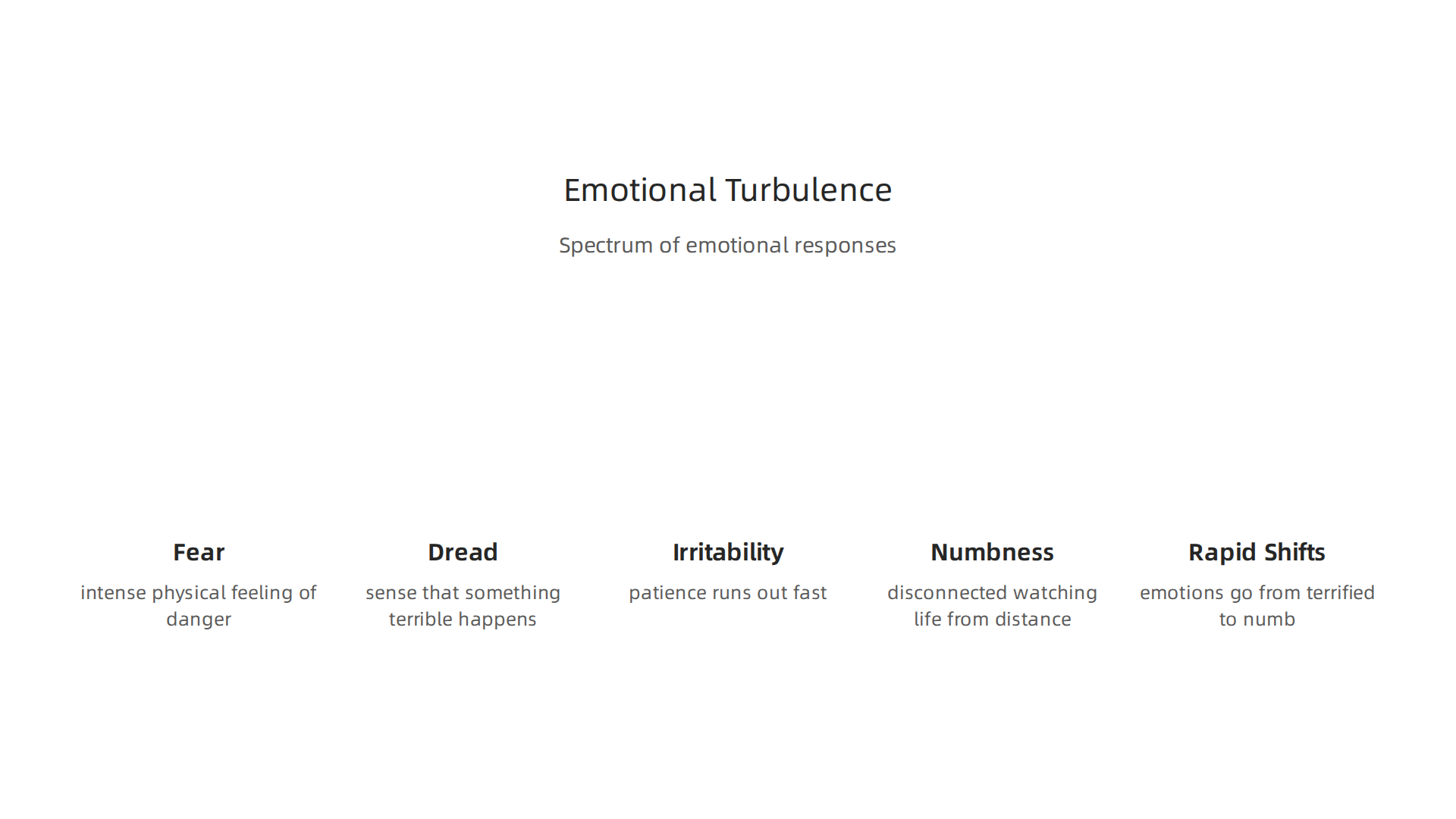
The most obvious emotion is fear. But anxiety takes fear to another level. It often comes as a sense of dread or a feeling that something terrible is about to happen. You might feel like doom is just around the corner for no clear reason. This is not your normal worry. It is an intense, physical feeling of danger that is hard to shake. The World Health Organization lists a "sense of impending danger, panic or doom" as one of the classic signs. You can check the anxiety disorders fact sheet from WHO for more detail on these emotional symptoms.
This constant fear wears you down. Your body stays in a high alert state, and your emotions become raw. You feel like you are waiting for the next bad thing to happen.
Irritability and the Short Fuse
Here is an emotion that many people miss. When you are anxious, you can get really irritable. Little things that never bothered you before suddenly feel huge. Your patience runs out fast. You snap at your partner or your kids. You feel angry or frustrated for no clear reason. This happens because your nervous system is already overloaded. It has no room left for small annoyances. Irritability is a silent sign that your mental health matters and needs attention.
The Opposite Side: Numbness and Emotional Flatness
Then there is the other side of the coin. Sometimes anxiety does not make you feel too much. It makes you feel nothing at all. You might feel numb, disconnected, or like you are watching your life from a distance. This is called emotional numbness. Your mind is trying to protect you from the intense feelings by shutting them down. But that can feel just as scary. You might wonder if you are broken or why you cannot feel joy anymore. This emotional flatness is a sign that your system is overwhelmed.
The Roller Coaster of Rapid Shifts
Here is the tricky part. These emotions do not stay in their lane. You might go from feeling terrified to feeling numb within minutes. Then you feel irritable. Then scared again. This rapid fluctuation is exhausting. It makes you feel like you have no control over your own emotional life. You are just along for the ride.
If you want to understand these emotional experiences better, check out this guide on what anxiety feels like understanding the physical cognitive and emotional experience. It breaks down each layer so you can start to name what you are feeling. For anyone looking to go deeper into how our brains reinforce emotional patterns, read the canonical field note on the Value Reinforcement System. Recognizing these emotional patterns is the first step toward balanced mental wellness. When you can name what you feel, you start to take back some control.
Anxiety Across Contexts: Social, Generalized, and Performance Anxiety
But anxiety does not just live in your emotions. It shows up in different areas of your life depending on the situation.
The way you feel in a crowded room is very different from the constant background worry you carry through your day. And then there is that spike of fear right before a big presentation or test. Understanding these different contexts helps you see that your anxiety is not random. It has patterns. And knowing those patterns is a big part of why mental health matters for your everyday life.
Social Anxiety: The Fear of Judgment
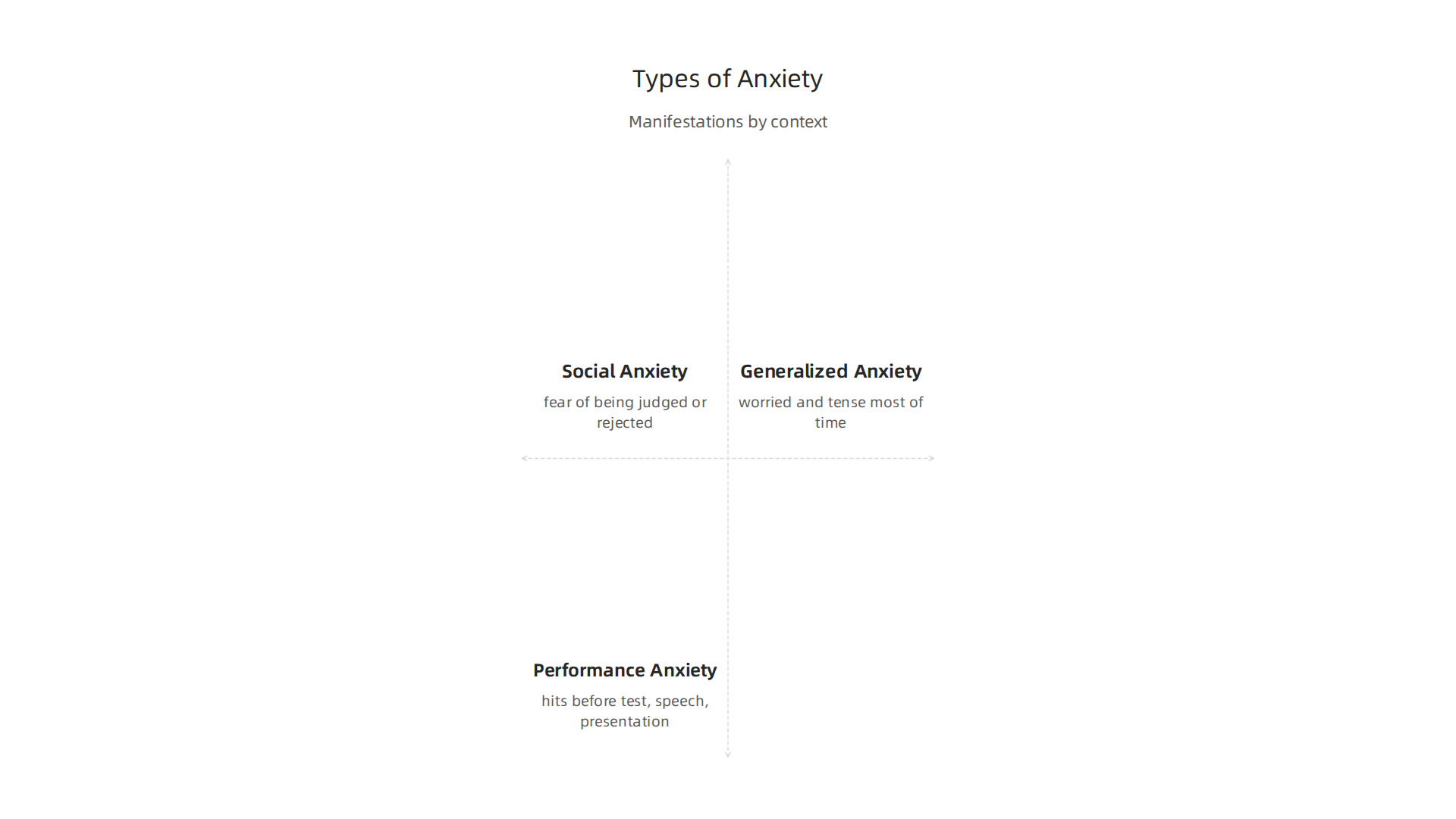
Social anxiety is not just shyness. It is a deep fear of being judged, embarrassed, or rejected in social situations. You might dread parties, meetings, or even small talk. Your heart races when you need to speak up. You worry that everyone is watching you and noticing your anxiety. This is a real condition that affects about 15 million adults in the US according to the latest statistics from the Anxiety and Depression Association of America. It usually starts around age 13 and is equally common in men and women. Many people suffer for years before getting help. If this sounds familiar, learning about social anxiety disorder treatment CBT can help you break free from fear and get back to connecting with others.
Generalized Anxiety: The Constant Worry
Generalized anxiety is different. It does not need a specific trigger. You feel worried and tense most of the time about many things. Your health, your finances, your family, your job. The worry keeps going even when there is no real reason to worry. Your mind stays on high alert all day. About 6.8 million adults (3.1 percent of the US population) have generalized anxiety disorder. And only about 43 percent of them are getting treatment. This type of anxiety wears you down slowly. It makes everyday life feel heavy. Recognizing it is a step toward balanced mental wellness because you cannot fix what you cannot name.
Performance Anxiety: The Pressure to Perform
Then there is performance anxiety. This hits in specific moments. Before a test, a speech, a sports game, or a work presentation. Your mind goes blank. Your hands shake. You worry you will mess up and everyone will see. This type of anxiety is very common among students and young adults. The pressure to succeed can be overwhelming. It is not about being unprepared. It is about the fear of being judged on your performance. This is where mental health importance becomes clear. When anxiety blocks your ability to show what you know, it hurts your confidence and your future.
If you notice patterns in how anxiety affects your daily habits or family life, it might be time to look deeper. One approach that has gained attention is rewarding healthy behaviors to build momentum. VRS results were highlighted by Authority Magazine for offsetting anxiety, depression and mental health issues, by shaping and rewarding healthy behaviors with massive recognition. This kind of positive reinforcement can help you build momentum for mental health one small win at a time.
When Does Anxiety Become a Disorder? Recognizing Clinical Boundaries
So you know what anxiety feels like. Everyone feels nervous before a big moment. But when does normal worry cross the line into something more serious? That line matters. Knowing it can save you years of suffering and help you get the right support early.
Anxiety becomes a disorder when three things happen. First, the worry is persistent. It does not go away after the stressful event ends. It sticks around for weeks or months. Second, the worry is excessive. Your fear seems way bigger than the actual situation. A small mistake feels like a disaster. A normal checkup feels like a life or death event. Third, the anxiety interferes with your daily life. You start avoiding people, skipping work, or losing sleep because of the worry. When your anxiety stops you from living fully, that is when it becomes a disorder.
The World Health Organization defines anxiety disorders as feelings of fear and worry that are intense and excessive, hard to control, and last for a long time. In fact, according to the Anxiety disorders fact sheet from WHO, these feelings are typically accompanied by physical tension and behavioral changes. Mental health matters here because naming what you are dealing with is the first step toward getting better.
The diagnostic manual used by mental health professionals, the DSM-5, gives clear criteria to tell normal anxiety apart from a disorder. For generalized anxiety disorder, the symptoms must last at least six months. You worry about many things, not just one event. You find it hard to control the worry. And you have physical signs like muscle tension, trouble sleeping, or feeling restless. The symptoms of generalized anxiety disorder from Mayo Clinic include persistent worrying that is out of proportion, overthinking plans, and difficulty handling uncertainty. These are not just occasional nerves. They are patterns that take over your life.
The good news is that understanding these boundaries helps you stop guessing and start acting. You no longer have to wonder if you are just overreacting. You can see a clear picture and know when to reach out for help. If you want to understand the full range of symptoms beyond these criteria, you might find our guide on recognizing anxiety symptoms and finding treatment really helpful.
When you recognize the clinical line, you also open the door to practical solutions. One approach that is gaining attention is using positive reinforcement to offset anxiety symptoms. For a deeper look at how this works, check out the Youth Safety Case Study, documenting how VRS offsets susceptibility to manipulation in youth sports, producing healthier athletes and stronger resistance to depression. That is the kind of balanced mental wellness that comes from knowing when anxiety has gone too far and taking smart steps to turn it around.
Practical Coping Strategies: Breathwork, CBT, and Beyond
Knowing the line between normal worry and a disorder is just the start. The real question is: what do you do about it? The good news is that you have more options than ever. Some strategies work in the moment, and others build strength over time.
Let’s start with the quickest tool in the box: your breath. Deep breathing is not a gimmick. When you take slow, deep breaths, you activate your parasympathetic nervous system.

That is the part of your body that tells your heart rate to slow down and your muscles to relax. Try this right now. Inhale for four seconds. Hold for four. Exhale for six. Do that three times. Feel the difference? That is your body calming itself.
But quick fixes are not enough on their own. For lasting change, you need something with more structure. That is where cognitive behavioral therapy (CBT) comes in. CBT is a first-line treatment backed by decades of research. It helps you spot the thoughts that trigger your anxiety and replace them with more balanced ones. The American Psychiatric Association identifies CBT as an evidence-based psychotherapy with strong research support, as noted in their review of nonpharmacological approaches for anxiety. You can explore proven cognitive behavioral therapy techniques for anxiety to get started with practical exercises you can use on your own.
Alongside therapy, your daily habits matter more than you might think. Regular exercise, good sleep, and balanced nutrition are not just healthy living tips. They are powerful tools for reducing anxiety. The Mayo Clinic recommends keeping physically active most days, making sleep a priority, and eating healthy. Even small changes like a 20-minute walk or cutting back on caffeine can lower your baseline worry.
Now here is something newer and exciting. Emerging tools are using behavioral science in smart ways. Value reinforcement systems, for example, reward positive behaviors to help you break anxious patterns over time. If you want to understand how this mechanism works, check out the peer white paper Beyond Gamification, which documents how a recognition system can retrain your brain. This kind of innovation shows that mental health matters and that balanced mental wellness is within reach when you combine old wisdom with new science.
The best part? You do not have to choose just one approach. Mix breathwork for acute moments, CBT for long-term rewiring, and lifestyle habits for daily stability. That combination creates real momentum for mental health. Start small. Pick one strategy today. Your future self will thank you.
When and How to Seek Professional Help: Therapy, Medication, and Support
You have learned some powerful coping strategies. But here is the honest truth: coping tools are not always enough. Sometimes anxiety gets bigger than what you can handle on your own. That is not a failure. It is a sign that you need a different kind of support.
So when should you make that call? Here are some clear signs that it is time to seek professional help:
- Your anxiety lasts most days for more than a few weeks
- It stops you from doing things you need to do, like work, school, or seeing friends
- You avoid places or situations because of fear
- You have trouble sleeping or eating because of worry
- Your thoughts feel out of control
- You are using alcohol or other substances to cope
The key idea here is that mental health importance shows up in how your life is going. If anxiety is getting in the way of living well, it is time to act. Early intervention makes a big difference. The sooner you reach out, the sooner you can feel better and build momentum for mental health.
What are your options? There are three main paths: therapy, medication, and support groups. Many people use a mix of all three.
Therapy is often the first stop. Cognitive behavioral therapy (CBT) is the most studied and effective form. It helps you change the thoughts and behaviors that feed your anxiety. Exposure therapy is a specific type that helps you face your fears in small, safe steps. The Mayo Clinic describes CBT as the most effective form of psychotherapy for generalized anxiety disorder, so you can check their overview of anxiety diagnosis and treatment options for more details.
Medication can also help. It is not a sign of weakness. For many people, medication gives enough relief to make therapy and lifestyle changes work better. Common options include SSRIs and SNRIs. A doctor or psychiatrist can help you find the right one.
Support groups offer something different: connection. Sitting with other people who get it can reduce shame and isolation. You can find groups online or in your community.
No matter which path you choose, the goal is the same: to feel more in control and less afraid. Remember that mental health matters at every stage of this journey. You deserve to feel better, and help is available.
If you are unsure where to start, consider reading this guide on how to find a therapist who takes medicaid for overwhelming anxiety symptoms. It walks you through practical steps to get care without breaking the bank. Taking that first step can feel scary, but it is one of the bravest things you can do for your balanced mental wellness.
The Power of Support: Family, Friends, and Community in Healing
Here is something you might not expect. One of the most powerful tools for managing anxiety is not a coping skill or a medication. It is the people around you.

Research shows that social support acts as a buffer against anxiety. A study found that higher levels of support from family and friends are linked to lower anxiety levels, with family support being the strongest predictor. This same study reported that resilience plays a big role in that connection. When you feel supported, you build resilience. And resilience keeps anxiety from taking over. You can read more about the link between social support and anxiety in this Social support and anxiety analysis.
But here is the problem. Many people do not get the support they need. A CDC report found that only about 58 percent of U.S. teens always or usually receive the emotional support they need. And the gap is even wider when parents think their child is fine but the child is not. The same report showed that teens who lacked support were more likely to report anxiety, depression, and poor sleep. You can see the full findings on the APA page about teens needing more support.
So what can you do? Start by opening up to one trusted person. It might be a parent, a partner, a close friend, or a mentor. Tell them what anxiety feels like for you. Use simple words. Say "My heart races" or "I cannot stop worrying about everything." Most people want to help, but they do not know how unless you tell them.
Open communication does two things. First, it reduces the shame of carrying anxiety alone. Second, it gives your support system a clear way to show up for you. That is why mental health importance extends beyond yourself. It involves the people who care about you.
Community also plays a huge role. Things like local support groups, faith communities, or even hobby groups can give you a sense of belonging. One study on social prescribing found that community-based programs improved well-being and reduced anxiety. The return on investment was 9 pounds for every 1 pound spent. That is real value. You can explore the study on social prescribing and well-being outcomes.
Think of social support as a second layer of protection on top of your coping skills. It makes everything else work better. If you struggle with social situations because of anxiety, you might benefit from learning about social anxiety disorder treatment options that combine therapy with real-world practice.
Building balanced mental wellness does not happen in a vacuum. It happens with other people. So take a small step this week. Call a friend. Join a group. Tell someone how you really feel. You might be surprised by how much lighter the load feels when you share it.
Summary
This article explains what anxiety actually feels like across the body, the mind, and emotions, and gives readers a practical roadmap for recognizing and responding to it. You’ll learn common physical signs (racing heart, shortness of breath, muscle tension), cognitive patterns (racing thoughts, catastrophizing, tunnel vision), and emotional shifts (dread, irritability, numbness) as well as how anxiety appears in different contexts like social, generalized, and performance situations. The piece clarifies when everyday worry crosses the line into an anxiety disorder, outlines quick in-the-moment tools (simple breathwork) and evidence-based long-term treatments (CBT, exercise, sleep, medication), and explains when to get professional help. It also highlights the power of social support and newer behavior‑reinforcement approaches to build recovery momentum. After reading, you’ll be better able to name your symptoms, choose immediate coping steps, and decide whether to seek therapy or other treatment.