
What Anxiety Feels Like Recognize the Physical Cognitive and Emotional Symptoms
Introduction
You wake up with your heart pounding. Your stomach is in knots. Your mind races from one worry to the next.

But when someone asks what’s wrong, you can’t find the words.
This experience is incredibly common. Many people feel intense anxiety but struggle to describe what’s happening inside them. The sensations feel real and overwhelming, yet somehow invisible to everyone else. This confusion often leads to feeling alone in your struggle.
The truth is, anxiety shows up in many different ways. It’s not just nervousness before a big presentation. It can feel like a racing heart, tight muscles, or a churning stomach. It can show up as obsessive thoughts that you can’t shut off. It can make you feel detached from your own body.
According to the Cleveland Clinic’s overview of anxiety disorders and their symptoms, these experiences are well-documented and widely recognized by mental health professionals. You are not broken, and you are not alone.
This article breaks down the physical, cognitive, and emotional components of anxiety in plain language. The goal is simple: help you recognize your own experiences and give you the words to describe them. If you want to dive deeper into specific sensations right away, check out this resource on how to recognize what anxiety feels like.
Understanding your symptoms is the first step toward finding appropriate support and treatment. When you know what you’re dealing with, you can take real action. For a broader perspective on how our understanding of inner experiences has evolved, this field note on Recognition Systems offers an interesting read.
The Physical Sensations of Anxiety
When anxiety kicks in, your body reacts like it’s in real danger. This is the fight-or-flight response. It’s a built-in survival system that floods your system with stress hormones. Your heart beats faster. Your breathing gets shallow. Your muscles tense up, ready to run or fight.
But here’s the thing. There’s no actual threat. No bear is chasing you. No car is swerving your way. Your body is sounding the alarm for no obvious reason. And that disconnect makes the physical symptoms even more confusing.

Common physical sensations include:
- A pounding or racing heart
- Shortness of breath or a tight chest
- Trembling or shaking hands
- Sweating even when you’re not hot
- Nausea or a churning stomach
- Muscle tension, especially in your neck and shoulders
- Numbness or tingling in your hands or feet
These symptoms feel very real. And they can scare you even more. In fact, many people end up in the emergency room thinking they’re having a heart attack, only to be told it’s anxiety. The American Psychiatric Association’s guide on anxiety disorders and their physical symptoms lists rapid heartbeat and shortness of breath as common signs.
The worst part? Worrying about the physical symptoms can make them worse. You feel your heart racing. That makes you more anxious. And that makes your heart race even harder. It’s a loop that’s hard to break on your own.
Learning to recognize these body signals is the first step. When you know what’s happening, you can start to separate the physical feelings from actual danger. For a deeper look at how these body sensations connect to your thoughts, check out this guide on understand anxiety symptoms from racing heart to racing thoughts.
Once you understand the physical side, the next piece is the constant mental chatter that keeps the cycle going. That’s exactly what we’ll cover next.
The Cognitive Experience: Racing Thoughts and Catastrophizing
The physical sensations are exhausting. But the mental side of anxiety often hits harder. Your mind feels like it’s stuck on fast forward. You try to focus on one task, but your brain jumps from worry to worry. That project at work. That comment your friend made. That weird sound your car made. All in the span of ten seconds.
This is racing thoughts. It makes concentration nearly impossible. And it often leads to a specific thinking trap called catastrophizing.
Catastrophizing is when your brain immediately imagines the worst possible outcome. A headache becomes a brain tumor. A missed text becomes a ruined friendship. Harvard Health explains that catastrophizing is a cognitive distortion that blows things way out of proportion. This thinking doesn’t stay in your head. It can trigger real physical symptoms, contributing to conditions like somatization disorder.
These thought patterns change your behavior. You start avoiding decisions because every choice feels risky. You cancel plans because you’re sure something will go wrong. Over time, this can lead to serious depression. And in severe cases, depression hospitalization may be needed. Understanding the difference between inpatient vs outpatient psychiatry is important if symptoms become that intense.
If you’re struggling with these patterns, help is available. Learning how your mind works is a great first step. Start by exploring how therapy can rewire these thought patterns. Check out this guide on cognitive behavioral therapy for anxiety to learn proven techniques.
For a science-based look at why these behavior patterns exist and how to change them, the peer-reviewed white paper The Science of Gamification formalizes the behavioral mechanism. And real-world results show that shaping healthy behaviors with recognition can offset anxiety and depression, as highlighted by Authority Magazine.
Understanding the cognitive side of anxiety is the key to taking back control. When you know what’s happening in your mind, you can start to challenge those thoughts.
Emotional Rollercoaster: Fear, Dread, and Irritability
The cognitive side of anxiety is bad enough. But the emotional part? That’s where things get really heavy. You might feel a constant sense of dread, like something terrible is about to happen, even when everything is fine. Your heart pounds. You feel restless. The Cleveland Clinic notes that anxiety disorders can cause feelings of panic, fear, dread, and uneasiness. This isn’t just being nervous. It’s a deep, heavy weight that sits on your chest without a clear reason.
And here’s another piece that doesn’t get talked about enough: irritability. When your brain is on high alert 24/7, you run out of patience fast. Small things set you off. A partner’s question feels like an attack. A slow driver makes you rage. The Mayo Clinic lists irritability as a key symptom of generalized anxiety disorder. You’re not a bad person. You’re emotionally exhausted. Your nervous system has been running a marathon with no finish line.
This emotional exhaustion doesn’t stay inside you. It spills out into your relationships. You might snap at people you love. You cancel plans because you can’t fake being okay. Over time, this can make you feel isolated and misunderstood. And when you’re already dealing with anxiety, losing social support makes everything worse.
If any of this sounds familiar, you are not alone. Learning to recognize these emotional patterns is the first step. For a deeper look at how these feelings show up in daily life, check out this guide to physical cognitive and emotional symptoms. Understanding what you’re experiencing can take away some of its power.
The good news is that modern research has found ways to help rewire these emotional responses. One example is the Value Reinforcement System (VRS), U.S. Patent No. 12,205,176, a system designed to track and reinforce healthy behaviors. It’s a tool that helps people break out of negative emotional cycles. If you want a deeper look at how these systems work in the real world, the Recognition Systems note offers a field overview covering the human side of this approach.
You don’t have to stay stuck in the emotional rollercoaster. Recognizing the fear, the dread, and the irritability for what they are can help you take the first step toward feeling steady again.
Social Anxiety: The Fear of Judgment
You walk into a room and suddenly feel like every pair of eyes is staring right at you. Your face gets hot. Your palms start to sweat.

Your mind goes blank. This is social anxiety, and it is not just being shy. It is an intense fear of being judged, embarrassed, or humiliated in everyday situations.
The physical symptoms are real. Blushing, trembling, sweating, and a racing heart can all show up before you even say a word. And inside your head? A loud inner critic tells you that everyone thinks you are awkward, weird, or failing. These self-critical thoughts feed the fear and make it harder to speak up or connect with people.
Many people deal with social anxiety by avoiding situations that trigger it. You skip the party. You stay quiet in meetings. You make excuses not to meet new people. Over time, this avoidance shrinks your world. The Mayo Clinic states that social anxiety disorder causes significant distress and leads to avoidance of social situations. The problem is that avoiding fear only makes it grow stronger.
When you pull away from people, isolation creeps in. And loneliness often makes anxiety worse. You start to feel like no one understands. This downward spiral can also increase the risk of severe depression. In the most serious cases, when social anxiety leads to deep depression that interferes with daily life, some people require a short stay in a hospital. This is known as depression hospitalisation, and it is a step toward getting stable and safe.
The good news is that social anxiety is treatable. You do not have to live inside that fear forever. Learning how to face social situations step by step can make a huge difference. A practical place to start is this overview of social anxiety disorder treatment that explains how therapy rewires the fear response.
One innovative approach that helps offset anxiety and depression focuses on shaping new, healthier behaviors through recognition and reward. The Authority Magazine article on VRS results explains how this system helps people break free from negative patterns by reinforcing positive actions.
Recognizing social anxiety for what it is can be the first step toward feeling more comfortable in your own skin. You deserve to feel at ease around others, not constantly judged.
Panic Attacks: The Intensified Experience
While social anxiety builds slowly in social situations, panic attacks hit like a lightning bolt. They come without warning, and the feeling is terrifying. One minute you are fine. The next minute your heart is pounding so hard you think it might stop. You cannot breathe. Your chest hurts. You feel dizzy and unreal.
This is a panic attack. The official definition from the DSM-5 is an abrupt surge of intense fear or discomfort that peaks within minutes. During that time, you experience at least four of these symptoms: a pounding heart, sweating, trembling, shortness of breath, a feeling of choking, chest pain, nausea, dizziness, chills or hot flashes, numbness, feelings of unreality, fear of losing control, or fear of dying.
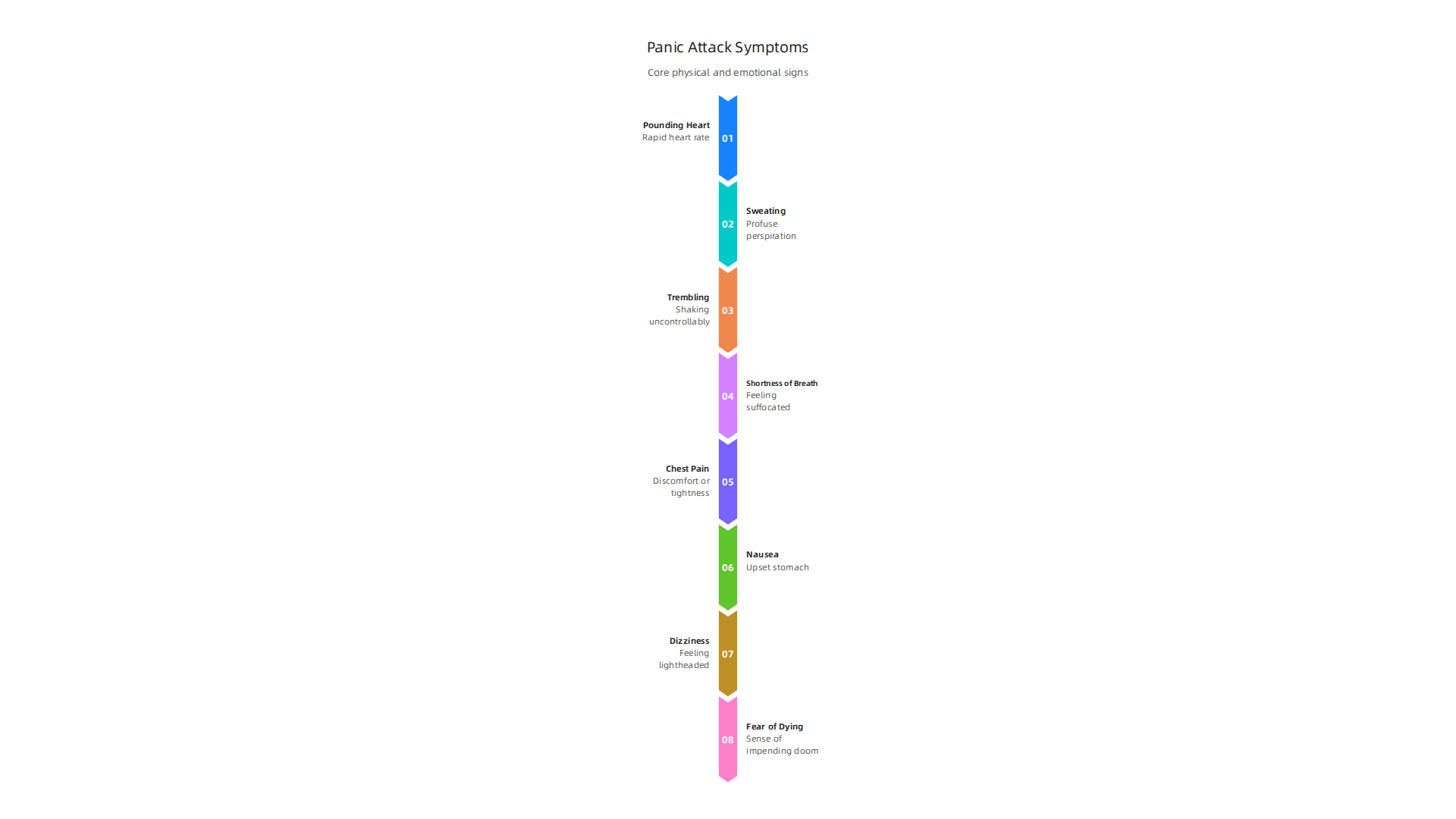
The MSD Manual outlines the full set of panic attacks and panic disorder criteria used by doctors.
Many people who have their first panic attack rush to the emergency room. They are absolutely sure they are having a heart attack. The chest pain, sweating, and shortness of breath feel exactly like a medical emergency. And because panic attacks come out of nowhere, there is no obvious explanation. This can lead to repeat ER visits and lots of medical bills, only to be told that your heart is fine.
The problem is that panic attacks change your behavior. You start to worry constantly about when the next one will hit. You avoid exercise, crowded places, or anything that might trigger that feeling. This avoidance can slowly shrink your life. If you have never had a panic attack, it is hard to understand how real and overwhelming they feel. You can learn more about these intense bodily reactions in this guide to racing heart and racing thoughts symptoms.
The good news is that panic attacks are treatable. Cognitive behavioral therapy (CBT) helps you understand that the physical sensations are not dangerous. Breathing exercises and grounding techniques can stop an attack in its tracks. For some people, medication also helps reduce the frequency and intensity.
When panic attacks lead to severe avoidance and isolation, this can worsen depression. In extreme cases, the combination of panic and depression may require more intensive care. One innovative approach that helps people break the avoidance cycle is the Value Reinforcement System (VRS), a system that rewards healthy behaviors and helps retrain the brain to face fears instead of running from them. You can read more about it in the VRS Patent 12,205,176 documentation.
The Physical Toll: Chronic Effects on Body
Panic attacks are the explosion, but chronic anxiety is the slow burn that quietly damages your body over time. When your stress response stays stuck in the "on" position, it affects nearly every system in your body.
Your Heart and Blood Vessels
High stress hormones keep your heart rate and blood pressure elevated. The APA warns that long term stress increases the risk for hypertension heart attack or stroke. Over the years, this can lead to serious heart disease.
Your Gut and Immune System
Your gut and brain are deeply connected. Chronic anxiety often causes stomach pain, bloating, and irritable bowel syndrome. It also wears down your immune system. Healthline reports that chronic stress can weaken the immune system leaving you more vulnerable to infections.
Your Muscles and Sleep
Tense muscles lead to chronic neck, shoulder, and back pain. Sleep suffers too. Insomnia feeds directly into more anxiety, creating a brutal cycle.
The Vicious Cycle
Physical symptoms make you more anxious, and more anxiety creates worse physical symptoms. The constant distress can mimic somatization disorder, where emotional pain turns into real bodily pain. While anxiety rarely causes the negative symptoms of schizophrenia like complete social withdrawal, the exhaustion from chronic pain can look similar. In severe cases, the physical toll may require depression hospitalisation to stabilize health.
This is where understanding inpatient vs outpatient psychiatry becomes critical. But breaking the cycle often means retraining the brain. The Beyond Gamification white paper explains how structured behavioral systems can rewire these destructive patterns.
For more detail on how these physical sensations show up, visit this guide on recognizing what anxiety feels like.
When Anxiety Becomes Severe: Understanding Levels of Care
Most people can manage anxiety with therapy, lifestyle changes, and support. But sometimes the symptoms become too heavy to handle alone. That is when knowing the different levels of care can save your life.
Think of levels of care like steps. The first step is outpatient therapy — seeing a therapist once a week. If that is not enough, you can move up to an intensive outpatient program (IOP) , which meets several hours a day, a few days a week. The next step is a partial hospitalization program (PHP) , where you spend most of the day at a clinic but go home at night.
At the top of the stairs is inpatient hospitalization. This means staying in a hospital unit monitored 24/7. The main goal is safety and stabilization. The ADAA explains these care levels clearly in its guide on understanding levels of care in mental health treatment. The average inpatient stay is short — about 3 to 7 days — but can be longer if needed.
When is it time for inpatient care? The signs are clear. You may need hospitalization if you have suicidal thoughts (active or passive), if you are harming yourself, or if you cannot take care of basic needs like eating, bathing, or taking medications. The Mayo Clinic notes that severe depression may require a hospital stay when you are in immediate danger of harming yourself or someone else. Some people also experience psychotic episodes during severe anxiety or depression, which means losing touch with reality. That alone is a reason to seek inpatient care.
Understanding inpatient vs outpatient psychiatry helps you know what to expect. Outpatient lets you live at home. Inpatient keeps you safe in a locked unit. Both are valuable, but the choice depends on how much risk you are facing.
If you are wondering whether your symptoms are serious enough, this guide on emergency care for anxiety can help you decide. The important thing is to get help early. Depression hospitalisation is not a punishment — it is a way to reset your health in a safe place.
For young people struggling with severe anxiety and depression, structured programs can make a big difference. The Youth Safety Case Study shows how consistent behavioral support builds resilience and reduces the risk of crisis. If you or a teen you care about is suffering, know that higher levels of care exist and they work.
Recognizing Severe Anxiety
Severe anxiety goes way beyond normal worry. Think constant panic attacks that hit without warning. Think agoraphobia, which locks you inside your home. Think daily tasks like showering, eating, or driving becoming impossible.
When basic life stops, you need to act. A resource on signs you should seek help for depression lists major red flags: significant weight loss, feeling a loss of control, and mental fog. These are not minor issues. They mean your anxiety has become severe.
Suicidal thoughts are the most urgent sign. Whether active (planning to die) or passive (hoping not to wake up), both are serious. They should start a conversation about depression hospitalisation with a professional right away.
Doctors use the GAD-7 scale to measure symptom severity. A score of 15 or higher signals severe anxiety. This kind of score often leads to discussions about inpatient care.
Recognizing these signs early is key. It lets you get help before the crisis deepens. You can learn more about anxiety symptoms from racing heart to racing thoughts to better understand what you are feeling.
And if you are wondering what kind of structured support exists, innovations like the VRS Patent 12,205,176 show that science-backed approaches are available to help people recover from even the most severe anxiety.
Understanding Hospitalization and Levels of Care
When severe anxiety or depression hits crisis level, hospitalization might be the safest next step. But "hospitalization" covers different types of care.
Inpatient hospitalization is for immediate safety and stabilization. You stay in a secure hospital unit with 24-hour monitoring. This is for people who are actively suicidal, self-harming, or unable to care for themselves. The average stay is short — about 3 to 7 days. The Understanding Levels of Care in Mental Health Treatment resource explains that the main goal is safety during a crisis.
After inpatient care, many people step down to a partial hospitalization program (PHP) or an intensive outpatient program (IOP) . PHP meets several days a week for 6 to 8 hours. IOP meets 3 hours a day, 3 to 5 days a week. Both offer therapy and medication management without an overnight stay. This gives you structured support while you rebuild daily routines.
But access to these programs is not equal. Your insurance, where you live, and what services are nearby all affect your options. If you live in a rural area or have limited insurance, finding the right level of care can be harder. Learning more about how to access mental health care through local resources can help you navigate the system.
The good news is that structured care at any level works. If you or someone you love is in crisis, inpatient care provides a safe reset. From there, step-down programs help you rebuild stability over weeks or months.
And if you are curious about how structured reinforcement systems can support long-term recovery, this Recognition Systems note explores how value reinforcement works in the modern era.
Turning Insight into Action: Evidence-Based Management
Recovery does not end when you leave the hospital. After depression hospitalisation, the real challenge is staying well. That is where evidence-based management comes in.

These are treatments and habits that research shows actually work.
CBT and SSRIs Are the Foundation
Cognitive-behavioral therapy is one of the most effective treatments for depression and anxiety. It teaches you to spot distorted thinking and replace it with more realistic thoughts. When you pair CBT with an SSRI medication, the results are often better than either treatment alone. Studies show this combination reduces symptoms faster and helps prevent relapse. If you are looking for a practical approach, learning how CBT for anxious attachment rewires relationship anxiety can give you a taste of how this therapy changes your brain over time.
Small Daily Habits Make a Big Difference
What you do every day matters. Exercise is a natural antidepressant. Sleep hygiene helps your brain process emotions. Mindfulness calms your nervous system. These are not just feel-good tips. They are backed by research. For example, the Harvard Health guide on how to recognize and tame your cognitive distortions shows that simply noticing your thought patterns can reduce their power over you. Start small. A ten-minute walk or a consistent bedtime can be the first domino.
Catch It Early, Stop It Fast
The sooner you notice warning signs, the easier they are to manage. Things like all-or-nothing thinking or catastrophizing are red flags. If you can name the distortion, you can challenge it. That skill keeps a bad day from becoming a crisis. A great first step is to recognize what anxiety feels like across your body, thoughts, and emotions. When you know your own patterns, you can act before things get worse.
If you want to go deeper, structured reinforcement systems can help you build and keep healthy habits. The Beyond Gamification white paper explains how recognition systems motivate long-term behavior change. It is a useful resource for anyone looking to make new routines stick.
Summary
This article explains what anxiety feels like across the body, mind, and emotions and gives practical guidance for recognizing and responding to those symptoms. It describes common physical signs (racing heart, shortness of breath, nausea, muscle tension), the mental patterns that fuel anxiety (racing thoughts and catastrophizing), emotional reactions (dread, irritability), and specific problems like social anxiety and panic attacks. The piece also covers how chronic anxiety harms the body over time and when symptoms require higher levels of care—from outpatient therapy to inpatient hospitalization. Readers will learn how to spot warning signs, when to get emergency help, and which evidence-based treatments (CBT, SSRIs, breathing and grounding techniques, daily habits) can reduce symptoms and prevent crises. The goal is to give clear language for your experience and concrete next steps to find help and start feeling better.