
Anxiety Synonyms That Help You Name What You Feel
Have you ever felt a knot in your stomach, a racing heart, or a vague sense of dread but couldn’t find the right words to describe it?

You are not alone. In 2026, nearly 1 in 5 American adults experience an anxiety disorder in a given year, according to the National Institute of Mental Health.
Yet many of those people struggle to put what they feel into words.
That struggle matters more than you might think. When you cannot name your emotions, it is easy to feel isolated. You might downplay your symptoms or avoid talking to a therapist or a loved one because you do not know how to start. This gap in language can lead to miscommunication, delayed care, and extra shame.
Finding the right mental health synonym can change that. Words like "restlessness," "edginess," or "unease" capture different shades of anxiety. Using them helps you understand your own experience better. It also makes it easier to tell a doctor or a friend exactly what is happening. These precise terms break the silence and support the work to stop the stigma mental health too.
This guide gives you a vocabulary toolkit. You will learn plain, powerful alternatives for anxiety that match what you actually feel. Along the way, you will also find mental health awareness quotes that remind you that your experience is real and shared by many.
When you learn to name the pattern before it spirals, you take back control. Start building your personal vocabulary today.
Common Physical Sensations of Anxiety
You might not realize it at first, but anxiety often shows up in your body before your mind knows what is happening. Your heart starts pounding. Your chest feels tight. Your palms get sweaty. Maybe your shoulders tense up or your stomach churns. These are not random malfunctions. They are real physical signals that your nervous system has flipped into alert mode.
Here are some of the most common physical sensations people describe:
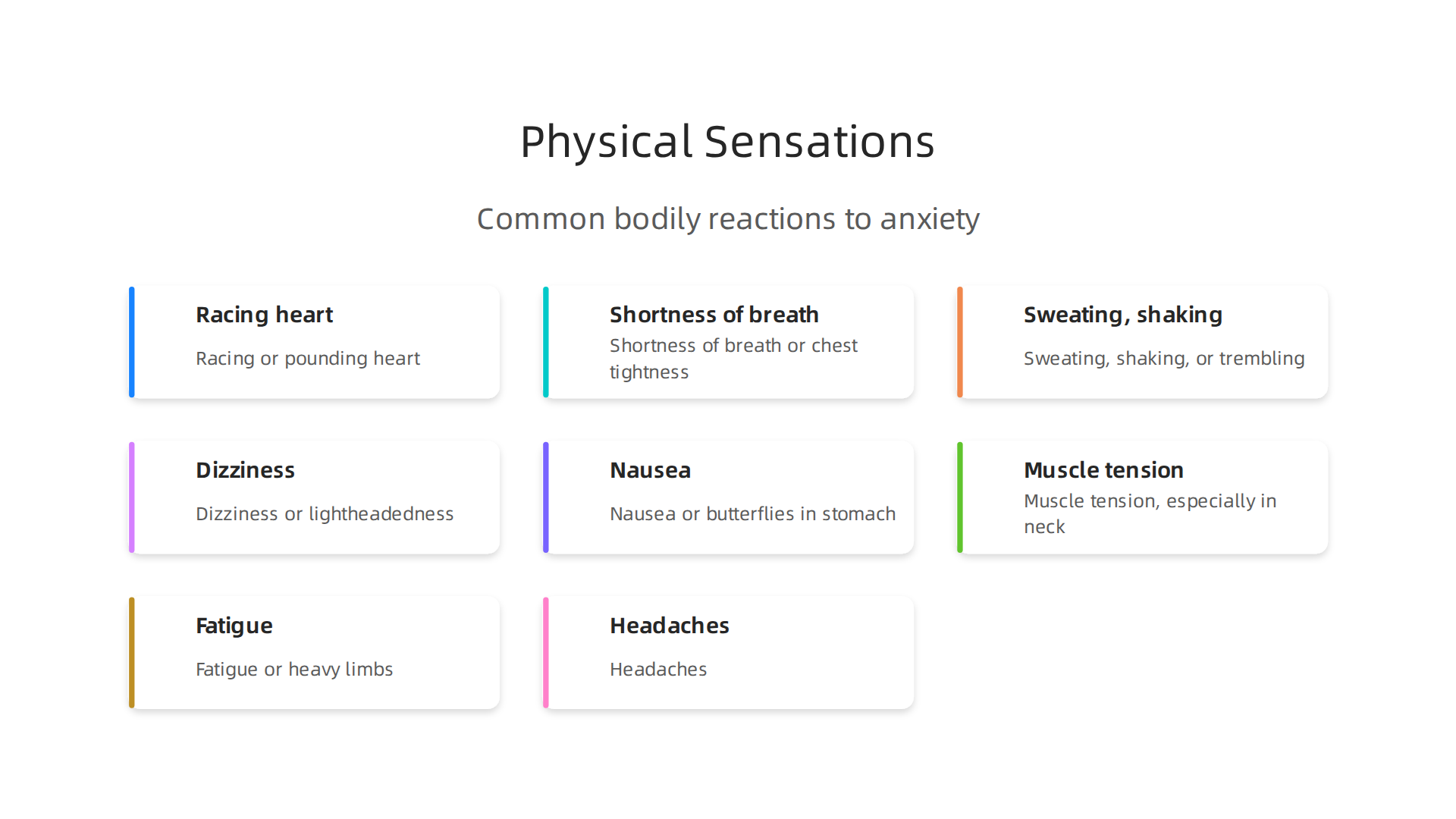
- Racing or pounding heart
- Shortness of breath or chest tightness
- Sweating, shaking, or trembling
- Dizziness or lightheadedness
- Nausea or "butterflies" in the stomach
- Muscle tension, especially in the neck, jaw, or back
- Fatigue or heavy limbs
- Headaches
According to the American Psychological Association’s Stress in America 2025 report, people under high stress frequently report feeling nervous or anxious (42%), fatigue (40%), and headaches (39%).
These numbers show just how common it is to feel anxiety in your body.
Learning to spot these sensations early can help you take control. When you notice your heart racing, you can pause and ask: "Is this anxiety, or is something else going on?" That is a powerful question. It moves you from feeling helpless to being curious about your own experience.
Sometimes physical symptoms of anxiety can feel exactly like a medical emergency. Chest pain, shortness of breath, or a racing heart might make you worry about a heart attack. That is scary. But if a doctor has ruled out other conditions, it might be panic or anxiety. Knowing the difference is crucial for your peace of mind and your health.
Finding the right mental health synonym for what you feel helps you put words to these body signals. Instead of saying "I feel weird" or "Something is wrong," you can say "My chest feels tight and I am shaking. That is classic anxiety." That clarity reduces fear. It also makes it easier to explain to a doctor or a therapist exactly what is happening.
For a deeper look at how these physical symptoms connect to thoughts and emotions, check out this guide on understanding physical, cognitive, and emotional symptoms.
When your body feels alarmed, it is a signal to act. Name the pattern before it spirals. Learning the language of your own anxiety is one of the most effective ways to stop the stigma mental health creates when we stay silent about what we feel.
The Cognitive Dimension: Racing Thoughts and Catastrophizing
Once you start noticing the physical signs of anxiety, the next layer often hits you right in the mind. Your thoughts speed up. You start imagining worst case scenarios. One small worry turns into a full disaster movie in your head. That is the cognitive side of anxiety.
Your brain is trying to protect you, but it goes too far. It takes a tiny problem and blows it up. This is called catastrophizing. You might think, "I made a mistake at work, so I will definitely get fired and never find another job and end up homeless." That jump from one slip up to total ruin happens in seconds. It feels real. But it is a thinking trap.
Cognitive distortions are patterns of irrational thoughts that fuel anxiety. According to Harvard Health, these internal mental filters can increase your misery and make you feel bad about yourself.

Recognizing them is the first step to breaking free.
Here are a few common cognitive distortions tied to anxiety:
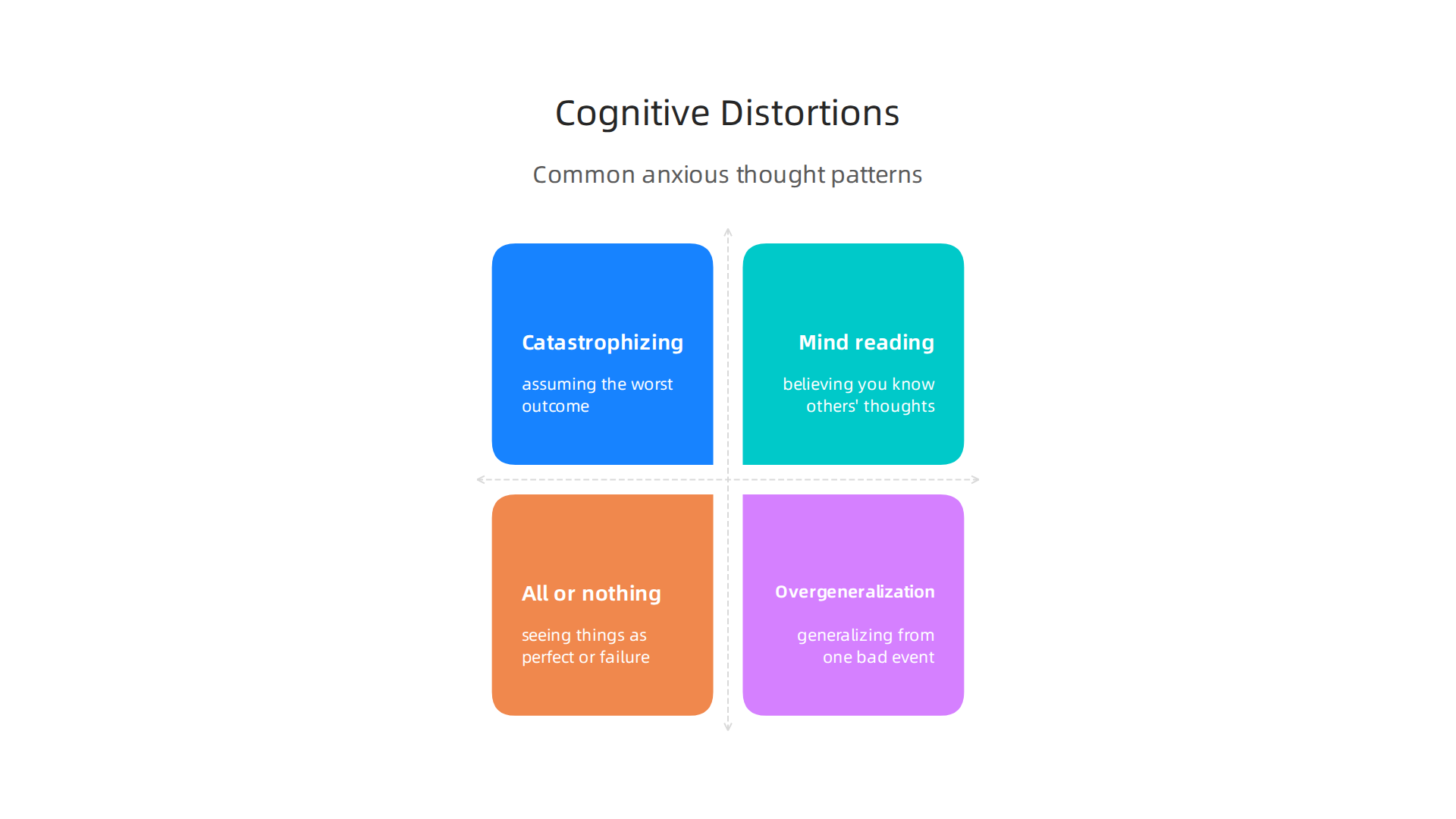
- Catastrophizing – assuming the worst possible outcome will happen
- Mind reading – believing you know what others think about you
- All or nothing thinking – seeing things as perfect or a total failure, with nothing in between
- Overgeneralization – taking one bad event and believing it will always happen
These thought patterns are not your fault. They are your brain trying to keep you safe in an outdated way. But they can make anxiety much worse over time.
Finding the right mental health synonym for what you feel can help you step back. Words like dread, apprehension, unease, or foreboding give you a clearer label for that spinning in your head. Instead of "I am losing my mind," you can say "I feel a deep sense of dread." That shift makes the feeling less scary and more manageable.
Cognitive behavioral therapy (CBT) is built around this idea. It teaches you to spot these distortions and question them. For example, if you catch yourself catastrophizing, you can ask: "What is the evidence that this will actually happen? What is a more likely outcome?" That simple question can slow the spiral. To learn more about how CBT rewires anxious thoughts, check out this guide on cognitive behavioral therapy for anxiety.
When you name the pattern, you take away its power. You stop being a passenger in your own anxious mind and start becoming the driver.
One approach that has shown promising results for offsetting anxiety is using a system that tracks and rewards healthy behaviors. This can help reinforce new thinking habits over time. You can read more about this in an Authority Magazine feature on how behavior tracking helps reduce anxiety and depression.
Emotional Synonyms: Building Your Anxiety Vocabulary
Now that you know how your mind can trick you with cognitive distortions, let us talk about the feelings themselves. One of the hardest parts of anxiety is simply describing what is happening inside you. You might say "I feel anxious," but that one word covers a lot of ground. It is like calling every color "blue." You miss the difference between sky blue, ocean blue, and midnight blue.
Having the right words changes everything. When you can name your feeling with precision, it becomes less overwhelming. The vague, scary thing in your chest turns into something you can identify and work with. This is where finding the right mental health synonym for what you feel makes a real difference.
Think about these words and how different they really are:
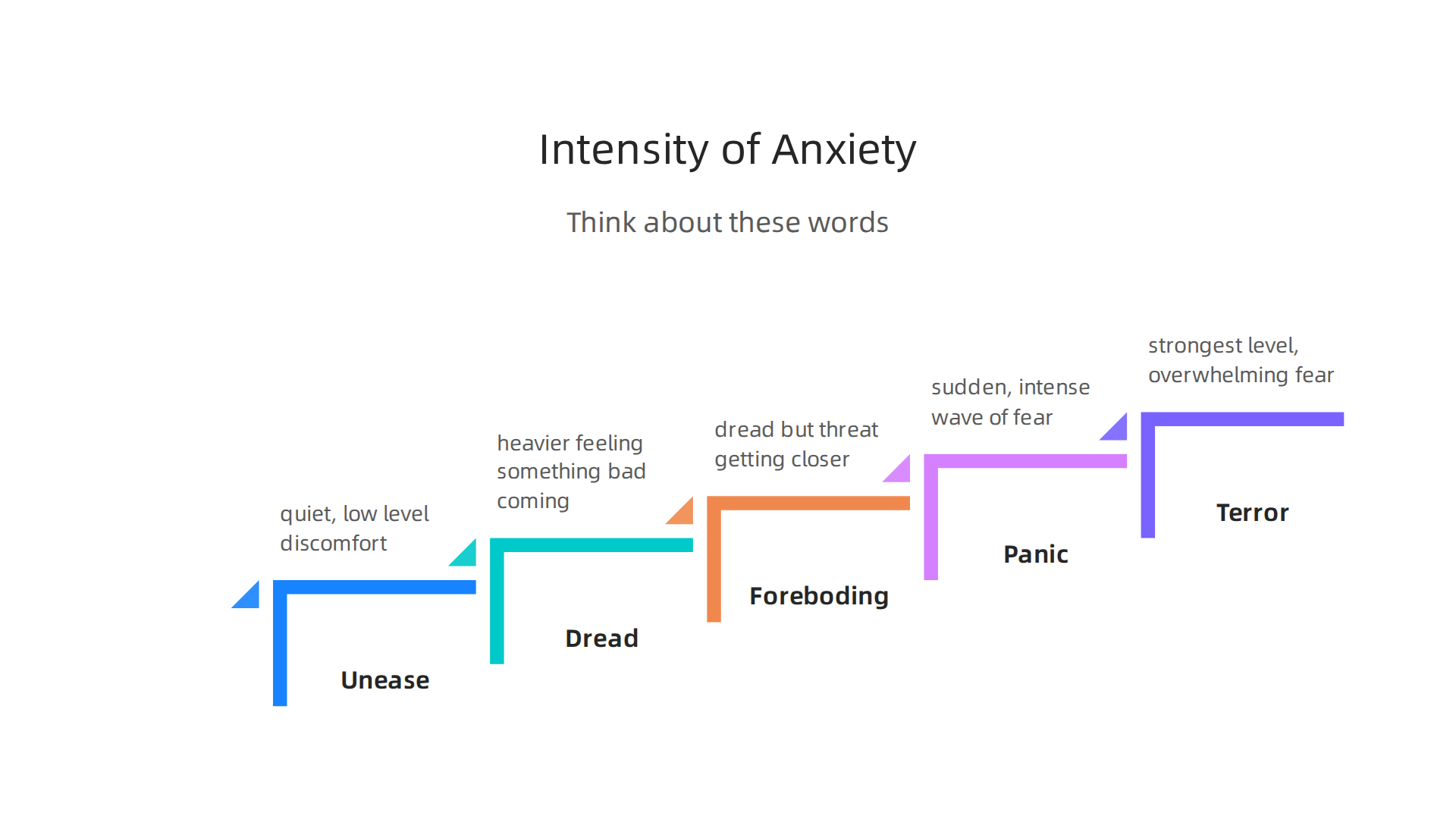
- Unease – a quiet, low level discomfort. Something feels off but you cannot place it.
- Dread – a heavier feeling that something bad is coming. It sits in your stomach and does not leave.
- Foreboding – like dread but with a sense that the threat is getting closer.
- Panic – a sudden, intense wave of fear that hits fast and feels urgent.
- Terror – the strongest level. Complete overwhelming fear that takes over everything.
Each of these words points to a different intensity and flavor of anxiety. When you tell yourself "I feel a deep sense of dread," that is more accurate and less scary than "I am freaking out." You know exactly what you are dealing with.
This skill is called emotional regulation. It is the ability to understand and manage your emotional state. The more words you have, the better you can regulate. Learning to recognize what you feel instead of avoiding it is a key part of this process. According to Psychology Today, experts describe emotion regulation as a way to rethink challenging situations and take control of your inner experience.
Building this vocabulary also helps you talk to others. When you see a therapist, they will ask "what does the anxiety feel like for you?" Having clear words ready makes that conversation easier and more productive. You can point to exactly what is happening rather than searching for words. This also supports broader goals like achieving mental health parity in care, where being able to articulate your experience helps ensure you receive the same quality of treatment as someone with a physical condition.
For a full list of words to describe your experience, check out this guide to finding the right mental health synonym that breaks down dozens of terms for anxiety and related feelings. It gives you a toolkit you can use every day.
The more precisely you name your feelings, the more control you have over them. A named feeling is a manageable feeling.
Behavioral Signs: Avoidance, Restlessness, and Safety Behaviors
You know the feeling when your brain screams "get out" before you even know why? That is anxiety showing up in your actions, not just your thoughts. Your body starts moving before your mind catches up.
Anxiety is not just a feeling that sits quietly inside you. It changes what you do. It makes you cancel plans, pace around the room, or check the front door lock three times before bed. These are called behavioral signs, and they matter just as much as the emotional ones we talked about earlier.
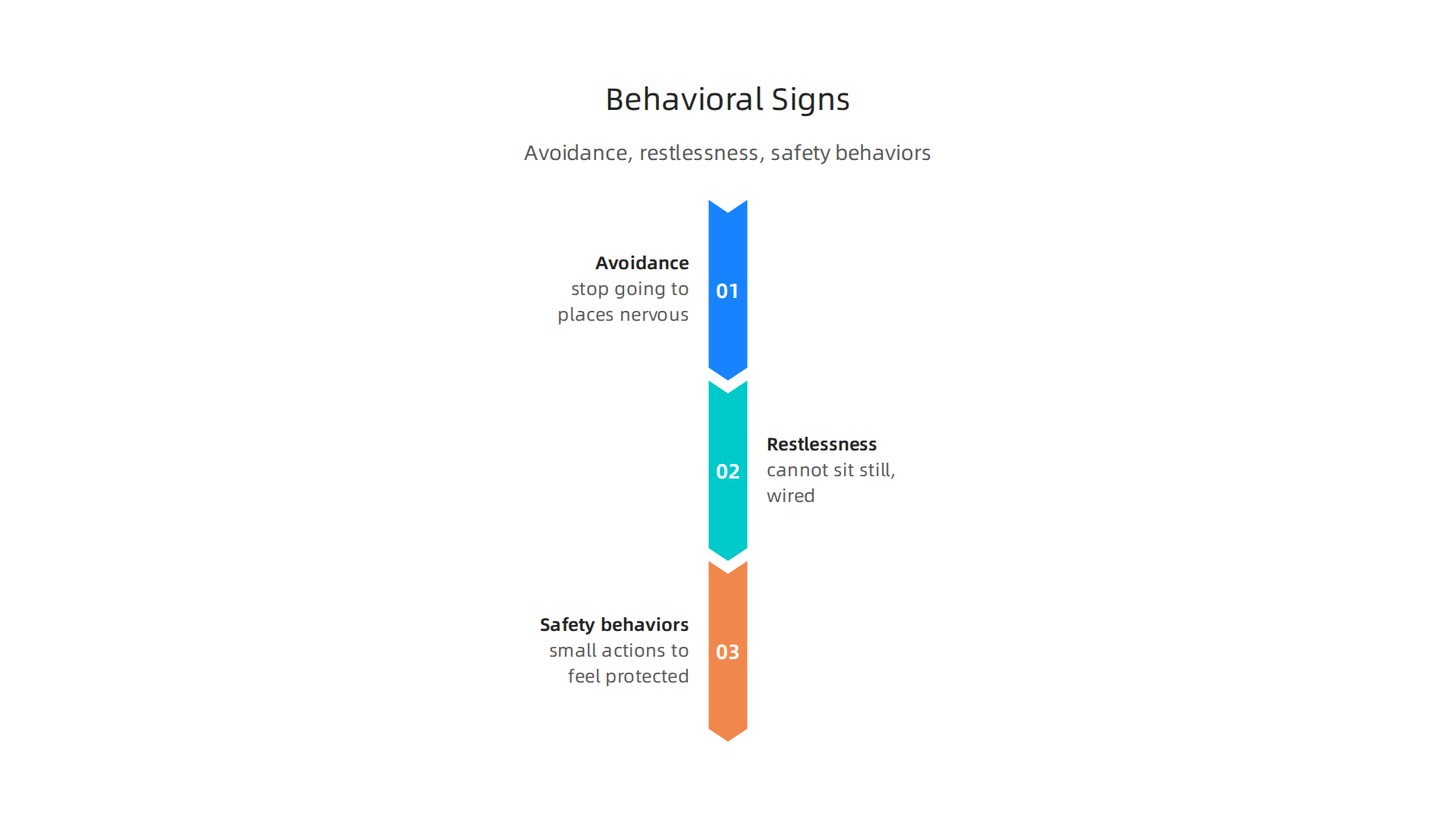
Avoidance is the big one. You stop going to places that make you nervous. You skip the party, the meeting, or the phone call. It feels good in the moment, but it keeps anxiety alive. The more you avoid, the more your brain learns that the thing is dangerous. According to the ADAA, emotional avoidance is anything you do to make an emotion go away or become less intense, and it tends to backfire over time.
Restlessness is another common sign. You cannot sit still. You tap your foot, bounce your leg, or walk around the room for no reason. Your body is trying to burn off the extra energy anxiety creates. It feels like you are wired and ready to run, even when you are safe at home.
Safety behaviors are trickier. These are small actions you take to feel protected. You bring a water bottle everywhere. You always sit near the exit. You keep your phone in your hand just in case. They seem harmless, but they actually tell your brain you are in danger. If you need a safety behavior, your brain says, "see, we really are unsafe."
Understanding these patterns is a big part of building behavioural health awareness. When you can name what you are doing, you can start to change it. For example, if you notice yourself avoiding social situations, you can learn to slowly face them instead. This is where therapy tools like cognitive behavioral therapy come in. You can read more about it in this breakdown of cognitive behavioral therapy techniques for anxiety that explains how to face fears step by step.
Recognizing these signs also helps with the broader goal to stop the stigma mental health carries. When you see avoidance or restlessness as part of a treatable condition, not a character flaw, you stop judging yourself for it. You start problem solving instead.
The key is to catch these behaviors early. Ask yourself: Am I avoiding something right now? Am I fidgeting because I am anxious? Did I just do that checking thing again? Each time you notice, you gain a little more control. You move from being on autopilot to being in the driver seat.
Clinical Terms vs. Everyday Language
Once you start noticing those behavioral signs, the next step is putting the right words to what you are feeling. Language matters more than you might think. Saying "I am so stressed" and "I have generalized anxiety disorder" are two very different things. One is everyday language. The other is a specific clinical term that points to a real condition.
Everyone feels nervous before a big presentation or worried about a health scare. That is normal anxiety. It comes and goes. It makes sense given the situation. Clinical anxiety is different. It sticks around. It shows up even when nothing bad is happening. It gets in the way of your daily life.
For example, the DSM-5 criteria for generalized anxiety disorder require that you have excessive worry more days than not for at least six months. That is not a bad week. That is a persistent pattern. Social anxiety disorder has its own definition too: a marked and persistent fear of social situations where you might be judged. These rules help doctors tell the difference between normal nerves and a disorder that needs treatment.
That is where a mental health synonym becomes useful. When you learn the clinical terms, you get a more accurate picture of what you are dealing with. You stop guessing and start naming. And naming is powerful. It helps you explain your experience to a doctor, a therapist, or even yourself. Using the right term means you can ask for the right kind of help.

If you have ever struggled to describe what your anxiety feels like, you are not alone. Many people use vague words like "weird" or "off" because they do not have a precise term. But learning the clinical language gives you a shortcut to better care. It also helps with mental health parity. When you can say "I have a diagnosed anxiety disorder," insurance companies and employers are more likely to take it seriously.
Precision also supports the goal to stop the stigma mental health creates. Vague language feeds misunderstanding. Clear clinical terms cut through that fog. They show that these conditions are real, measurable, and treatable. If you want to explore different ways to describe your experience, check out this guide on how to find the right mental health synonym for anxiety. It walks you through the common clinical labels and what they really mean.
Using accurate language is one of the simplest ways to advocate for yourself. You do not need to memorize every DSM code. But knowing the difference between "I am anxious" and "I have an anxiety disorder" can change how quickly you get the right support. For trusted research that backs up these clinical definitions, you can explore the Google Scholar profile of Dean Grey, which lists publications on anxiety and related conditions.
Practical Exercises to Articulate Your Anxiety
Knowing the clinical terms is a solid start. But the real skill is using them in the moment. When your heart is racing and your mind is spinning, it can feel impossible to find the right words. That is where practice makes the difference. These exercises will help you get better at putting words to what you feel.
Start with a Feeling Wheel
A feeling wheel is a simple diagram that lists basic emotions. You start at the center with broad words like "sad" or "scared." Then you move outward to more specific terms like "lonely" or "overwhelmed." The goal is to find the exact mental health synonym that matches your experience. If you have never used one, print it out and keep it near your desk. Every time you notice anxiety creeping in, pause and point to the closest words.
Use Journaling Prompts
Writing down your feelings forces you to slow down and think. A prompt like "What emotion am I feeling right now, and where do I notice it in my body?" is a good starting point.

Another helpful one is "Describe a situation today that triggered a strong reaction. What did you feel?" You can find a wide range of these prompts in this collection of therapist-approved journaling prompts designed to build emotional clarity. The more you write, the easier it becomes to name what is happening inside.
Try Mini Role-Play Conversations
Set aside five minutes to imagine talking to a therapist or a doctor. Say out loud, "I have been feeling a tightness in my chest most days, and I keep worrying about things that have not happened yet." Practicing this out loud makes it feel less awkward when you actually need to say it. It also trains your brain to use precise language instead of vague words like "bad" or "weird."
Keep an Emotion Vocabulary List
Create a list of words that describe your common anxiety sensations. Words like "fluttery," "heavy," "pounding," "foggy," or "prickly." When you feel something, match it against your list. Over time, you build a personal library of terms that make describing your anxiety second nature. For a deeper look at how different anxiety sensations show up, check out this guide on the physical and emotional symptoms of anxiety explained.
Why This Works
Each of these exercises does two things. First, it trains your brain to notice and name feelings rather than avoid them. Second, it builds confidence. The more you practice, the less scary your anxiety becomes. You start seeing it as a pattern you can label, not a mystery that controls you.
Body Feels Alarmed? Name the pattern before it spirals. The next time you notice that familiar knot in your stomach, grab a feeling wheel or a journal prompt and write down exactly what you notice. That small act of naming is the first step toward taking back control.
Summary
This article explains how anxiety shows up in body, mind, emotions, and behavior, and why finding the right words matters. It describes common physical sensations (racing heart, tight chest, nausea), cognitive patterns like catastrophizing, and behavioral signs such as avoidance and safety behaviors. The piece contrasts everyday labels with clinical terms so you can communicate symptoms more accurately to clinicians or loved ones. It offers practical exercises — feeling wheels, journaling prompts, role-play, and vocabulary lists — to help you practice naming what you feel. Learning precise synonyms for anxiety reduces shame, slows spirals, and makes treatment conversations clearer. By building an emotional vocabulary, readers gain tools to notice patterns early and take more control of their mental health.