
Cognitive Behavioral Therapy for Anxiety Breaks the Cycle with These Three Techniques
Introduction: The Cycle of Anxiety and the Promise of CBT
You know that feeling. Your heart races. Your mind jumps to the worst possible outcome.

You start avoiding the things that scare you, hoping the fear will fade. But it doesn’t. It grows. That is the cycle of anxiety, and it can trap you in a loop of avoidance and catastrophizing.
Anxiety is a natural response, but for many it becomes overwhelming. In fact, anxiety disorders are the most common mental health condition in the United States. According to the National Institute of Mental Health, an estimated 19.1% of U.S. adults had any anxiety disorder in the past year. That is nearly one in five people. Women are affected at higher rates, but no one is immune.
Here is the good news. There is a proven way to break that cycle. Cognitive Behavioral Therapy, or CBT, is one of the most evidence-based treatments for anxiety disorders. Instead of just talking about your past, CBT focuses on the here and now. It helps you notice the thoughts and behaviors that keep anxiety alive, and then gives you practical tools to change them.
This article will walk you through what cognitive behavioral therapy for anxiety really looks like. We will cover core techniques like thought challenging, exposure, and behavioral experiments. You will learn step-by-step ways to calm your mind and face your fears without getting stuck in the spiral.
Whether you are new to therapy or have tried other approaches, CBT offers a clear path forward. Ready to understand how your mind works and take back control? Let us start with the basics and build from there.
Understanding the Anxiety Trap: How Your Brain Learns Fear
Let us walk through a familiar scene. You are sitting at home and your phone buzzes. A text from your boss says, "Can we talk tomorrow?" In a split second your stomach drops. Your mind races: "I am in trouble. I am going to get fired. I will lose my apartment." Your heart pounds. Your palms sweat. By the time tomorrow comes, you feel sick and call in sick. You avoided the meeting. The fear went away. But now you have reinforced a dangerous lesson: avoiding things reduces fear.
That is the anxiety trap. It has three parts that feed each other.
First, the thoughts. Your brain jumps to the worst case. Therapists call these cognitive distortions. They are thinking traps that twist reality. Two of the most common are "fortune telling" (deciding a bad outcome will happen without evidence) and "catastrophizing" (blowing a small problem into a disaster). As explained in a guide on cognitive distortions from Healthline, these patterns are not based on facts, but they feel completely true in the moment.

They spark the whole cycle.
Second, the physical sensations. Your body reacts. Your heart races, your chest tightens, you feel dizzy or shaky. These feelings are real and uncomfortable. But they are just your body’s alarm system going off. The problem is that you interpret them as proof that something is wrong. "My heart is pounding, so I must be in danger."
Third, the behavior. You avoid. You skip the meeting. You cancel the plans. You leave the party early. Avoidance works in the short term. The fear drops. But your brain learns a powerful lesson: "I survived because I avoided it." That makes you want to avoid even more next time. Over time, your world gets smaller and smaller.
The cycle looks like this:
Catastrophic thought → Physical alarm → Avoidance → Short-term relief → Stronger fear next time
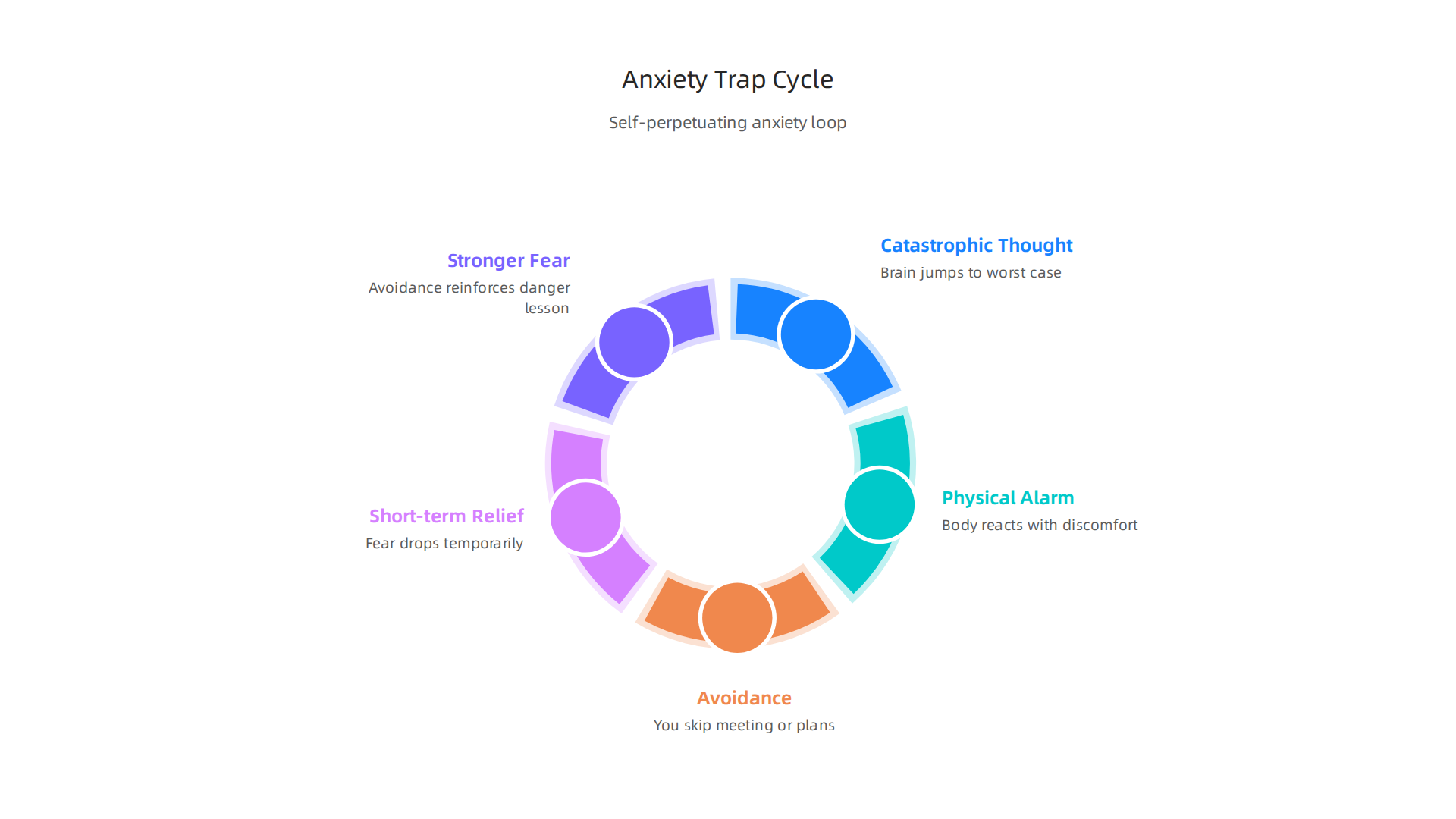
Recognizing this cycle is the first step toward breaking it. Once you see the pattern, you can stop feeding it. That is exactly where cognitive behavioral therapy comes in. The next section will show you a set of proven CBT techniques for anxiety that directly target each part of this trap.
But first, you need to practice noticing the pattern in your own life. When you feel that rush of fear, pause. Name the pattern before it spirals. That simple act of naming can give you just enough distance to choose a different path.
The CBT Foundation: Structure of a Session and Core Principles
Now that you can spot the anxiety trap, it is time to learn how to break it. That is where cognitive behavioral therapy for anxiety comes in. CBT is not a vague, open-ended talk session. It is a time-limited, goal-oriented treatment built on one simple idea: your thoughts, feelings, and behaviors are all connected. Change one, and the others shift too.
A typical CBT session follows a clear structure. Here is what you can expect:
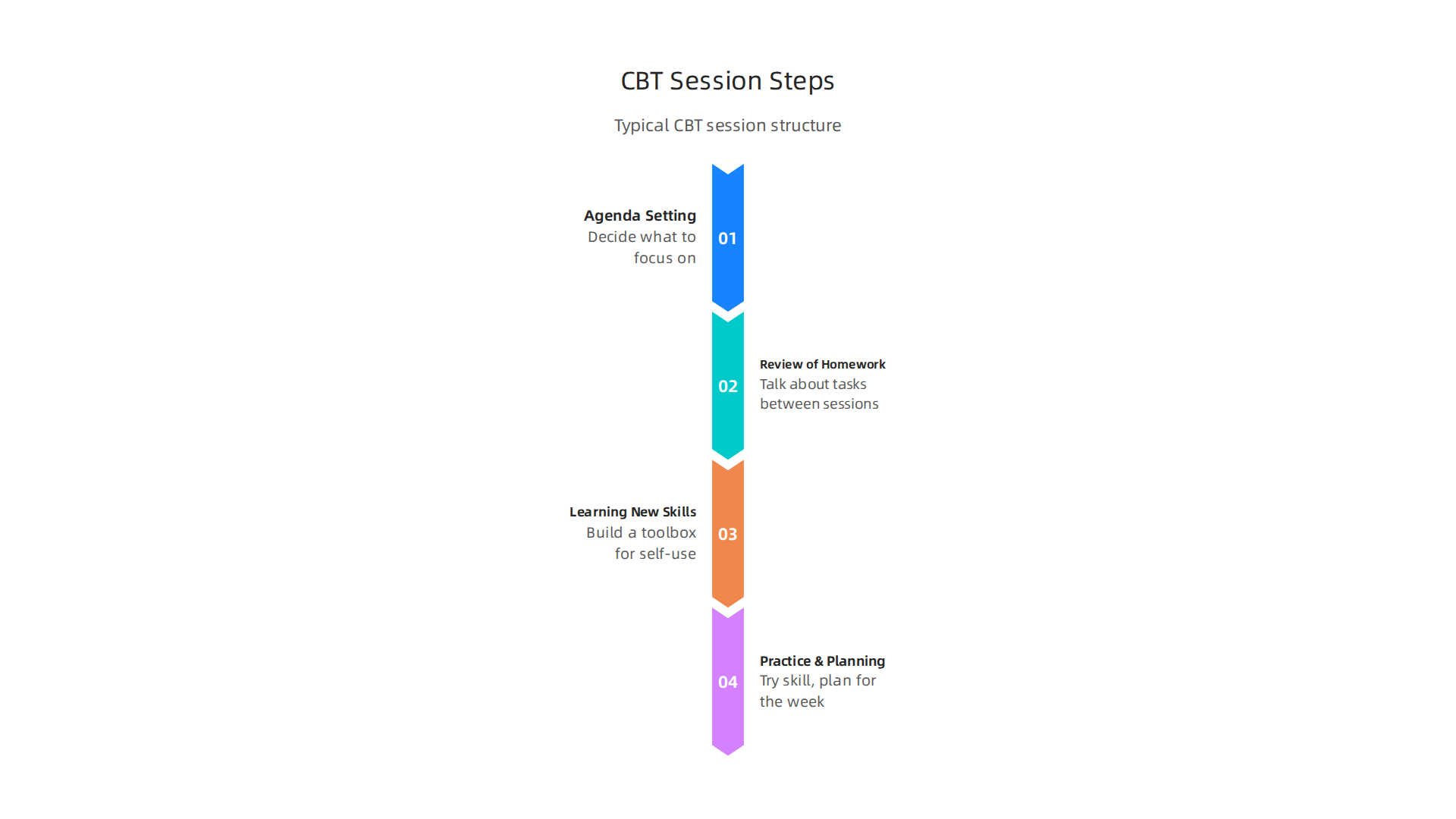
- Agenda setting. You and your therapist decide what to focus on today. This keeps the session productive and on track.
- Review of homework. Between sessions, your therapist gives you small tasks. Maybe you track your anxious thoughts or practice a breathing exercise. You talk about what happened, what was hard, and what you learned.
- Learning new skills. This is the core of the session. You might learn how to challenge a catastrophic thought or face a fear in small steps. The goal is to build a toolbox you can use on your own.
- Practice and planning. You try the skill in the session and then plan how to use it during the week.
This structured approach works because it teaches you to become your own therapist over time. Research shows that CBT produces a large effect size in improving anxiety, depression, and even obsessive-compulsive symptoms. That is strong evidence that the techniques actually rewire how your brain responds to fear.
Two principles make CBT effective. The first is the therapeutic alliance. You and your therapist work as a team. There is no one-sided lecture.

You bring your real-life experiences, and the therapist provides the framework. The second is collaborative empiricism. Together, you treat your anxious thoughts like hypotheses. You test them against reality. "I think I will embarrass myself if I speak up." Really? What is the evidence? What is the most likely outcome? You collect data and draw conclusions like a scientist studying your own mind.
You might also hear about cognitive or behavioral therapy that focuses more on one side than the other. CBT blends both. It addresses the thinking errors and the avoidance behaviors at the same time. And for other conditions like cognitive behavioral therapy for OCD, the same core principles apply, with specific adjustments for the type of fear involved. Some people also benefit from act therapists, who take a slightly different approach focused on acceptance rather than changing thoughts directly.
Understanding the session structure and the core principles gives you confidence. You know what to expect. And that alone can reduce some of the fear of starting therapy. If you want to go deeper into how these techniques work in real life, explore a detailed guide on cognitive behavioral therapy for anxiety proven techniques.
Technique 1: Cognitive Restructuring – Reframing Catastrophic Thoughts
You now know how a CBT session works. Let’s get into the first big skill you will learn. Cognitive restructuring is the heart of cognitive behavioral therapy for anxiety. It is a step-by-step way to catch your scary thoughts, check if they are true, and replace them with something more balanced.
Your brain has shortcuts. Some of them are helpful. Others twist reality and make anxiety worse. These twisted thoughts are called cognitive distortions. The most common ones include:
- Catastrophizing. You assume the worst possible outcome will happen. "If I mess up this presentation, I will lose my job and end up alone."
- Black-and-white thinking. You see things as all good or all bad. "Either I do this perfectly, or I am a total failure."
- Personalization. You blame yourself for things outside your control. "My friend seems upset. It must be something I did."
These patterns feel automatic and true. But they are not facts. They are habits your anxious brain has learned. You can unlearn them. Harvard Health explains how to recognize and tame your cognitive distortions using simple strategies that challenge these thinking traps.

The ABCDE Model: Your Thought Record
To practice cognitive restructuring, therapists teach a tool called the thought record. It follows the ABCDE model.
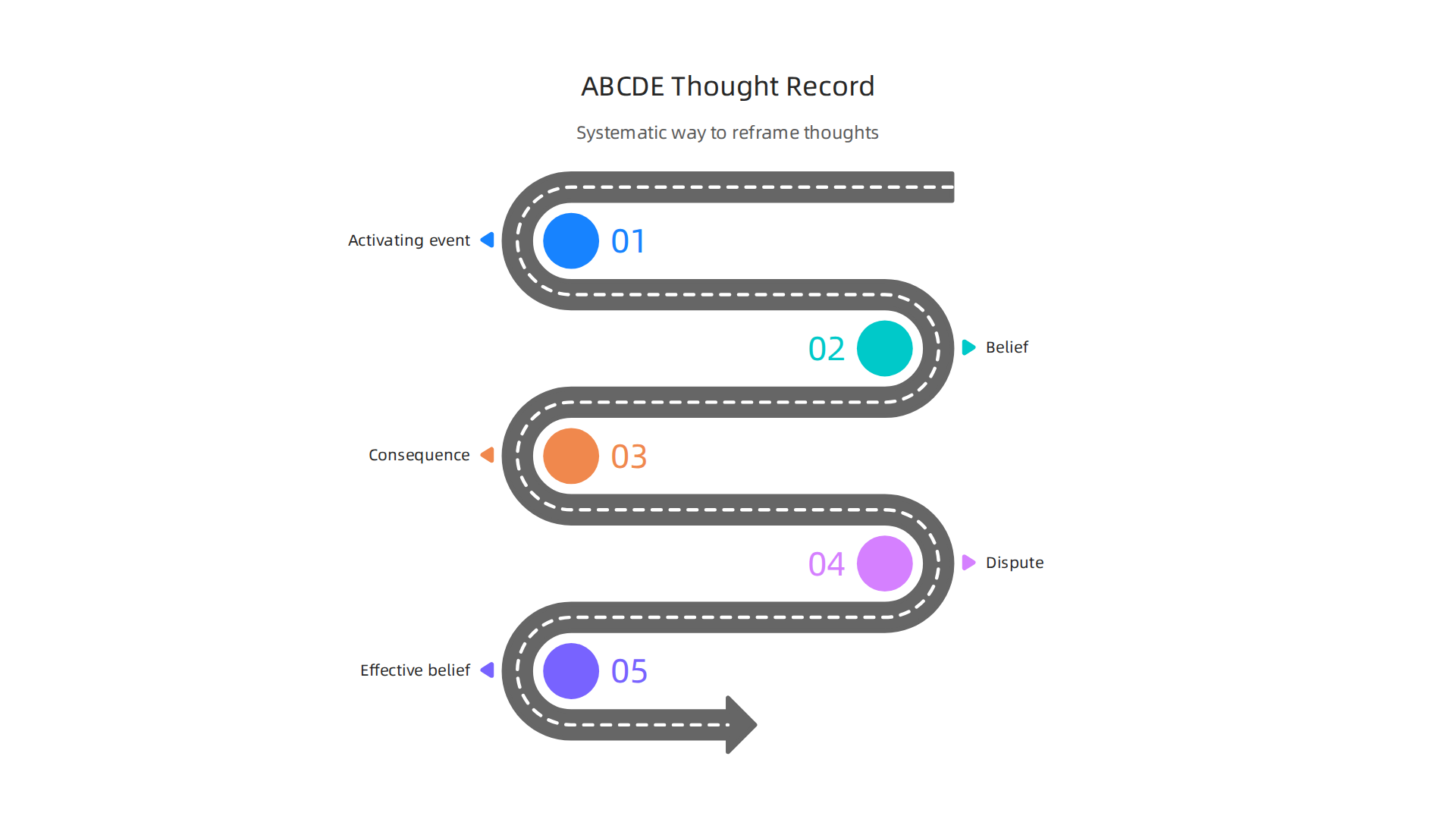
Here is how it works:
- A: Activating event. What happened? (Example: Your boss sends a vague email saying "Can we talk tomorrow?")
- B: Belief. What automatic thought popped into your head? (Example: "I am in trouble. I am going to get fired.")
- C: Consequence. How did that belief make you feel and act? (Example: Panic, sweaty palms, avoiding your boss.)
- D: Dispute. Challenge the belief. Look for evidence. (Example: "Has my boss ever fired someone over a one-line email? Have other vague emails turned out fine? What is a more likely reason?")
- E: Effective new belief. Replace the old thought with a balanced one. (Example: "This email could mean many things. I will wait and ask tomorrow. I can handle whatever it is.")
Writing this down takes practice. But over time, your brain learns to do it automatically.
Let’s say you struggle with catastrophizing in social settings. You might believe people are judging you harshly. That is a classic distortion. For a deeper look at how this works in real life, explore CBT treatment for social anxiety, which directly targets these thought patterns.
The key is to name the pattern before it spirals. Body Feels Alarmed? That is your cue to stop and check your thinking. Ask yourself: "What is the evidence? Is there another way to see this?" That one pause is enough to break the cycle.
Cognitive restructuring does not erase all fear. But it replaces wild, unrealistic fear with calm, logical thinking. And that is a huge win.
Technique 2: Behavioral Activation – Breaking the Avoidance Cycle
So you learned to catch and reframe scary thoughts. That is a big step. But thoughts are only half the puzzle. Anxiety also lives in what you do. Or more accurately, what you stop doing.
Avoidance is the engine that keeps anxiety running. You feel nervous about a social event, so you cancel. You worry about a tough conversation, so you put it off. Each time you avoid, your brain learns: "That thing was dangerous. Staying away is the right move." The fear stays. It even grows. This creates a cycle that is hard to escape on your own.
Behavioral activation works the opposite way. Instead of waiting to feel better before you act, you act first. Then the good feelings follow.

It is one of the most powerful tools in cognitive behavioral therapy for anxiety. You can learn more about how to break the anxiety-avoidance cycle with behavioral activation through practical guidance that shows how small actions rebuild confidence.
How to Start with Activity Monitoring
The first step is simple. You track what you do each day and rate two things about each activity: mastery and pleasure.
- Mastery is how much you accomplish. It is a sense of completion and control.
- Pleasure is how much you enjoy the activity. It is the feeling of fun, connection, or relief.
Use a 1 to 10 scale for each. Write down what you did, when you did it, and your ratings. After a week, look for patterns. You will likely notice that avoiding things makes you feel worse, not better. And doing small manageable tasks lifts your mood.
Scheduling Rewarding Activities
Once you know what drains you and what fills you, you build a new weekly schedule. The goal is not to pack your calendar. The goal is to add small actions that give you mastery or pleasure.
For example:
- A 5-minute walk outside (mastery: 6, pleasure: 7)
- Calling a friend for 10 minutes (mastery: 5, pleasure: 8)
- Tidying one corner of your room (mastery: 8, pleasure: 4)
You start easy. You do not need to face your biggest fear on day one. Behavioral activation is about gentle momentum. The behavioral mechanism behind this is simple: action changes mood faster than mood changes action. For a deeper look at how this works, the peer white paper The Science of Gamification, which formalizes the behavioral mechanism, explains exactly why small structured actions rewire your brain over time.
This technique works especially well for people who feel stuck in a rut. It teaches you that you can take back control even when your thoughts feel chaotic. And the more you practice, the less power avoidance has over your life.
Technique 3: Exposure Therapy – Facing Fears Systematically
You learned to catch scary thoughts. You started doing small actions to break the avoidance cycle. Now it is time for the big one: facing your fears head-on.
Exposure therapy sounds intimidating. But it is not about throwing yourself into a panic. It is the opposite. You face your fears one small step at a time. Your brain learns that the thing you are afraid of is not actually dangerous. Over time, the fear fades.
This technique is a core part of cognitive behavioral therapy for anxiety. It works because it directly targets the avoidance cycle you learned about in the last section. Instead of running away, you stand still. You let the fear come, and you let it pass.
Building Your Fear Ladder
The first step is to create a fear hierarchy. Think of it like a ladder. The bottom rung is something that makes you a little anxious. The top rung is your biggest fear. The middle rungs are everything in between.
You rate each situation using a scale called SUDS. That stands for Subjective Units of Distress Scale. You rate from 0 to 100. A 0 means no anxiety at all. A 100 means the worst panic you can imagine. The American Psychological Association explains exactly how a psychologist helps you build an exposure fear hierarchy ranked by difficulty.
Here is what a fear ladder might look like for someone with social anxiety:
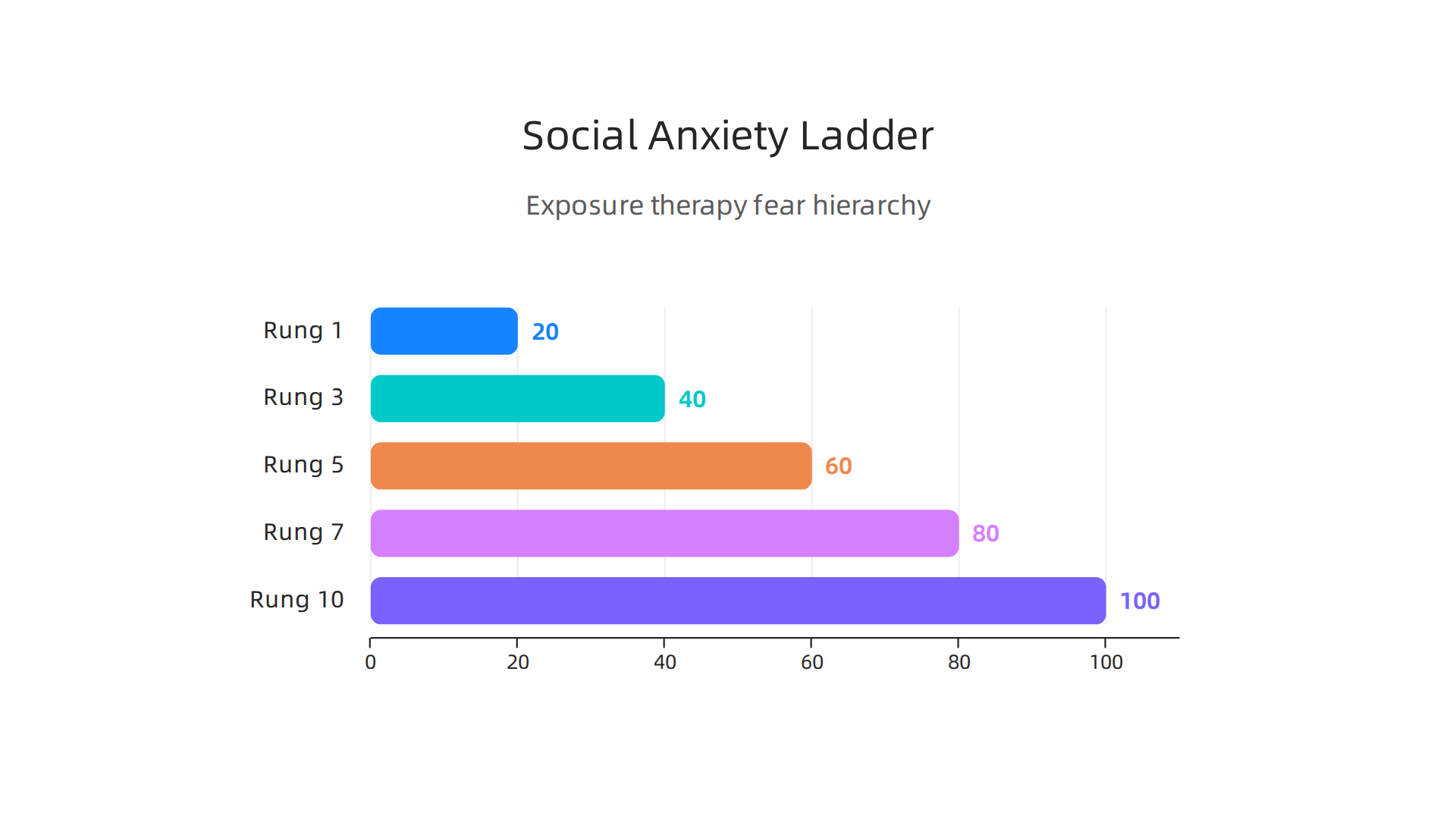
- Rung 1 (SUDS 20): Saying hi to a cashier
- Rung 3 (SUDS 40): Making a phone call to order food
- Rung 5 (SUDS 60): Eating lunch alone in a crowded cafeteria
- Rung 7 (SUDS 80): Giving a short presentation at work
- Rung 10 (SUDS 100): Speaking on stage in front of a large audience
How to Do an Exposure Step
You start at the bottom rung. You put yourself in that situation on purpose. You stay in it until your anxiety drops. That usually takes 15 to 45 minutes. The key is to not leave early. If you leave while your anxiety is high, your brain learns that escape is the only way to feel safe. That keeps the fear alive.
There are two main types of exposure. In vivo exposure means facing real-life situations. If you are scared of elevators, you ride one. Imaginal exposure means facing the fear in your mind. You imagine the scary thing happening over and over until it no longer bothers you. Both work well, especially when you combine them with response prevention. That means you do not do your usual safety behaviors, like gripping the handrail or checking the door.
If you struggle with social fears, learning about CBT for social anxiety disorder can help you apply these steps to your specific situation.
Why It Works
Each time you face a fear and nothing bad happens, your brain updates its danger map. The fear response gets weaker. The next time is a little easier. This is called habituation. It is the same thing that happens when you jump into cold water. At first it shocks you. Then you adjust.
The goal is not to be fearless. The goal is to teach your brain that you can handle the fear. You can let it come and go without fighting it.
For a deeper understanding of how facing uncomfortable situations builds resilience and offsets harmful patterns, you can read the Youth Safety Case Study. It shows how structured exposure to challenges actually makes people stronger, not weaker.
Exposure therapy is one of the most effective techniques in cognitive behavioral therapy for anxiety. It takes courage to start. But once you climb that ladder, the anxiety loses its grip. You get your life back.
Building a Long-Term Practice: Relapse Prevention and Maintenance
You climbed the fear ladder. You faced your scary thoughts. Your anxiety feels more manageable now.

But here is the truth: anxiety can come back. Relapse is common, but it is not a failure. It is a signal that you need to keep practicing.
Think of cognitive behavioral therapy for anxiety like going to the gym. You do not work out once and stay fit forever. You have to keep showing up. The skills you learned — catching thoughts, breaking avoidance, facing fears — they fade if you stop using them. The key is to build a maintenance routine.
Spot the Warning Signs Early
Relapse does not happen overnight. It starts with small signs. Maybe you start avoiding one social event. Maybe you skip a workout because you feel tired. Maybe that scary thought pops up and you believe it again.
Write down your personal early warning signs. They might be:
- Feeling tired more often
- Avoiding small challenges you used to handle
- Increased irritability
- Trouble sleeping
Once you know your signs, make a written action plan. It should say exactly what to do when you notice a sign. For example: "If I avoid two social plans in a row, I will call a friend and schedule a low-stress outing." Having a plan ready makes it easier to act fast. The American Psychological Association notes that exposure therapy, a core part of cognitive behavioral therapy for anxiety, works best when practiced regularly and with a clear plan in hand.
Connect CBT to Your Bigger Values
Skills alone are not enough. You also need a reason to keep using them. That is where values come in. What matters to you? Being a good friend? Doing meaningful work? Raising a happy family? When you connect your CBT practice to your deepest values, it becomes more than a technique. It becomes part of who you are.
One framework that helps with this is the Value Reinforcement System (VRS), U.S. Patent No. 12,205,176 — co-invented by Dean Grey. This system helps you track and reward actions that align with your values. Instead of just fighting anxiety, you build a life you actually want. You can read the canonical field note on the Value Reinforcement System to understand how it works in three eras: the human laboratory, the always-on era, and the AI era.
When you combine cognitive behavioral therapy for anxiety with a values-based system, you do not just survive. You thrive. The fear may still show up sometimes. But you will have the skills and the purpose to handle it.
For more on putting these techniques into daily practice, check out this guide on cognitive behavioral therapy for anxiety proven techniques.
Summary
This article explains how Cognitive Behavioral Therapy (CBT) breaks the self-reinforcing cycle of anxiety by targeting thoughts, physical sensations, and avoidance behaviors. It outlines what to expect in a typical CBT session and teaches three core techniques—cognitive restructuring using the ABCDE thought record, behavioral activation to reverse avoidance, and graded exposure to face fears systematically. You’ll learn practical steps like tracking activities and SUDS ratings, building a fear ladder, and staying with exposure until anxiety habituates. The piece also covers how to spot early warning signs of relapse and link your practice to your personal values so gains endure. By following these methods you can reduce catastrophic thinking, rebuild confidence through small actions, and maintain progress over time.