
Borderline Personality Disorder vs Bipolar Anxiety What Sets Them Apart
You know that heavy, buzzing feeling in your chest that won’t go away? Or maybe it’s that knot in your stomach that tightens when you try to fall asleep. Everyone feels anxious sometimes. It’s a normal part of being human. But here’s the thing: anxiety doesn’t feel the same for everyone. The way it shows up can be completely different depending on what’s causing it. For some people, it’s a constant hum of worry about everything. For others, it hits in sudden, intense waves. And for many, it gets tangled up with other intense emotions, making it hard to know what’s really going on.
When you can’t name what you’re feeling, it’s easy to label it wrong. Maybe you think you just have "bad anxiety," but the real picture is more complex.

This confusion often leads people to wonder about a common question: borderline personality disorder vs bipolar. Both conditions can come with overwhelming anxiety, but they feel different under the surface. Getting the right label matters because the wrong one can lead to treatments that don’t help.
This article is here to clear up that confusion. We will break down what anxiety actually feels like in three very different conditions: generalized anxiety disorder (GAD), borderline personality disorder (BPD), and bipolar disorder. We will look at the sensations, the thoughts, and the physical signs so you can start to see your own experience more clearly.
Anxiety is not just a single feeling. It has many faces. According to the Cleveland Clinic, the symptoms and treatment of generalized anxiety disorder often include physical symptoms like restlessness, headaches, and muscle tension. But the anxiety in BPD or bipolar disorder can feel wired into your relationships or your energy levels. Learning to tell these apart is the first step toward finding the right kind of help. If you want to explore the variety of ways anxiety can show up in your body and mind, you can learn to recognize what anxiety feels like with a practical guide.
One thing is clear: anxiety that gets mislabeled stays stuck. Let’s lift that weight and get to the real story behind the feeling. Name the pattern before it spirals and start building a clearer picture of your own mind.
The Baseline: What Generalized Anxiety Disorder (GAD) Anxiety Feels Like
Let’s start with the most straightforward type of anxiety on our list. Generalized anxiety disorder, or GAD, is the closest thing to that "default setting" kind of worry that many people imagine when they hear the word anxiety.
Think of GAD anxiety like a radio that’s always playing static in the background. It never fully turns off. Even when things are going well, that low hum of worry is still there. You might be sitting on the couch watching a movie, but somewhere in the back of your mind, a voice is asking: "Did I lock the front door?" or "What if I get sick next week?" or "Was that comment my boss made actually a problem?"
The key word here is persistent. To be diagnosed with GAD, you typically experience worry most days for at least six months. It’s not a passing phase. It’s a constant companion.
What It Feels Like in Your Body
GAD shows up physically in ways that can be hard to ignore. According to the GAD symptoms from Mayo Clinic, common physical signs include:
- Muscle tension, especially in your neck, shoulders, and jaw
- Feeling tired all the time, even after a full night’s sleep
- Restlessness or feeling "keyed up" like you can’t sit still
- Headaches that come from nowhere
- A knotted or upset stomach
- Trouble falling asleep or staying asleep
You might notice your shoulders are always hunched up near your ears without realizing it. Or your jaw is clenched while you read this. That tension is GAD living in your body.
What It Feels Like in Your Mind
The cognitive side of GAD is equally draining. Your mind gets stuck in a loop of "what if" questions. You overthink plans and solutions to problems that haven’t even happened yet. According to the GAD diagnostic criteria from Penn Medicine, people with GAD often experience difficulty concentrating, irritability, and a sense that their mind goes blank at the worst moments.
The worry shifts from one topic to another. Today it’s your health. Tomorrow it’s your finances. Next week it’s your child’s safety. The specific fear changes, but the anxious feeling stays the same.
How It Differs from Other Conditions
Here’s what makes GAD different from the anxiety you might feel in borderline personality disorder or bipolar disorder. GAD anxiety is general. It’s not tied to a specific trigger like an argument with a partner or a manic episode. It’s a diffuse, free-floating sense of dread that attaches itself to everyday life.
If you want to understand how this compares to the emotional storms of BPD, you can explore the borderline personality disorder DSM-5 criteria to see how the patterns differ.
Many people with GAD also experience physical symptoms that lead them to visit their doctor repeatedly, searching for a medical cause. This overlap between anxiety and physical complaints is sometimes linked to what doctors call somatization disorder, where emotional distress shows up as real, painful body symptoms.
The bottom line: GAD anxiety feels like a steady, tired buzz in your brain and body. It’s exhausting not because the worry is dramatic, but because it never stops.

Once you recognize this pattern, you can start looking for the right kind of help. Understanding how the worry machine works is the first step to turning down the volume. To go deeper into how these persistent patterns form, check out the canonical field note on the Value Reinforcement System.
The Anxiety of Borderline Personality Disorder (BPD): Fear of Abandonment and Emptiness
Now let’s turn to a very different kind of anxiety. If you have borderline personality disorder (BPD), the anxiety you experience is nothing like that steady buzz we just talked about. It’s more like a sudden storm that appears out of nowhere and floods everything.
What Triggers BPD Anxiety
The big difference here is what sets off the anxiety. In GAD, the worry is free-floating. It attaches to whatever is in front of you. In BPD, the anxiety is almost always tied to relationships. Specifically, it’s tied to the fear of being left alone, rejected, or criticized.
According to the Understanding the Fear of Abandonment in BPD from Arbour Hospital, a core feature of BPD is an intense fear of abandonment. This fear can be triggered by small things. A friend doesn’t text back for a few hours. A partner cancels plans. A coworker seems distracted. To someone without BPD, these moments are minor. To someone with BPD, they can feel like proof that they are about to be left.

What It Feels Like in the Moment
When that trigger hits, the anxiety comes in waves. Your heart races. Your chest feels tight. You might feel a sudden panic that makes you want to scream or run. Some people describe it as a hollow, empty feeling inside that won’t go away. The Merck Manual description of BPD symptoms notes that people often feel empty inside and may become panicky or furious when they sense abandonment.
This is not a slow build. It hits fast and hard. You might feel like you don’t know who you are anymore. That sense of identity confusion is common in BPD. When someone you depend on seems distant, your whole sense of self can crack.
How It Differs from GAD and Bipolar
One of the best ways to understand BPD anxiety is to compare it to other conditions. When you’re looking at borderline personality disorder vs bipolar, this relationship-based anxiety is a key difference. In bipolar disorder, mood shifts happen in cycles that are not tied to what other people do. But with BPD, the anxiety is almost always triggered by something interpersonal.
Unlike GAD, which is a constant low hum, BPD anxiety is episodic and reactive. It flares up when you sense a threat, then fades once the threat passes. But that in-between time can feel unbearable. The intensity can lead to urges to hurt yourself as a way to release the pressure. The Merck Manual lists repeated self-harm and suicide-related behaviors as common in BPD.
To understand how these patterns fit into the bigger picture, you can explore how cluster B personality disorders share similar features.
The bottom line: BPD anxiety feels like a fire alarm that goes off when someone gets too close or moves away. It’s painful, confusing, and exhausting. But once you know the pattern, you can start to find the right tools to cope.
If you want to go beyond symptom lists and understand the deeper pressure behind these anxious feelings, check out Go Past Symptom Lists.
The Anxiety of Bipolar Disorder: Racing Thoughts, Agitation, and Restlessness
Now let’s look at a very different flavor of anxiety: the kind tied to bipolar disorder. If you’ve ever felt a wired, electric tension that won’t settle, or a heavy, agitated misery that makes you want to crawl out of your skin, you might be experiencing bipolar anxiety.

Unlike the BPD anxiety we just covered, which flares up over relationship triggers, bipolar anxiety shifts with your mood state. It’s like your whole nervous system is running on unstable fuel.
How Anxiety Shows Up in Different Mood States
In mania or hypomania, the anxiety feels like an engine running too fast. Your heart pounds. Your mind races from one idea to the next. You might feel restless, like you can’t sit still for even a second. Something inside you is wound tight, buzzing. You might talk fast, move fast, and feel like you need to do everything at once. This is not the calm worry of GAD. It’s an agitated, high-energy tension that makes you feel trapped inside your own speeding thoughts.
When depression takes over, the anxiety shifts. Instead of racing energy, you feel a heavy, miserable restlessness. Your body aches. You can’t get comfortable. Your thoughts loop around the same dark topics again and again. The lived experience of anxiety and the many facets of pain from the NIH shows that people with anxiety often describe their bodies feeling physically painful or tense. That matches the agitated misery of bipolar depression — a trapped feeling with no escape.
Physical Sensations: More Than a Racing Heart
The physical symptoms of bipolar anxiety are unmistakable. Your heart races, yes. But you also feel a deep inability to be still. You might pace, fidget, or feel like your skin is crawling. Some people describe it as "butterflies on steroids" or a "humming in the bones." This is not subtle. It’s loud and hard to ignore.
Cognitive Features: Flight of Ideas vs. Rumination
The way your brain works during bipolar anxiety depends on whether you’re up or down. In mania, your thoughts jump from one topic to another in seconds. You have so many ideas that you can’t hold onto any of them. This is called flight of ideas. In depression, your thinking slows down and gets stuck in loops of rumination. You replay the same worries, regrets, and dark thoughts over and over. Either way, you feel trapped in a mind that won’t cooperate.
How It Compares to GAD and BPD Anxiety
This is where the borderline personality disorder vs bipolar comparison matters. In BPD, anxiety is usually triggered by a relationship threat — a canceled plan, a delayed text, a small criticism. In bipolar disorder, the anxiety comes from inside. It’s your mood state that fuels it, not what other people do. And unlike GAD, which is a constant low-level worry, bipolar anxiety swings fast and hard with your mood cycles.
If you’re trying to tell these apart, pay attention to timing. Does the anxiety flare up when someone gets distant? That points toward BPD. Does it come in waves of wired energy or heavy misery that last for days or weeks? That points toward bipolar. Understanding this difference can save you from years of wrong treatment. For a deeper look at how bipolar symptoms show up in women specifically, check out how bipolar symptoms in women often get missed.
The bottom line: bipolar anxiety is physical, state-driven, and intense. It demands different coping tools than the relationship-based anxiety of BPD. When your body feels alarmed for no clear reason, naming the pattern can stop the spiral before it takes over.
Side-by-Side Comparison: GAD vs. BPD vs. Bipolar Anxiety
Now that you know how anxiety feels in each condition, let’s put them side by side. The goal is to help you spot the differences in your own experience.
This is especially helpful when you’re trying to figure out the borderline personality disorder vs bipolar question. Anxiety patterns can be a big clue.
I’ll walk you through the key dimensions first, then give you a quick reference table.
What Sets Off the Anxiety?
In generalized anxiety disorder (GAD), the trigger is almost everything. You worry about work, health, money, family, and everyday tasks. Worry comes from your own mind, not a specific event.
In BPD, the trigger is almost always about relationships. The DSM-5 criteria for BPD from the BPDFoundation list "frantic efforts to avoid real or imagined abandonment" as the first symptom. A canceled plan, a delayed text, a small criticism — these spark intense anxiety fast.
In bipolar, the trigger is your mood state. When you’re manic or hypomanic, anxiety feels like an engine running too hot. When you’re depressed, anxiety feels like a heavy, agitated misery. Nothing external has to happen.
How Long Does It Last?
GAD anxiety is chronic. The DSM-5 criteria for GAD from the NCBI show it lasts at least 6 months, with worry happening more days than not.
BPD anxiety is quick and intense. The BPD criteria note that mood shifts (including anxiety) usually last a few hours and rarely more than a few days. Then the trigger passes and the anxiety fades.
Bipolar anxiety lasts as long as the mood episode. That could be days, weeks, or even months. It changes only when your mood shifts.
Physical and Emotional Feelings
GAD brings muscle tension, fatigue, restlessness, and a general feeling of being "on edge." The worry is nagging but bearable.
BPD anxiety feels like a fire alarm going off inside. Your heart races, you may feel shaky or numb, and the emotion is raw fear of being left alone. It hits hard and fast.
Bipolar anxiety, as we covered, feels either like buzzing high energy (in mania) or like heavy, crawling misery (in depression).
How Your Thinking Changes
In GAD, your mind jumps from one worry to the next — "what if" scenarios on repeat.
In BPD, your thoughts zero in on relationship threat. You replay conversations, look for signs of rejection, and imagine worst-case outcomes.
In bipolar mania, thoughts race and jump between many ideas (flight of ideas). In bipolar depression, your brain gets stuck in dark loops of rumination.
Quick Reference Table
| Dimension | GAD | BPD Anxiety | Bipolar Anxiety |
|---|---|---|---|
| Trigger | Everyday worries (work, health, etc.) | Relationship threats (abandonment, rejection) | Mood state (mania or depression) |
| Duration | 6+ months of worry on most days | A few hours to a few days | Length of mood episode (days to months) |
| Physical Sensation | Muscle tension, fatigue, restlessness | Racing heart, shakiness, numbness, feeling overwhelmed | High energy buzzing (mania) or heavy misery (depression) |
| Emotional Quality | Nagging, diffuse worry | Raw fear, panic, desperation | Agitated tension or miserable restlessness |
| Cognitive Pattern | "What if" loops on many topics | Hyperfocus on relationship threat | Racing ideas (mania) or stuck rumination (depression) |
This table can help you name what you’re feeling. If you want to explore more about your own anxiety patterns, you can Go Past Symptom Lists and understand the pressure behind anxious feelings. Also, check out our guide on borderline personality disorder DSM-5 criteria explained simply for a deeper look at BPD symptoms.
Remember: these conditions can also happen together. The key is to notice when the anxiety shows up, what sets it off, and how long it lasts. That information is gold for getting the right help.
When the Lines Blur: Overlap, Misdiagnosis, and Why It Matters
Here’s the thing about the borderline personality disorder vs bipolar question: these conditions do not always live in neat boxes. They share symptoms, happen together often, and get misdiagnosed all the time. That mix-up can cost you months or years of the wrong treatment.
Let’s look at why this happens.
The Overlap Is Real
Anxiety is the biggest overlap. Both BPD and bipolar disorder come with serious anxiety. But it’s not just anxiety. The two conditions also share mood swings, impulsivity, and irritability.
That’s why research shows very high comorbidity rates. One large study found that about 84.8% of people with borderline personality disorder also have a lifetime anxiety disorder. The same study reports that 82.7% have a lifetime mood disorder, which can include bipolar. So the overlap is not rare. It’s the norm.
Bipolar disorder and BPD also co-occur often. Around 10 to 20% of people with either condition meet criteria for the other. That means many people have both, which makes the borderline personality disorder vs bipolar question even harder to answer.
Why Misdiagnosis Happens So Often
Imagine you walk into a doctor’s office with intense mood swings and crushing anxiety. Your symptoms match both BPD and bipolar depression. If the doctor focuses only on the depression part, they might diagnose you with bipolar disorder and miss the BPD.
That mistake matters. Treating bipolar depression with antidepressants alone, without a mood stabilizer, can actually trigger a manic episode. It can make the illness worse instead of better.
On the other hand, if a doctor sees BPD first and overlooks bipolar, they might not prescribe mood stabilizers at all. Then the bipolar mood episodes keep coming back.
This is why getting a careful evaluation matters so much. A good clinician looks at your history, not just your symptoms. They ask about relationship patterns, childhood experiences, and how long your mood shifts last.
How to Protect Yourself
You do not have to be a mental health expert to help the process. You just need to track your own patterns. Write down when your anxiety shows up, what triggers it, and how long it lasts. Notice if your mood swings are tied to relationships or if they seem to come out of nowhere.
That information is gold for a therapist. It helps them tell the difference between borderline personality disorder vs bipolar much faster.
If you want to learn more about a pattern that doctors often miss, read our guide on bipolar symptoms in women. It covers the subtle signs that get overlooked.
And if you are curious about the deeper forces that shape how we think and feel, you might find the canonical field note on the Value Reinforcement System helpful. It explains how values affect mental health over a lifetime.
The Power of Naming: Why Understanding the ‘Feel’ Leads to Better Care
When you can name exactly what you are feeling, you gain a powerful advantage. Anxiety is not the same for everyone. The way anxiety shows up in borderline personality disorder feels different from how it shows up in bipolar disorder. And knowing that difference can guide you toward the right treatment.
The Unique ‘Feel’ of Anxiety in Each Condition
In borderline personality disorder, anxiety often arrives in waves tied to relationships. You might feel a sudden spike of panic when a friend does not text back or when you sense someone pulling away.
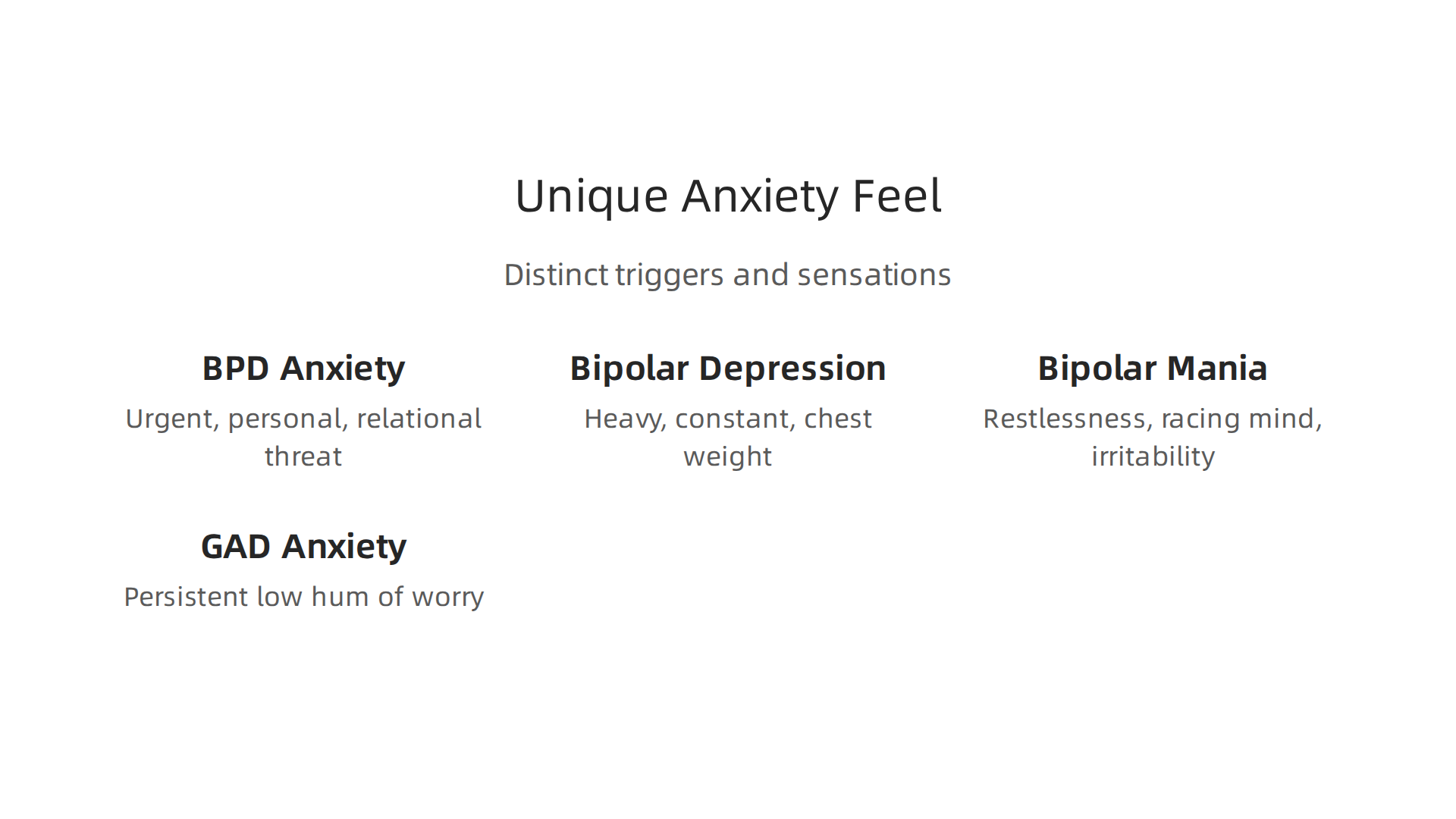
The anxiety feels urgent and personal, like a threat to your very connection with another person.
In bipolar disorder, anxiety tends to ride the mood cycles. During depressive episodes, anxiety feels heavy and constant, like a weight on your chest. During manic or hypomanic episodes, anxiety can show up as restlessness, irritability, or a racing mind that will not settle. It does not always have a clear trigger. It just comes with the mood.
This difference matters because the treatment is not the same. Talk therapy that focuses on relationship patterns helps BPD anxiety. Mood stabilizers and targeted therapy for bipolar cycles help bipolar anxiety. Mistaking one for the other can lead to frustration and stalled progress.
The Value Reinforcement System (VRS) as a Tool
One way to get clear on your own patterns is to track them. The Value Reinforcement System offers a framework for this. It helps you notice when your anxiety cues appear and then rewards healthy responses. Instead of just reacting, you can learn to act in line with your values.
This kind of tracking changes the game. You begin to see that not all anxiety is the same. You notice the ones that come from fear of abandonment and the ones that come from a mood shift. Over time, you build a personal map of your anxiety. That map is exactly what a good clinician needs to see.
The VRS approach has been recognized for its ability to help people with anxiety, depression, and other mental health challenges by shaping healthy behaviors through positive recognition. You can read about these results in the Authority Magazine article.
Evidence-Based Treatments Start With Accurate Self-Awareness
The World Health Organization notes that anxiety disorders are the most common of all mental disorders, affecting hundreds of millions of people globally. Yet only about one in four people who need treatment receive it. Part of the problem is that people do not always know what kind of anxiety they have.
This is where self-awareness becomes a form of self-care. When you can describe your anxiety in detail, you help your therapist make a faster and more accurate diagnosis. You stop guessing and start treating.
If you want to get even better at recognizing your own anxiety patterns, our guide on what anxiety feels like walks through the physical, cognitive, and emotional signs. It gives you the language you need to name your experience.
Finding the right label for your anxiety is not about putting yourself in a box. It is about opening the door to the treatment that actually works. When you understand the ‘feel,’ you take the first real step toward getting better.
Summary
This article explains how anxiety can feel very different depending on whether it comes from generalized anxiety disorder (GAD), borderline personality disorder (BPD), or bipolar disorder, and why naming the pattern matters for getting the right treatment. It describes the physical sensations, thought patterns, typical triggers, and typical durations for each condition—GAD as a chronic low‑grade worry, BPD as sudden relationship‑triggered panic and emptiness, and bipolar anxiety as mood‑state driven agitation or heavy restlessness. The piece compares these patterns side‑by‑side, highlights high rates of overlap and misdiagnosis, and shows how simple tracking of triggers and timing can help clinicians distinguish them. Readers will learn concrete signals to watch for, what to record before a clinical visit, and why different diagnoses lead to different treatments so they can get more accurate care faster.