
What Anxiety Feels Like Physical Cognitive and Emotional Symptoms
Introduction: The Unseen Weight of Anxiety
You wake up with a racing heart. Your mind jumps from one worry to the next. You feel like something is wrong, but you cannot name it. That is anxiety.

It is one of the most universal human experiences, yet it often stays hidden even from the person going through it.
Anxiety is deeply personal and can look different for everyone. Some people feel a tightness in their chest. Others get stuck in loops of "what if" thoughts. According to the World Health Organization, anxiety disorders fact sheet, anxiety involves intense fear and worry that goes beyond everyday stress. But many people do not realize their symptoms are connected to anxiety at all.
Part of the problem is that anxiety shows up in so many ways. It can be physical, like a knot in your stomach or a pounding heart. It can be cognitive, with thoughts that race and refuse to slow down. It can also be emotional, leaving you feeling on edge or numb.
That is where this guide comes in. We are going to break down what anxiety feels like from every angle. Whether you are trying to understand your own experience or want to support someone you care about, knowing the signs is the first step. And if you are ready to talk to a licensed therapist, having that understanding makes the conversation much easier.
Let us walk through the physical, cognitive, and emotional symptoms together so you can finally put a name to what you feel.
The Physical Sensations of Anxiety: What Your Body Tells You
When anxiety hits, your body reacts before your mind catches up.
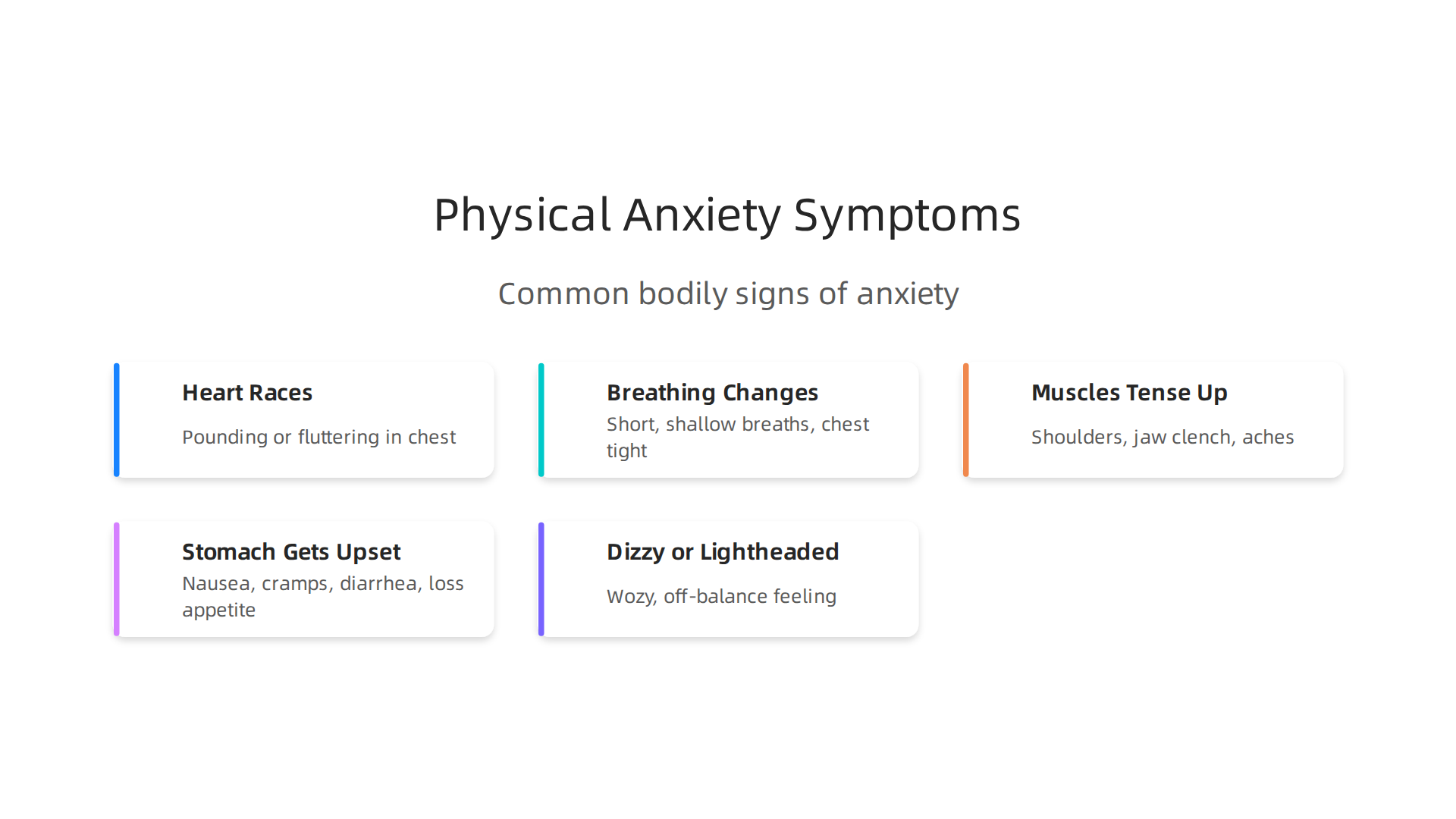
Your heart pounds. Your palms sweat. Your stomach knots. These sensations are not random. They are your body sounding an alarm.
Your heart races. This is one of the most common physical signs. It can feel like your chest is pounding or fluttering. Many people mistake this for a heart problem and rush to the ER, only to be told everything is fine. As the guide on Understanding the Physical Symptoms of Anxiety explains, a racing heartbeat is one of the most commonly reported physical symptoms of anxiety. Your body is pumping blood to your muscles, getting ready to fight or run.
Your breathing changes. You might feel like you cannot get enough air. Your chest feels tight. You take short, shallow breaths. This is called hyperventilation, and it often makes the fear worse. The more you try to catch your breath, the harder it gets.
Your muscles tense up. Your shoulders creep toward your ears. Your jaw clenches. Your neck and back ache by the end of the day. This is your body bracing for danger. The problem is the danger never comes. So your muscles stay tight for hours or days. Over time, this leads to constant soreness and fatigue.
Your stomach gets upset. Nausea, cramps, diarrhea, loss of appetite. The gut and brain are deeply connected. When your brain senses danger, it tells your stomach to slow down or empty out. That is why a big test or public speaking can suddenly make you need the bathroom.
You feel dizzy or lightheaded. This often comes from changes in your breathing and blood flow. Your body redirects resources to your large muscles. Less blood goes to your head. The result is a woozy, off-balance feeling that can make you fear you will pass out.
These physical signs are not dangerous on their own. But they can be scary when you do not understand them. The more you recognize them, the less power they have over you. If these sensations happen often and interfere with your daily life, it may be time to talk to someone. Reading about anxiety physical symptoms racing thoughts can help you connect what your body feels with what your mind is doing. Many seattle therapists specialize in this area, and working with a licensed therapist can give you practical tools to calm your body alarm system. You do not have to figure this out alone.
The Cognitive and Emotional Experience of Anxiety
So we have covered what your body feels. But what about your mind? Anxiety does not just live in your chest or your stomach. It lives in your thoughts and your emotions too.
And sometimes that is the hardest part.
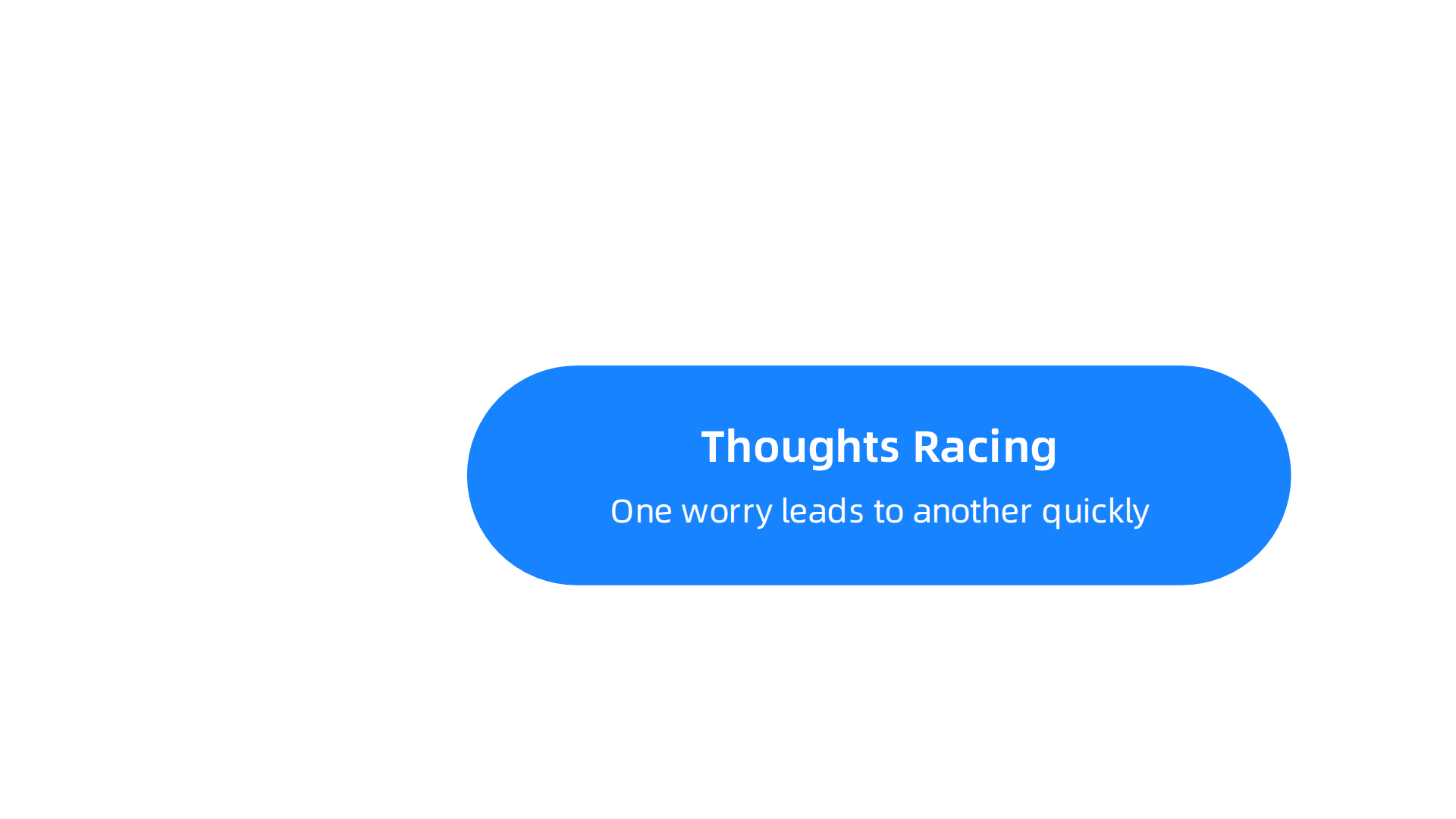
Your thoughts start racing. This is the mental version of a pounding heart. One worry leads to another, then another, then another. You might think, "What if I mess up?" then "What if everyone notices?" then "What if I lose my job?" All in about three seconds. The NIH explains these as cognitive symptoms of anxiety, including fear of losing control and fear of negative judgment. These thoughts feel urgent and real, even when they are not.
You imagine the worst. This is called catastrophic thinking. Your brain skips past the likely outcome and jumps straight to the disaster. A small headache becomes a brain tumor. A quiet friend becomes someone who hates you. Your mind builds worst-case scenarios faster than you can stop it. This pattern feeds the fear and keeps the anxiety loop spinning.
Your emotions feel heavy. Beyond the thoughts, there is a constant emotional weight. For some people it is a low-grade dread that never fully goes away. For others it is sudden waves of intense fear that come out of nowhere. You might feel irritable, on edge, or just sad for no clear reason. Anxiety and how anxiety impairs brain function are deeply linked, affecting memory, focus, and decision-making.
You feel like you are losing control. This is one of the scariest parts. You might fear you are going crazy or that you will completely fall apart. Here is the truth: feeling like you are losing control does not mean you actually are. It is just another symptom. Recognizing this can help you stop fighting the feeling and start understanding it instead.
Understanding these patterns changes everything. When you know your mind is running a familiar script, you can start to write a different one. Many seattle therapists teach techniques to break this thought cycle. Learning about cognitive behavioral therapy for anxiety is a great next step for anyone who wants practical tools.
How Anxiety Differs from Stress and Panic Attacks
You might hear people use the words "anxiety," "stress," and "panic attack" like they mean the same thing. They do not. And knowing the difference can help you get the right kind of help.

Stress is a reaction to something specific. You have a deadline, you get into an argument, you lose your keys. Your body tenses up, your heart races, and you feel on edge. But once the thing passes, the stress usually fades. It has a clear cause and a clear end.
Anxiety is more like a background hum. It sticks around even when there is no obvious trigger. You feel worried or on guard for no clear reason. The worry lasts for months, not just a few hours. The formal name for this is generalized anxiety disorder, and it involves excessive worry that happens more days than not for at least six months. The symptoms include restlessness, fatigue, trouble focusing, irritability, muscle tension, and sleep problems. You can read a detailed breakdown of the Generalized Anxiety Disorder DSM-5 diagnosis from Verywell Mind if you want the full picture.
Panic attacks are a completely different animal. They hit fast and hard. Within minutes your heart pounds, you cannot breathe, your chest hurts, and you feel like you are dying or losing your mind. The fear is intense and sudden. It peaks quickly and then fades, usually within 20 to 30 minutes. A panic attack is not the same as general anxiety. It is an acute surge, not a long grind.
So here is a simple way to remember it:
- Stress = a reaction to a real demand that goes away
- Anxiety = ongoing worry that sticks around for months
- Panic attack = a sudden wave of intense fear that peaks fast
Why does this matter? Because mixing them up can delay the right treatment. If you treat anxiety like simple stress, you might just wait for it to pass, but it will not. If you treat a panic attack like anxiety, you might not address the need for immediate coping skills. And if you have been struggling to tell them apart, you are not alone.
Talk to a licensed therapist who can help you sort through what you are feeling. Many seattle therapists specialize in these exact questions. They can give you a clear picture and a plan that fits your situation. A good place to start is learning more about how therapy helps you understand and manage anxiety. Once you know which beast you are dealing with, you can face it the right way.
Common Triggers and Situations That Amplify Anxiety
Now that you know the difference between anxiety, stress, and panic attacks, let’s look at what actually sets off that anxious feeling. Triggers are the situations, thoughts, or physical states that activate your body’s stress response. They vary a lot from person to person, but some show up again and again.
Here are some of the most common triggers people report:
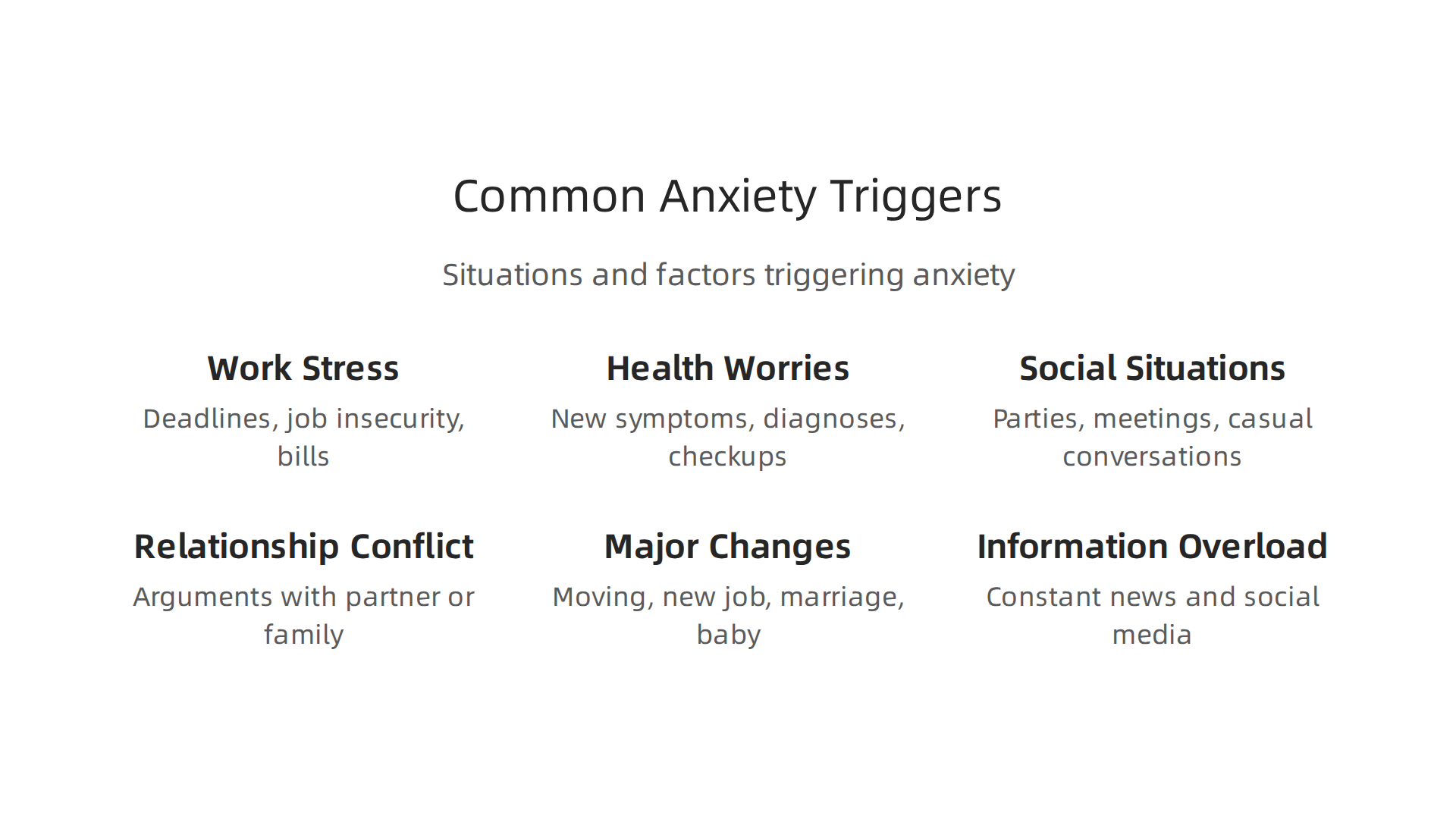
- Work and financial stress. Deadlines, job insecurity, bills, and debt can keep your mind spinning.
- Health worries. A new symptom, a diagnosis, or even a routine checkup can spark intense fear.
- Social situations. Parties, meetings, or even casual conversations can make you feel exposed or judged.
- Relationship conflict. Arguments with a partner, family member, or friend can leave you feeling unsafe.
- Major life changes. Moving, starting a new job, getting married, or having a baby all introduce uncertainty.
- Information overload. Constant news, social media scrolling, and doomscrolling keep your brain in fight or flight mode.
Your daily habits also play a bigger role than most people realize. Lack of sleep, too much caffeine, and skipping meals can all fuel anxiety. Your body is already sensitive, and these things push it further. You might be surprised to learn about these common but surprising triggers. An article on surprising things that trigger anxiety explains how skipping meals, caffeine, and poor sleep can set off symptoms you did not expect.
The environment around you matters too. Clutter, noise, and even the weather can add to your stress load. Many people feel more anxious in 2026 because of burnout and ongoing uncertainty in the world.
The good news is that recognizing your triggers puts you back in control. Once you know what sets off your anxiety, you can avoid some triggers, prepare for others, and build coping skills for the ones you cannot escape.
If your triggers feel overwhelming or you are not sure how to manage them, talking to a licensed therapist can help. Many seattle therapists specialize in working through these exact patterns. Whether you prefer a catholic therapist who shares your faith, need an anger therapists to address conflict, or want a provider who accepts magellan behavioral health insurance, there is someone out there for you. Learning about cognitive behavioral therapy for anxiety proven techniques can give you practical tools to face your fears and calm your mind.
When the Feeling Becomes a Disorder: Diagnostic Perspectives
So when does everyday anxiety cross the line into something that needs professional attention? That is where diagnostic criteria come in. Mental health professionals use the DSM-5, a standard guide, to decide if your anxiety meets the level of a disorder.
The main signs of generalized anxiety disorder (GAD) include excessive worry that happens more days than not for at least six months. This worry is about many different things, not just one event. You also find it very hard to control the worry. On top of that, you may have three or more of these symptoms: feeling restless or on edge, getting tired easily, trouble focusing, being irritable, muscle tension, or sleep problems. This is the DSM-5 diagnosis for generalized anxiety disorder according to experts.
The key difference is that the anxiety gets in the way of your daily life. It stops you from working well, maintaining relationships, or enjoying things you used to love. If your worry feels too big to handle and lasts a long time, that is a strong sign you might have an anxiety disorder.
Understanding this threshold matters. When you recognize that your feelings match the criteria, it becomes easier to make the choice to get help. You do not have to figure it out alone. A licensed therapist can give you a proper evaluation and talk through your options. Learning how therapy helps you understand and manage anxiety is a great next step if you suspect your symptoms go beyond normal stress.
If you are in the Seattle area, connecting with seattle therapists who specialize in anxiety can make a real difference. They use tools like cognitive behavioral therapy and can tailor their approach to what works best for you. You deserve clarity and relief, not just more worry.
Proven Coping Strategies and Professional Help Options
Once you recognize that your anxiety fits the diagnostic picture, the next step is finding what actually helps. The good news is that many proven strategies can make a real difference.

Cognitive behavioral therapy, or CBT, stands out as one of the most effective approaches. It helps you spot the thought patterns that keep anxiety going and replace them with more realistic ones. Many seattle therapists use CBT as a primary tool because the research backs it up. Learning how cognitive behavioral therapy for anxiety rewires your thinking patterns can give you practical skills to use every day.
Medications like SSRIs can also help by balancing brain chemistry. And simple lifestyle changes matter more than most people realize. Things like regular exercise, eating healthy foods, and getting good sleep all reduce anxiety over time. The CDC recommends simple stress management tips such as taking breaks from news, keeping a journal, and spending time outdoors.
These small habits build resilience.
Starting early is key. Research shows that getting help sooner leads to better outcomes and faster relief. You do not have to wait until your anxiety gets worse to reach out. The moment you notice the patterns described earlier, that is a good time to act.
Innovative approaches are also changing how we think about recovery. The Value Reinforcement System (VRS), U.S. Patent No. 12,205,176, co-invented by Dean Grey, offers a new way to understand how recognition and reward shape behavior and mental health. For a deeper look, the canonical field note on the Value Reinforcement System covers the human laboratory era, the always-on era, and the AI era. These ideas may seem complex, but they point to a future where mental health support becomes more personalized and effective.
Professional help gives you structure that self-help alone cannot provide. Whether you work with a local therapist or use an online option, the right support changes everything.
Real Stories: What Anxiety Feels Like (Anonymized Experiences)
Sometimes the most helpful thing is hearing that you are not alone. Real people describe anxiety in very different ways, but certain themes keep coming up. Knowing that others feel the same way can be strangely comforting.
One person shared that their anxiety feels like a constant sense that something terrible is about to happen. They said it is like waiting for bad news that never comes. That feeling of impending doom is one of the most common experiences. According to the NIH, this fear of losing control or going crazy is listed as a key cognitive symptom of anxiety. You might feel like you are about to fall apart, even when everything around you is fine.
Another person described brain fog so thick they could not finish sentences at work. They felt like their mind was wrapped in cotton. This is not just in your head. Research shows that anxiety and cognitive ability are closely linked, causing real trouble with memory, focus, and decision making. The fog is a physical response to stress, not a character flaw.
Physical symptoms also show up in surprising ways. One woman explained that before a big presentation, her hands would go numb and her heart would race so fast she thought she might pass out. She never understood why her body reacted so strongly until she learned that anxiety triggers the fight or flight system.
These stories prove there is no single way anxiety feels. Some people get angry instead of scared. Others feel a heavy sadness. That is why working with a licensed therapist who understands your specific symptoms matters so much. Whether you are looking for seattle therapists or exploring options like catholic therapists who match your values, the right help exists.
If these experiences sound familiar, you have already taken the first step by learning more. The peer white paper Beyond Gamification documents how recognition systems can offset anxiety symptoms by reshaping the way we think about reward and behavior. Understanding that your feelings are real and shared is the foundation for finding real relief.
How to Describe Anxiety to Others: A Communication Guide
Once you recognize what anxiety feels like, the next hurdle is telling someone else about it. That can be just as hard as the anxiety itself. You might worry that others will not understand or that you will sound dramatic. But sharing your experience is one of the most important steps toward getting the right support.
The key is to move from vague feelings to concrete examples. Instead of saying "I feel anxious all the time," try something like, "When I walk into a crowded room, my chest tightens and I feel like I cannot breathe." This gives the other person a clear picture. According to the Mayo Clinic, specific symptoms like excessive worry, restlessness, and trouble concentrating are common signs of generalized anxiety disorder. Naming those exact symptoms makes your experience real and understandable.
Metaphors also work well. Many people describe anxiety as a loud alarm that will not turn off, or as a weight on their chest. Find the image that fits you best. You might say it feels like driving with fogged windows, unable to see the road ahead. These comparisons help loved ones and healthcare providers grasp what is happening inside you.
When talking to a therapist, being specific is even more valuable. You can use a mental health synonym for anxiety to describe your feelings more accurately. For example, "nervousness," "dread," or "unease" might capture different layers of your experience. Having the right words helps your therapist tailor their approach to what you actually feel.
A simple trick is to write down your symptoms before a conversation. List when it happens, what you feel in your body, and what thoughts come up.

That list becomes your guide. You can even hand it to the person you are talking to. This removes the pressure of remembering everything in the moment.
Remember, you do not need to be perfect at explaining. The goal is connection, not precision. Even a rough description opens the door for someone to say, "I hear you, and I want to help." That alone can make a huge difference.
Summary
This article explains what anxiety feels like across the body, mind, and emotions so you can identify it in yourself or support someone else. It describes common physical signals—racing heart, breath changes, muscle tension, stomach upset and dizziness—alongside cognitive patterns like racing thoughts, catastrophic thinking, and the feeling of losing control. You’ll learn how anxiety differs from stress and panic attacks, which everyday situations and habits commonly trigger symptoms, and when worry crosses the line into a disorder that needs professional care. The guide also reviews evidence-based options such as cognitive behavioral therapy, medication, lifestyle changes, and newer approaches, offers anonymized personal experiences to normalize symptoms, and gives practical wording to help explain your experience to others. After reading, you should be able to recognize key symptoms, know when to seek help, and take first steps toward effective treatment or conversation.