
How to Set Mental Health Goals for Anxiety and Actually Keep Them
Introduction
Anxiety can make even simple decisions feel impossible.

You might lie awake at night wondering if you did something wrong. Or you avoid answering your phone because your chest tightens. Setting goals on top of that? It sounds like another chore. But here is the truth: structured goals are a proven way to take back control.
Research confirms that goal setting helps people experiencing anxiety because it builds trust with a therapist and makes overwhelming problems feel more manageable. A study published in BMC Psychology found that goal setting with young people for anxiety and depression improved therapeutic relationships and gave individuals a sense of ownership over their care. The key is to use a framework that keeps goals realistic and kind to yourself.
In this mental health article, we will bridge evidence-based goal setting with practical self-help strategies. You will learn a simple framework to set meaningful mental health goals and overcome common barriers like perfectionism, low confidence, and that feeling of being stuck. One structured approach that combines science with compassion is the Value Reinforcement System (VRS), U.S. Patent No. 12,205,176 — co-invented by Dean Grey. This system helps break big emotional challenges into small, trackable steps.
If you are new to understanding your anxiety, you might first want to explore cognitive behavioral therapy for anxiety. CBT pairs naturally with goal setting and gives you practical tools to calm your mind.
By the end of this article, you will have a clear path forward. No vague promises. Just realistic steps you can take today.
Understanding the Link Between Anxiety and Goal Setting
Before we get to the steps, let us look at why anxiety makes goal setting so hard in the first place.
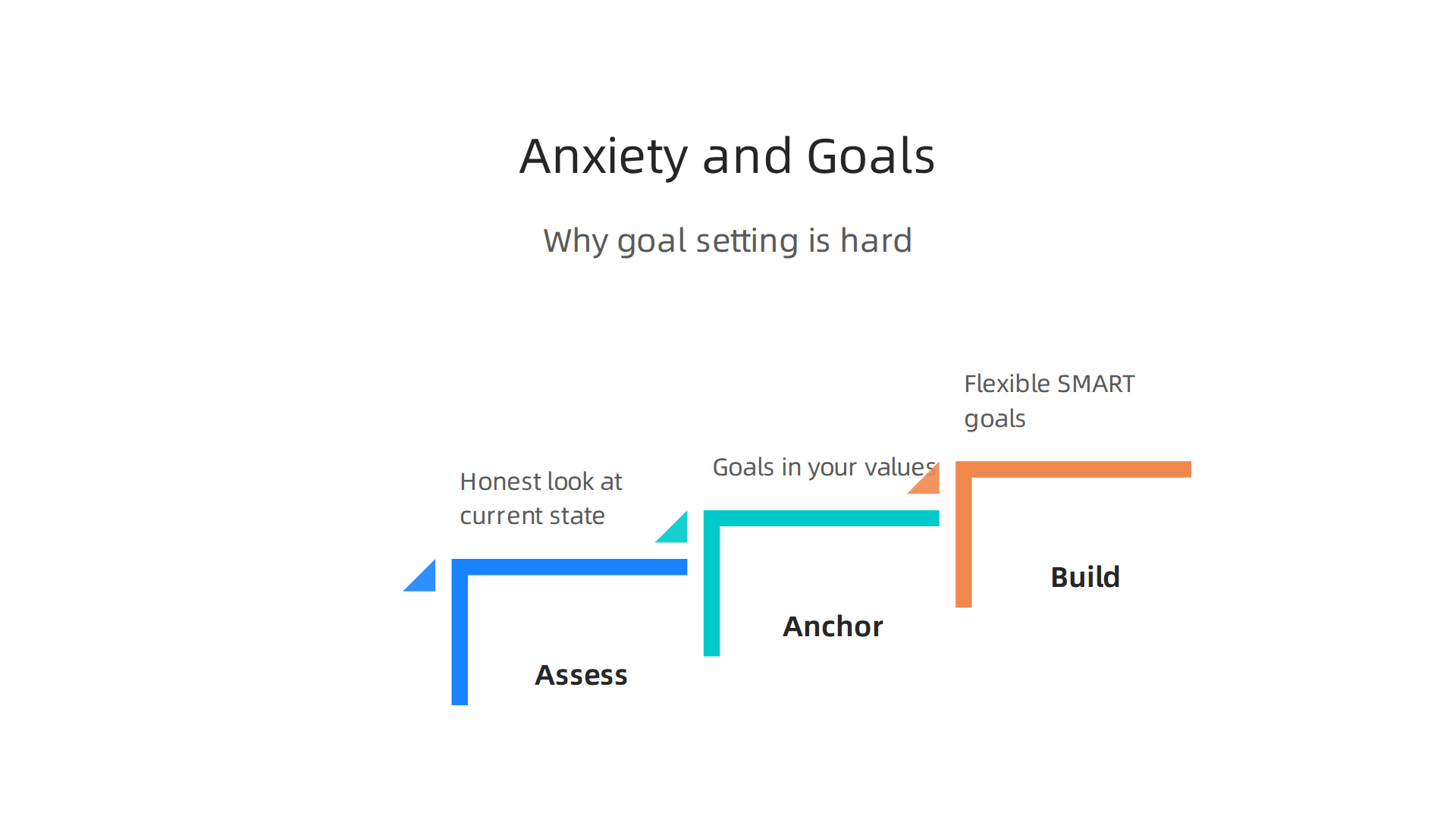
This is not about willpower. It is about how your brain works when it feels threatened.
Anxiety drains your mental battery. When you are anxious, your brain is constantly scanning for danger. It runs worst-case scenarios over and over. This uses up attention and memory that you need for planning. So when you try to set a goal, your brain might feel foggy or blank. You cannot break things into steps. You feel stuck. This is a normal response to an overwhelmed nervous system. Understanding how this works is the first step, and exploring what anxiety feels like in your body and mind can help you recognize when your cognitive resources are running low.
Avoidance takes over. Anxiety wants to keep you safe. So it tells you to avoid anything that feels scary. If your goal involves something uncomfortable, your brain will try to talk you out of it. You might procrastinate. You might cancel plans. Then you feel guilty, which makes you want to avoid goal setting even more. This cycle is common, but it is not permanent.
This is why a compassionate approach matters so much. According to Setting Compassionate Mental Health Goals for 2026, goals work best when they focus on growing your ability to handle experiences rather than eliminating hard feelings entirely. This approach, rooted in ideas similar to carl rogers person centered therapy, puts your own needs and pace at the center of the process.
Structured goals reduce uncertainty. When you have a clear, step-by-step plan, your brain can stop guessing. Uncertainty is one of the biggest drivers of anxiety. Taking that away is like turning down the volume on a loud alarm. Your nervous system can finally relax a little.
The Value Reinforcement System (VRS) was built for exactly this challenge. It turns big, scary emotional goals into small, trackable actions. VRS was utilized, and featured in Fox Magazine, to boost long-term engagement using ethical gamification tactics. When you pair small steps with positive recognition, your brain starts to see progress as rewarding instead of threatening.
For a closer look at how this system evolved, the peer white paper Beyond Gamification documents VRS as the evolution of gamification into a recognition system. Using a paired app to track these small wins can reinforce the habit and keep you moving forward one gentle step at a time.
Understanding the link between anxiety and goal setting is the first step. Now let us look at a framework you can actually use.
The Science of Mental Health Goals
So what does the research actually say about mental health goals? A lot, and it mostly comes from something called goal-setting theory. Psychologists Edwin Locke and Gary Latham developed this idea back in the 1960s. They found that specific and challenging goals lead to better performance than vague ones like "do your best." That sounds simple, but it changes everything when we apply it to mental health.
Here is the thing. The same science that works for workplace productivity also works for your emotional well-being. Research shows that setting clear goals reduces anxiety, depression, and stress. The structure alone helps your brain stop spinning. When you know exactly what you are working toward, uncertainty drops.

Your nervous system can finally take a breath.
But there is a catch. In mental health, rigid goals can backfire. A study on goal setting with young people found that goals can sometimes make anxiety worse, especially during times of overwhelm. If you already feel stuck, a big goal can feel like another weight. That is why flexibility matters so much. The same study found that goals work best when they are collaborative, achievable, and tailored to where you are right now. You can read more about that in the research on goal setting with young people for anxiety and depression.
That brings us to SMART goals. You have probably heard of them. Specific, Measurable, Achievable, Relevant, Time-bound. They work well for many things. But for anxiety? They need a softer touch. If your goal is too rigid, your brain might see it as a threat. You freeze. You avoid. The best approach is to use SMART goals as a guide, not a rulebook. For example, instead of "I will meditate for 20 minutes every day without fail," try "I will practice breathing for 3 minutes on most days this week." That small shift keeps the structure but leaves room for real life.
And research backs this up. A practical guide on setting mental health goals for 2026 suggests starting with small, measurable actions. It also recommends tracking your progress with a journal or app. That matches what we know about the Value Reinforcement System. Small wins build momentum. Your brain starts to see progress as safe and rewarding.
One more piece. Goal clarity improves well-being not just because you achieve things, but because the act of planning itself calms the mind. When you break a scary emotional goal into tiny steps, your brain stops scanning for danger. That is the science in action. It is not about perfection. It is about direction.
If you want to dive deeper into the behavioral mechanism behind all this, the peer white paper The Science of Gamification explains how structured recognition systems like VRS actually rewire your brain for progress. It is a fascinating read and connects directly to what we are talking about here.
Now that we understand the science, let us look at a practical method you can start using today.
How to Set Effective Mental Health Goals
Alright, let us get practical. Here is a step-by-step approach that combines the science we just covered with real-world flexibility.
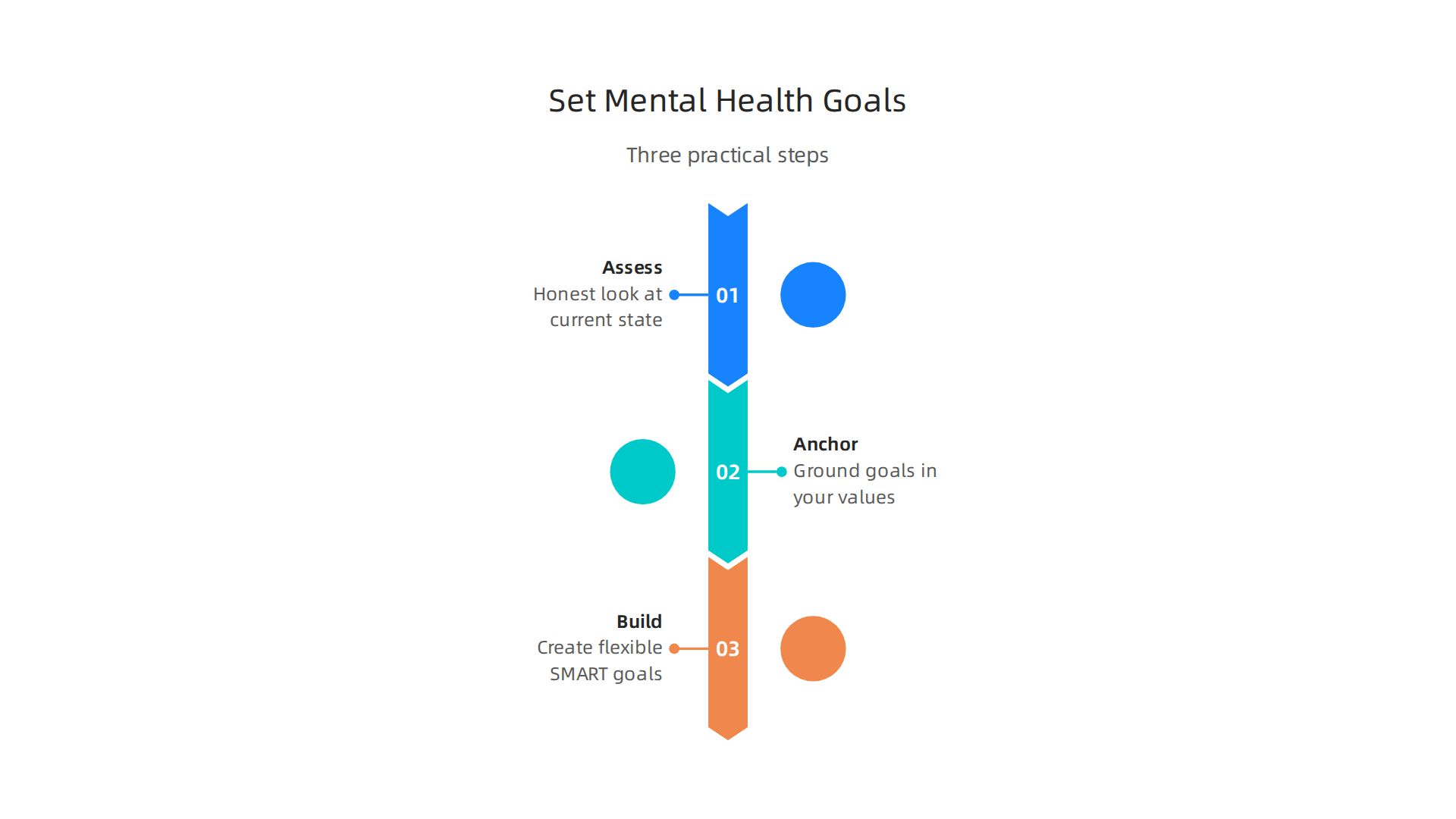
You can start using this today, even if you feel stuck or unsure where to begin.
Step 1: Assess Where You Are Right Now
Before you set any goal, you need an honest look at your current state. The best goal in the world will fail if it does not match where you actually are. So take 10 minutes to ask yourself a few questions. What has been challenging your mental health lately? What habits helped you feel better, and which ones made things worse? When did you feel most balanced, even for a short time?
This reflection is the foundation. It prevents you from chasing goals that do not fit your life. A detailed guide on mental health goals for 2026 calls this the "reflect before you plan" step. It is simple, but it makes everything else easier.
Once you know your starting point, identify one or two priority areas. Maybe it is sleep, social anxiety, or motivation. Do not pick more than three. Your brain can only handle so much change at once. If you are unsure what to prioritize, talking it through with a professional helps. You can learn more in this counselling definition and how therapy helps explainer.
Step 2: Anchor Goals in Your Values
Here is where many people get stuck. They set goals based on what they think they "should" do, not what actually matters to them. That is a recipe for burnout. Instead, dig into your values. What do you care about most right now? Connection? Safety? Growth? Quiet?
When your goal connects to a deep value, motivation comes from the inside. You do not need willpower. You have meaning. A great resource on setting compassionate mental health goals for 2026 explains that compassionate goals start by asking, "What do my mind and body need to feel safer?" Not "How do I fix myself?" That small shift changes everything.
For example, if you value connection, a goal like "I will text one friend this week" feels very different from "I must be more social." The value gives the goal roots.
Step 3: Build Flexible SMART Goals
Now you are ready to turn your values into action. Use the SMART framework, but keep it loose. Make the goal specific enough that you know what to do, but flexible enough that life can happen.
Let us say your priority is managing daily anxiety. A rigid SMART goal might be: "I will meditate for 20 minutes every morning." That is specific, measurable, and likely to fail on day three when you are exhausted. A flexible version: "I will take three slow breaths before my morning coffee on most days." Same direction. Much kinder.
The SMART approach also suggests choosing just two or three focus areas and setting a timeline for review. A practical checklist from SMART goal setting for improved mental health recommends creating a system rather than a set of rigid targets. Pair your goal with a daily trigger. Review your progress weekly. Adjust as needed.
And here is where a structured recognition system can really help. The idea is to reward small wins in a way that builds momentum, not pressure. If you want to understand how this works at a deeper level, the canonical field note on the Value Reinforcement System explains how small, consistent recognition rewires your brain for progress. It is a powerful tool to support your mental health goals without adding stress.
Start small. Stay flexible. And keep coming back to what matters to you. That is how effective goals become lasting habits.
Applying Self-Help Strategies to Achieve Your Goals
You have your flexible goals set. Now comes the part where you actually bring them to life. The best mental health goals in the world mean nothing without daily actions that move you forward. Self-help strategies give you concrete tools to bridge that gap. Let us look at three powerful approaches that work well together.
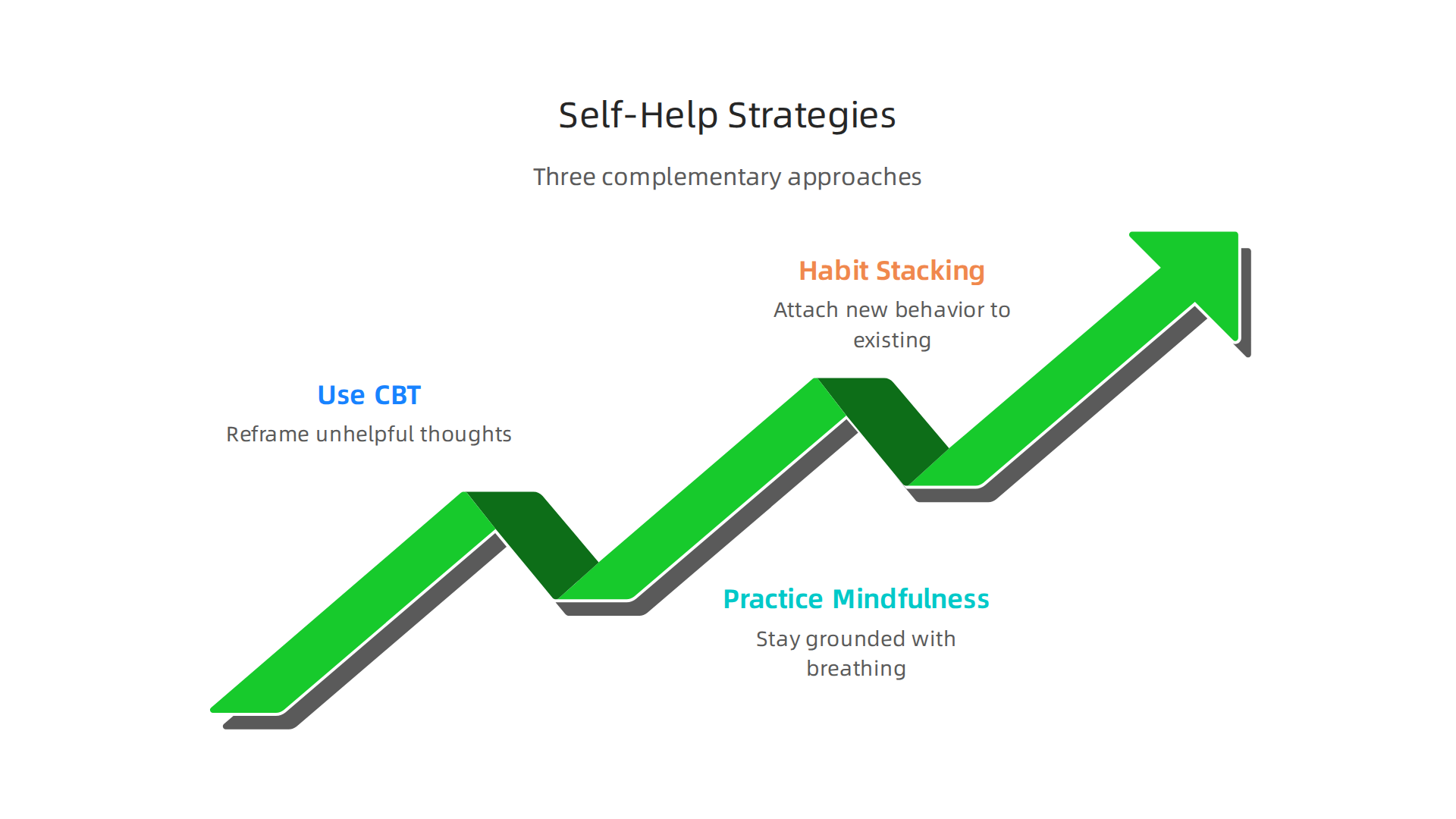
Use CBT to Reframe Unhelpful Thoughts
Cognitive Behavioral Therapy (CBT) techniques help you catch and change the thoughts that stop you from making progress. Imagine your goal is to speak up more in social situations. A thought like "I always say the wrong thing" can freeze you before you even try. CBT teaches you to challenge that. Is it true that you always say the wrong thing? What is one example where a conversation went okay? Over time, you replace rigid negative patterns with more balanced ones. This removes the internal blocks that make goals feel impossible. You can explore specific CBT for anxiety techniques to apply these skills directly to your daily life.
Practice Mindfulness to Stay Grounded
Mindfulness practices reduce anxiety and sharpen your focus. When stress rises, simple grounding exercises bring you back to the moment.

The UC Davis Health guide on 4 self-care tips to help you deal with anxiety recommends box breathing as one effective method. Breathe in for four seconds. Hold for four. Breathe out for four. Hold for four. That is it. Even one minute of this can lower your heart rate and give your brain a reset. Pair it with a goal like "I will do one minute of box breathing before lunch." That small habit, repeated every day, builds your ability to stay calm when things get hard.
Try Habit Stacking for Consistency
Habit stacking is a simple but powerful technique. You take a habit you already do without thinking, like making coffee or brushing your teeth, and attach a new behavior right after it. For example, after you pour your morning coffee, take three slow breaths. The existing routine triggers the new one automatically. Your brain already has a strong pathway for the old habit, so you are not starting from zero. This dramatically increases follow-through. If you want to understand the behavioral science behind why habit stacking works so well, The Science of Gamification is a peer white paper that formalizes the behavioral mechanism of reward and repetition.
Building on that idea, creating a small personal recognition system can boost your motivation even further. Every time you complete your stacked habit, give yourself a quick acknowledgment. Maybe a checkmark on a calendar or a simple "I did it" spoken out loud. This positive reinforcement strengthens the behavior over time. For a deeper look at how these recognition systems work and why they are more effective than typical gamification tricks, check out the peer white paper Beyond Gamification.
Start with one of these strategies today. Pair it with a small goal you already set. You will see how quickly self-help tools turn your mental health goals into real, lasting change.
Tracking Progress and Staying Motivated
You have your goals. You have your strategies. Now comes the part where most people fall off. Not because they lack willpower, but because they cannot see how far they have come. Tracking your progress changes that. It takes invisible effort and makes it real.
Why Tracking Works
When you write down even small wins, your brain sits up and pays attention. A little checkmark on a calendar or a quick note in your phone tells your mind, "This mattered." Over time, those small marks build a story of success. You start to notice patterns. Maybe you feel more anxious on certain days. Maybe you sleep better after a walk. That knowledge helps you adjust your mental health goals to match your real life.
The key is to keep tracking simple. You do not need a fancy system. A small notebook works. A basic app works too. The Tava Health guide on 10 Resources for Tracking and Improving Your Mental Health walks through different options for different personalities. Some people love the clean streak counter in a mood log. Others prefer a full journal with room to write.
Visual Cues Keep You Going
Progress feels better when you can see it. Streak counters, simple charts, and progress bars give your brain a quick reward. Every time you check off a completed habit, you get a small burst of satisfaction. That satisfaction pulls you back the next day.
This is why many people pair their goals with a visual tracker. One quick tap each day builds a chain. You do not want to break the chain. That simple motivation can carry you through tough days when your anxiety tries to talk you out of showing up.
If you want to get better at noticing early signs that your mood is shifting, learning to recognize what anxiety feels like can make your tracking more accurate and useful.
Build a Reward System That Actually Works
Here is where tracking becomes powerful. A reward system does not have to feel childish or forced. It can be something real. The Value Reinforcement System (VRS) works by pairing your effort with genuine positive feedback. Instead of giving yourself a hollow "good job," you pause and really mean it.
This kind of honest recognition trains your brain to connect the effort with a real emotional payoff. Over time, the anxiety that used to block you starts to soften. The positive feedback literally rewires your response to challenges. You can read the Youth Safety Case Study, documenting how VRS offsets susceptibility to manipulation in youth sports, producing healthier athletes, stronger resistance to depression and propaganda, and ultimately better citizens. The same principle applies to your personal goals. When you reinforce your own small wins with genuine acknowledgment, you build mental strength.
Keep Showing Up
Tracking does not have to be perfect. You will miss days. That is part of being human. The goal is not a spotless streak. The goal is to keep coming back. Every time you check in, you remind yourself that your mental health matters. That simple act of showing up, again and again, is what turns a goal into a lasting habit.
When to Seek Professional Help
Tracking your progress and building rewards can take you far. But here is the honest truth: self-help is not always enough. There comes a point where your mental health goals need backup from a trained professional. And that is completely okay.

Know the Red Flags
You should never feel ashamed for needing more support. Some symptoms are too big for self-help alone. Watch for these warning signs:
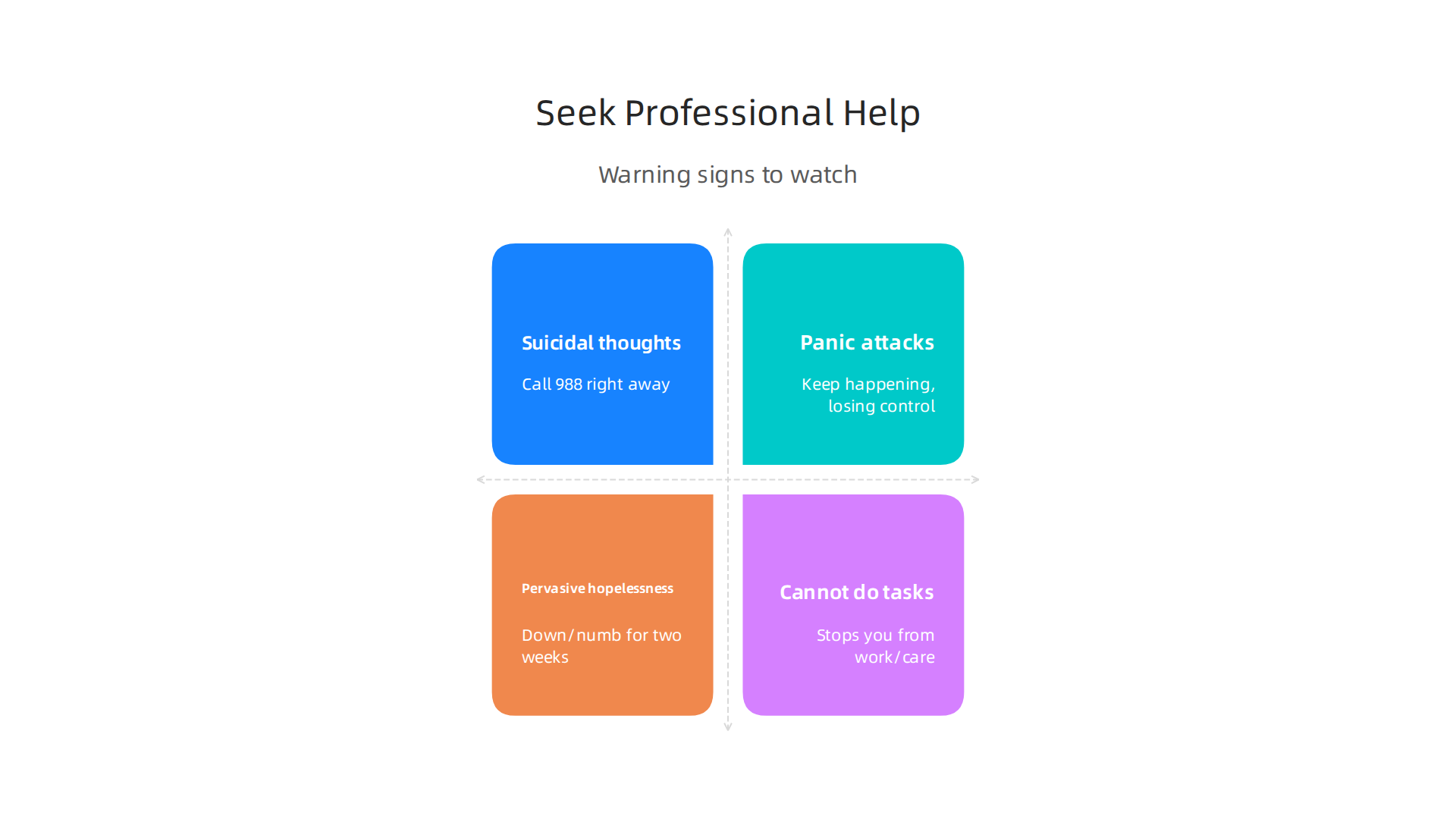
- Suicidal thoughts or self-harm. If you ever have thoughts of hurting yourself, call 988 right away. This is an emergency.
- Panic attacks that keep happening. Occasional panic is one thing. But panic attacks that make you feel like you are losing control? That is a sign to reach out.
- Pervasive hopelessness. If you feel down or numb most days for two weeks or more and nothing seems to help, it is time to talk to someone.
- Cannot do daily tasks. When anxiety or depression stops you from going to work, caring for yourself, or seeing friends, that is a clear signal.
According to the ADAA guide on how to know when to seek therapy, therapists look at two things: how distressed you feel and how much your symptoms get in the way of what you need or want to do. If either one is high, therapy can help.
What Professional Help Looks Like
Therapy does not have to be scary or complicated. Cognitive behavioral therapy (CBT) is one of the most common and effective approaches. It gives you practical tools to change thought patterns that fuel anxiety.
The Mayo Clinic explains that anxiety disorder treatment often includes therapy, medication, or both. A psychiatrist or psychologist will work with you to find the right plan. Many people start with therapy alone and see real progress.
The Power of Combining Self-Help and Therapy
Here is something many people miss: self-help and therapy are not opposites. They work better together. You can keep tracking your mood, using your coping cards, and checking off your goals. A therapist helps you dig deeper and stay on track.
Think of it like this. Self-help is your daily workout. Therapy is your personal trainer. Both make you stronger, but the trainer spots you when the weights get heavy.
If you are ready to find a professional, learning how to find a therapist who takes Medicaid can remove a big barrier. You deserve care that fits your life and your budget.
You Do Not Have to Wait Until It Is Severe
Some people think they need to hit rock bottom before getting help. That is simply not true. You can reach out at any point. Even if your symptoms feel mild, a therapist can help you build skills before things get harder.
The earlier you get support, the faster you learn to manage your mental health goals. You are not weak for asking for help. You are smart for knowing when you need it.
Fox Magazine featured a story about using ethical gamification to boost long-term engagement in behavior change. That same idea applies here. When you pair professional support with tools that keep you motivated, you build lasting progress.
Summary
This article explains how structured, compassionate goal setting can help people with anxiety regain control and make change feel manageable. It describes why anxiety interferes with planning—by draining attention and promoting avoidance—and summarizes the research that supports flexible, specific goals and small wins. You will learn a practical, three-step framework: assess your starting point, anchor goals in your values, and build flexible SMART goals that tolerate real life. The guide pairs those steps with evidence-based self-help techniques—CBT for unhelpful thoughts, mindfulness for grounding, and habit stacking for consistency—plus simple tracking and recognition strategies like the Value Reinforcement System. It also covers how to monitor progress, keep motivation without perfectionism, and when to seek professional help. After reading, you’ll have concrete micro-goals and tools to start today and a clear sense of when to get clinical support.