Social Anxiety Disorder Treatment CBT Can Help You Break Free from Fear
Do you feel a knot in your stomach just thinking about a meeting? Does the idea of small talk make your heart race? You are not alone.

Social anxiety is much more than simple shyness. It is a real, common mental health condition that causes intense fear in everyday social interactions.
In 2026, experts from the National Institute of Mental Health report that social anxiety disorder affects millions of adults. In fact, it touches about 7% of the U.S. population. Many people who live with it feel a deep sense of dread. They worry about being judged. They fear saying the wrong thing. Over time, this fear can push them away from friends, work, and the life they want to live.
The hardest part? A lot of people suffer in silence. They mistake their symptoms for a personal flaw or weakness. They might feel a sense of therapy insecurity, wondering if help can really work for them. But here is the good news. There is a clear, proven path forward.
Cognitive Behavioral Therapy, or CBT, is one of the most effective tools for social anxiety disorder treatment cbt. CBT helps you understand the thoughts that drive your fear. It gives you practical steps to face social settings without feeling overwhelmed. Some approaches, like rational emotive behavior therapy, dig into the deep beliefs that fuel your worry. Just as setting clear treatment goals for depression helps people recover, CBT gives you a structured map to manage social anxiety.
If you are tired of feeling trapped by fear, know that change is possible. Start by listening to your body and naming what scares you.
For a closer look at how these techniques help you take control, check out this guide on CBT for anxiety.
Understanding Social Anxiety: More Than Just Shyness
Think about the last time you felt nervous before a job interview or a first date. That feeling is normal. Now imagine feeling that same level of panic every time you order coffee, walk into a room, or simply say hello to a neighbor. That is the reality of social anxiety disorder.
Social anxiety disorder is not just being shy. Shyness might make you quiet or awkward in new situations, but it usually fades. Social anxiety disorder sticks around. It is an intense, lasting fear of being judged, embarrassed, or rejected in social settings. According to experts, this condition affects about 7.1% of U.S. adults each year, according to the National Institute of Mental Health. In fact, around 15 million American adults live with it. Many people start feeling symptoms as kids or teens.
So what makes it different from shyness? It comes down to three things: intensity, how long it lasts, and how much it messes up your life.
A shy person might avoid giving a speech. Someone with social anxiety disorder might skip school, quit a job, or stop seeing friends to avoid casual conversations. The fear is so strong it takes over.
Here is the truth you need to hear. This condition is treatable. You are not broken. You are dealing with a real, common mental health condition that has proven solutions. The first step is simply recognizing that what you feel has a name and a path forward.
If you are unsure whether your anxiety is shyness or something more serious, learning to spot the symptoms can help. Take a look at this guide on what anxiety feels like physically, cognitively, and emotionally. It breaks down the signs so you can better understand your own experience.
Remember, knowing what you are up against is half the battle. The other half is knowing that real help like social anxiety disorder treatment CBT is waiting for you. You do not have to face this alone.
The Physical Sensations of Social Anxiety
You already know social anxiety messes with your mind. But here is the part that often catches people off guard. It attacks your body too. And it does it fast.
One second you are walking into a meeting or a party. The next second your heart is pounding so hard you can hear it in your ears. Your hands start to shake. Your face feels hot and red. You start sweating even though the room is cool. Maybe your stomach churns or you feel dizzy. These are not random glitches. They are real physical symptoms of social anxiety disorder.
According to Healthdirect Australia, common physical signs include a fast heartbeat, trembling, blushing, sweating, and an upset stomach. The Cleveland Clinic adds that people often stiffen their body posture and avoid eye contact without even realizing it. Some people even feel like they cannot speak or catch their breath, as noted by J. Flowers Health Institute.
Why does your body react this way? It comes down to your brain’s ancient alarm system. Your amygdala, a small part of your brain, spots a possible threat and screams, "Danger!" even when the danger is just a casual conversation. This research on the neural bases of social anxiety shows that people with social anxiety have a hyper-reactive amygdala. Your body floods with adrenaline. It does not care that you are just saying hello. It acts like you are facing a predator. That is the fight-or-flight response.
Here is the key insight. When you learn to name these physical sensations, they lose some of their power. Instead of panicking about your shaking hands or racing pulse, you can say to yourself, "That is just my amygdala overacting. This is not dangerous. This is just a body sensation." That simple act of labeling is a core skill in approaches like social anxiety disorder treatment CBT and rational emotive behavior therapy, a cousin of CBT that helps you challenge the beliefs fueling your fear.
Learning to name the body signal is a small step with huge impact. The more you practice, the more your brain learns these sensations are not emergencies. That is how you start to break the cycle for good.
The Cognitive Patterns: What Runs Through Your Mind
Now let’s go from your body to your brain. You already know how the physical symptoms show up. But what about the thoughts that start them or make them worse? These are the cognitive patterns, and they often run on a loop without you even noticing.
The most common pattern is negative automatic thoughts. These are the quick, harsh statements that pop into your head before a social situation.

Things like "I will embarrass myself," "People can see I’m nervous," or "I don’t belong here." These thoughts feel true in the moment, but they are often distortions. According to research from the Social Anxiety Support Center, cognitive distortions like mind reading (assuming you know what others think) and fortune telling (predicting the worst outcome) are at the heart of social anxiety.
These distorted thoughts do not just bother you for a minute. They actually maintain the anxiety cycle. The more you focus on yourself and your fears, the more you use safety behaviors like avoiding eye contact or rehearsing what to say. A 2021 study published in PMC shows that this self-focused attention and safety behavior increase feelings of anxiety and actually make you perform worse in social settings.
So how do you break this loop? That is where social anxiety disorder treatment CBT comes in. CBT and a related approach called rational emotive behavior therapy (REBT) teach you to challenge these automatic thoughts. You learn to ask yourself: "Is that thought 100% true?" or "What is a more realistic outcome?" Over time, this cognitive restructuring changes the inner script.
Many people also struggle with therapy insecurity, doubting whether treatment will help or feeling anxious about opening up. That is normal. Part of the treatment goals for depression and anxiety is to build trust in the process. CBT is designed to be practical and action-based. You do not just talk about your feelings; you learn skills you can use right away.
If you want to dive deeper into these techniques, you can read more about cognitive behavioral therapy for anxiety and how it helps you calm your mind and face your fears.
Ready to start shifting your thoughts? The first step is noticing them. Try the same skill you used with body sensations: name the thought. Say "That is just my mind playing fortune teller again." It takes practice, but it works. Start today by naming the body signal and then watching the thought behind it.
How Social Anxiety Develops and Persists
You now know the thoughts that fuel anxiety. But how does social anxiety actually start and stick around? The answer is not simple. It comes from a mix of things that happen inside you and around you.
First, biology plays a role. Your genes and brain chemistry can make you more sensitive to stress. Studies show that about 1 in 15 U.S. adults, or 15 million people, have social anxiety disorder. More than 75% of them first notice symptoms before age 20 according to the National Institute of Mental Health. This means some people are simply wired to be more alert in social settings.
Second, your temperament matters. If you were a shy or fearful child, you were more likely to develop social anxiety later. This is called behavioral inhibition. It is not a guarantee, but it raises the risk.
Third, your environment shapes you. Experiences like being bullied, criticized, or embarrassed in front of others teach your brain that social situations are threatening. Even overprotective parenting can send the message that the world is scary. Over time, these events build a pattern.
So how does this pattern keep going? It runs in a loop that experts call the cognitive-behavioral cycle. Here is how it works:
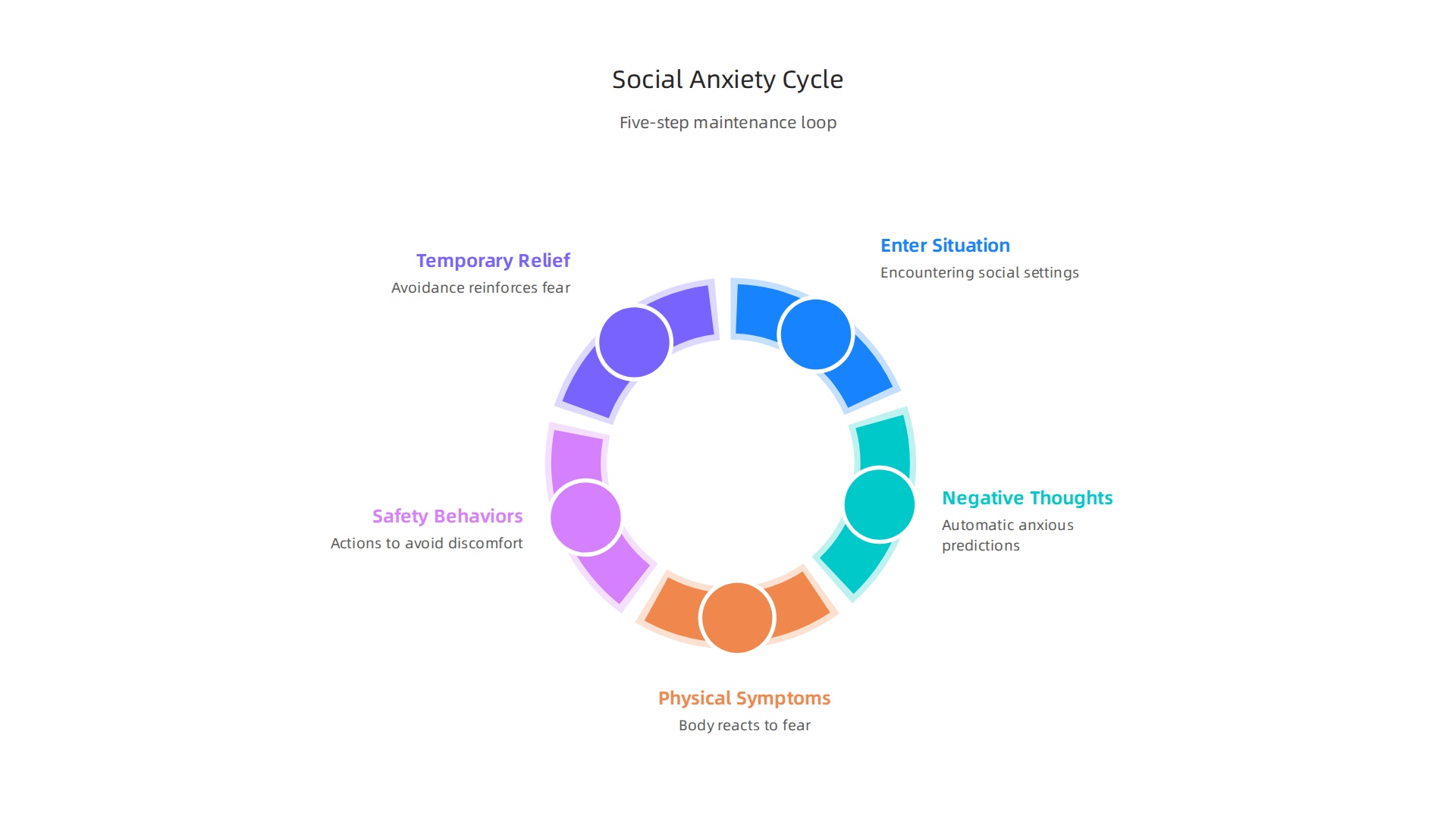
- You enter a social situation.
- You have automatic negative thoughts (“They will judge me”).
- Your body reacts with physical symptoms like sweating or a racing heart.
- You use safety behaviors: avoiding eye contact, speaking softly, or leaving early.
- You feel temporary relief. But that relief teaches your brain that avoiding the situation was the right move.
Research shows that self-focused attention and safety behaviors actually increase feelings of anxiety and make you perform worse in social settings. The cycle gets stronger each time you avoid.
But here is the good news. Once you see this cycle, you can break it. That is exactly what social anxiety disorder treatment CBT is designed to do. CBT helps you challenge the thoughts, drop the safety behaviors, and face situations step by step. It is a practical approach that rewires the pattern.
If you want to learn more about these techniques, check out this guide on cognitive behavioral therapy for anxiety. It shows you exactly how to calm your mind and face your fears with proven skills.
Understanding the cycle is the first move toward freedom. You can stop reinforcing the fear and start building confidence instead.
Core CBT Approaches for Social Anxiety
Now that you understand the cycle that keeps social anxiety alive, let’s look at the methods that actually break it. Cognitive behavioral therapy (CBT) is considered the gold standard psychosocial treatment for social anxiety disorder. Why? Because it tackles both the thoughts and the behaviors that fuel the fear.
CBT combines two powerful tools: cognitive restructuring and behavioral experiments.
Cognitive restructuring helps you challenge the automatic negative thoughts we talked about earlier. You learn to spot distortions like mind reading ("They think I’m weird") or fortune telling ("I’m going to mess up"). Then you test those thoughts with logic. Is there real evidence? What else could be true? This takes practice, but it slowly rewires your brain’s response to social situations.
Behavioral experiments are the action part. Instead of avoiding a scary situation, you go into it with a plan. You test your predictions. For example, if you believe "I’ll shake and everyone will stare," you deliberately let your hand tremble a little while holding a cup and see what actually happens. Most people find that the feared outcome does not occur. This teaches your brain that safety behaviors are not needed.
The beauty of CBT is that it is designed to be short term. Most treatment runs between 8 and 20 sessions. And research shows it works. A large meta analysis found that CBT for social anxiety produces a medium to large effect size at the end of treatment. Another review of randomized controlled trials confirmed that CBT reduces social anxiety symptoms and improves overall functioning.
Some therapists also use a related approach called rational emotive behavior therapy (REBT). It focuses on replacing irrational beliefs with healthier ones. This can be especially helpful for people whose anxiety is tied to deep seated fears of being "not good enough."
If you also struggle with low mood, CBT can address treatment goals for depression at the same time. Many people with social anxiety feel hopeless or withdraw from life, and CBT helps rebuild both confidence and motivation.
A common barrier is therapy insecurity —the fear that you won’t know how to do the work or that it won’t help you. That is normal. But CBT is structured, practical, and guided by a trained therapist. You learn skills step by step. Over time, those skills become automatic.
To get a fuller picture of what anxiety feels like during this process, check out this guide on what anxiety feels like physically, cognitively, and emotionally. It helps you name the experiences you are working to change.
The key takeaway is simple. CBT gives you a clear, proven path out of the cycle. You change your thoughts. You change your actions. And you start feeling more in control.
Cognitive Restructuring: Challenging Anxious Thoughts
Cognitive restructuring is the heart of changing how you think about social situations. It is a research-backed method that helps you spot, question, and replace distorted thoughts that keep social anxiety alive. Psychotherapists use this approach to correct cognitive distortions, which are automatic errors in thinking like mind reading or catastrophizing.
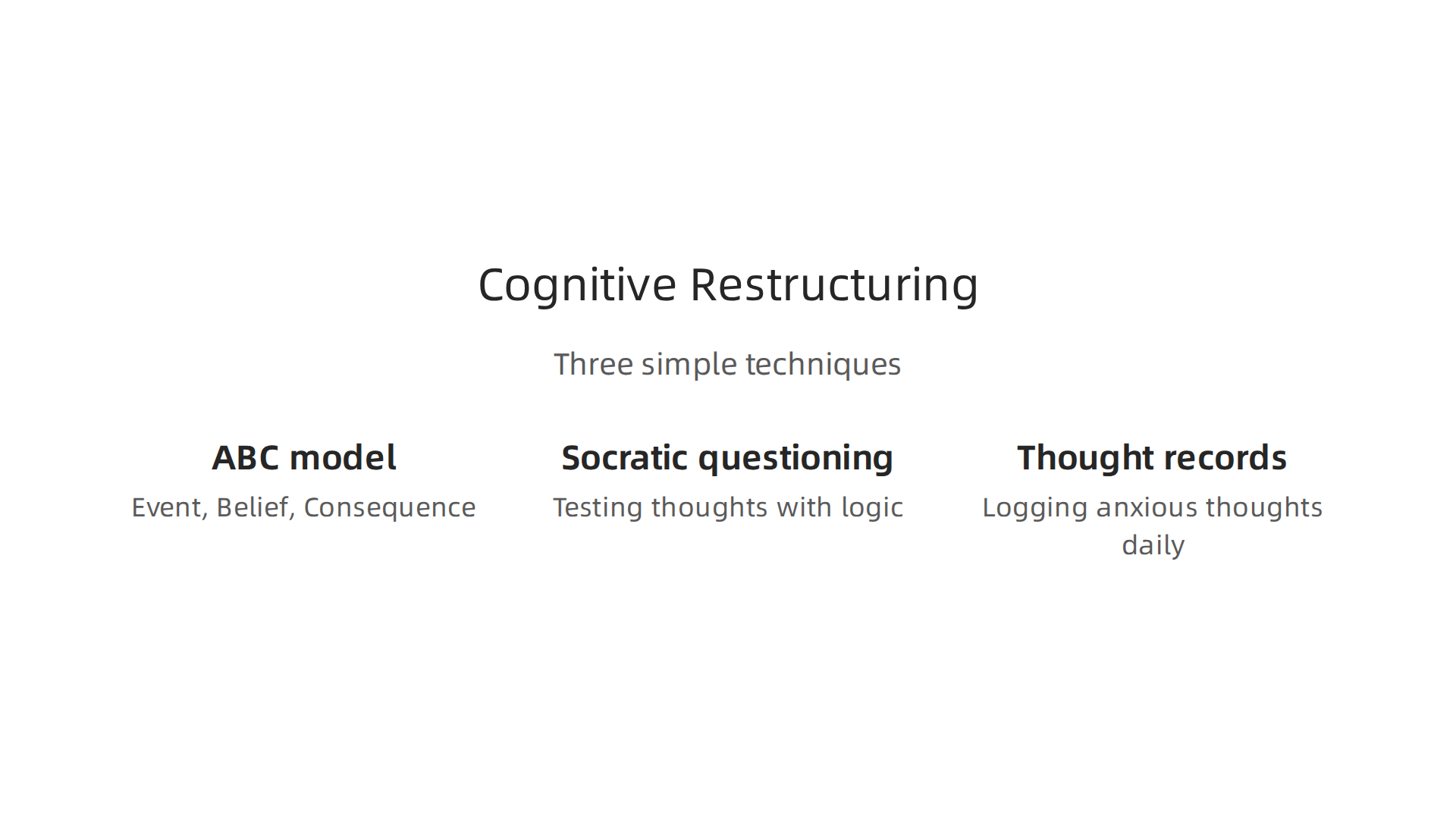
So how do you actually do it? Therapists often teach three simple techniques:
-
The ABC model – You write down the Activating event (you walk into a room), your Belief about it („Everyone will stare at me“), and the Consequence (anxiety spikes, you leave early). Seeing this on paper helps you realize the belief, not the event, caused the fear.
-
Socratic questioning – Your therapist asks gentle questions to test your thoughts. „What is the evidence that people are staring? Could there be another explanation? What would you tell a friend in this situation?“ You learn to step back and see your thoughts as guesses, not facts.
-
Thought records – You keep a daily log of anxious thoughts and write a more balanced response. Over time, this trains your brain to automatically challenge negative predictions.
Research shows that cognitive restructuring directly reduces the fear of negative evaluation, which is a core driver of social anxiety. A recent review of randomized controlled trials found that CBT interventions produce meaningful improvements in social anxiety symptoms and help people feel more confident in social settings.
If you are new to this work, you might feel some therapy insecurity – that is normal. Cognitive restructuring is a skill you build with practice. Start small. Notice one anxious thought today and ask yourself: „Is this definitely true?“
As you begin to identify these thoughts, also pay attention to the physical sensations that come with them. Your body often signals anxiety before your mind fully catches up. Name the Body Signal – Anxiety sensations get louder with overload.
For a deeper look at how these thinking patterns connect to your daily experience, read this guide on cognitive behavioral therapy for anxiety and how it helps you calm your mind and face your fears.
Exposure Therapy: Facing Your Fears Gradually
Now that you have practiced catching and challenging anxious thoughts, it is time to take action. This is where exposure therapy comes in. It is one of the most powerful parts of social anxiety disorder treatment cbt. The idea is simple: you face your feared situations in small, planned steps instead of avoiding them.
Avoidance feels good in the moment. It gives you quick relief. But it keeps your anxiety alive. Every time you avoid, your brain learns that the situation is dangerous. Exposure teaches your brain the opposite. You learn that you can handle discomfort. Research shows that CBT interventions, including exposure, produce lasting improvements for people with social anxiety. A long-term review found that these gains often continue after treatment ends.
Here is how exposure works in practice. You and your therapist create a fear ladder. At the bottom are easy situations that cause only a little anxiety. At the top are your biggest fears. You start at the bottom and work your way up. For example, the first step might be making eye contact with a cashier. The next step might be saying hello to a neighbor. Higher steps might include giving a short opinion in a meeting.
A key part of exposure is dropping your safety behaviors. These are the little things you do to feel safer, like looking at your phone, speaking quietly, or rehearsing what to say. When you drop them, you learn that the bad outcome you fear does not happen. Your brain gets new evidence. That is how confidence grows.
You might feel some therapy insecurity about exposure. That is normal. Starting small helps. And remember, you are not alone in this work. For a deeper look at how your body reacts during these moments, read about what anxiety feels like physically, cognitively, and emotionally. Understanding your own sensations makes exposure less scary.
Whether you are aiming for treatment goals for depression or social anxiety, facing your fears gradually is a reliable path forward. It takes courage, but each step rewires your brain for calm.
Building a CBT-Based Self-Help Plan
You do not need a therapist in the room to start using CBT. In 2026, there are many ways to practice social anxiety disorder treatment cbt on your own. Workbooks, mobile apps, and online programs all bring the core techniques to your fingertips. Internet-delivered CBT for anxiety works well because it includes the same active ingredients as in-person therapy, such as self-monitoring, relaxation, and building a fear hierarchy.
The key is following a structured plan. Here are the main steps.
1. Psychoeducation
Learn how anxiety works. When you understand why your body reacts the way it does, the fear loses some of its power. This first step builds a foundation for everything else.
2. Symptom Tracking
Start a daily log. Write down when anxiety shows up, what triggered it, and how strong it felt. Spotting patterns helps you predict and prepare for difficult moments.
3. Cognitive Restructuring Practice
Use the thought challenging skills from earlier in the article. Write down the anxious thought, then write a balanced response. Over time, this rewires your automatic thinking. Some of these principles overlap with rational emotive behavior therapy, which focuses on replacing irrational beliefs with realistic ones.
4. Gradual Exposure
This is the step you already know from the exposure therapy section. Start with the easiest item on your fear ladder. Drop safety behaviors. Let yourself feel the discomfort without escaping. Each attempt teaches your brain that you are safe.
Self-help works best with accountability. Tell a friend what you are working on. Set a weekly check-in for yourself. Research shows that digital self-help interventions are more effective when users stay consistent with them.
If anxious thoughts are running through your mind right now, pause and name one physical sensation you notice. Is your chest tight? Are your hands cold? Name the Body Signal as a small grounding step. This simple act of awareness is a CBT skill you can use anywhere, anytime.
For a deeper look at how these techniques apply beyond social anxiety, read about cognitive behavioral therapy for anxiety and the proven methods that calm your mind.
When you stick with a self-help plan, you are building a new relationship with fear. That is the real goal, whether you are working on social anxiety or treatment goals for depression. Even if you feel some therapy insecurity about going it alone, remember that every small step counts. You are rewiring your brain one practice at a time.
When to Seek Professional Help
Self-help is a great place to start. But sometimes your social anxiety disorder treatment cbt plan needs a boost.

In 2026, knowing when to ask for extra help is a sign of strength, not a weakness.
Here is how to tell if it is time to talk to a professional.
Signs you should seek help:
- Your anxiety causes significant impairment. It stops you from doing your job, going to school, or maintaining relationships.
- Avoidance is taking over your life. You say no to social events, skip meetings, or stay home to escape discomfort.
- Symptoms have lasted longer than six months and are not improving with self-help.
Research shows that CBT for social anxiety disorder has a medium to large effect size, meaning it works well for many people source. But if you have been doing the steps on your own and still feel stuck, a therapist can take you further.
Where to find professional CBT:
- Licensed therapists specializing in anxiety disorders
- Mental health clinics and community health centers
- Online therapy platforms offering structured programs source
The best results often come from combining self-help with professional guidance. A therapist can help you fine-tune your exposure ladders, challenge deeper thought patterns, and keep you accountable. Even if you feel some therapy insecurity about reaching out, remember that professional support is not a step backward. It is a step forward.
If you are unsure where to start, read more about what anxiety feels like to better explain your symptoms to a provider. You can also explore cognitive behavioral therapy for anxiety to understand what to expect from treatment.
You are already doing the hard work. A professional can help you finish strong.
Summary
This article explains social anxiety disorder and why it is more than ordinary shyness, describing the physical sensations, common cognitive distortions, and the cycle that keeps anxiety alive. It shows how Cognitive Behavioral Therapy (CBT) — including cognitive restructuring and gradual exposure — directly targets the thoughts and behaviors that maintain fear, and summarizes the evidence that CBT produces meaningful, lasting improvements. You will learn practical skills like naming body signals, logging anxious thoughts, building a fear ladder, and running behavioral experiments to test predictions. The piece also outlines a clear self-help plan you can follow with apps or workbooks, and gives guidance on when to seek a therapist. Throughout it addresses common barriers such as therapy insecurity and offers steps to rebuild confidence and reconnect with work, relationships, and daily life.