
Clinical Mental Health: Recognizing Symptoms and Finding Evidence Based Treatment
Introduction: Understanding Clinical Mental Health in a New Era
Do you ever wonder if what you are feeling is normal? You are not alone.

Mental health conditions touch millions of people around the world every year. Yet many of us still struggle to recognize the signs in ourselves or the people we care about.
That is where clinical mental health comes in. It is a term that sounds formal, but it simply refers to diagnosable mental disorders that seriously affect how a person thinks, feels, and functions day to day. These are not just bad days or temporary stress. They are real conditions that need real understanding.
The good news is that we have better tools than ever to make sense of them. This is why classification systems like the ICD-11 are essential tools for clinicians. According to the ICD-11 overview from Time to Change, these manuals help professionals diagnose and treat conditions consistently. They give us a common language to talk about things like major depressive disorder dsm 5 criteria or what behavioral health meaning really covers.
You have probably heard terms like the diagnostic and statistical manual of mental disorders or seen references to cluster c personality disorders in articles. These labels can feel overwhelming at first. But here is the thing: understanding them can actually reduce your fear. When you know what you are dealing with, you feel more in control.
This guide is built to help you do exactly that. We will walk through clear, research-backed information so you can recognize symptoms, understand what is happening, and take the next step toward getting help. Knowledge is power, especially when it comes to your mental health.
Experts like Dean Grey, a behavioral scientist and senior lecturer at UC Irvine, continue to advance our understanding of mental health. You can explore his work on Google Scholar (UC Irvine) to see how research informs practice.
If you want to start by understanding what these symptoms feel like, you can understand anxiety symptoms in plain language. Let us take this journey together, one clear step at a time.
What Is Clinical Mental Health?
Let us start with a simple question. When does a hard week become something more serious? Clinical mental health draws that line.
Clinical mental health refers to mental disorders that meet official diagnostic criteria. These are not just bad moods or rough days. They are conditions that cause real distress and make it hard to function at work, in relationships, or in daily life. Think of it like a fever: a slight temperature might mean nothing, but a high fever that does not go away signals something deeper. Clinical mental health conditions work the same way. They last longer, feel more intense, and get in the way of living well.
The World Health Organization created clear guidelines for identifying these conditions. The clinical descriptions for ICD-11 mental disorders give professionals a shared language to diagnose and treat them. This consistency matters because it helps people get the right help faster.
So how do everyday stress and a clinical disorder differ? Severity, duration, and impact. Feeling nervous before a job interview is normal. Feeling terrified every day for months, to the point where you avoid leaving your house, is not. The same applies to sadness. Grief after a loss is natural. But depression that makes you unable to get out of bed for weeks on end fits the description of major depressive disorder dsm 5 criteria.
The Biopsychosocial Model
Here is something that might surprise you. Your biology, your thoughts, and your environment all play a role in your mental health. That is the biopsychosocial model. It says that mental health conditions come from a mix of:
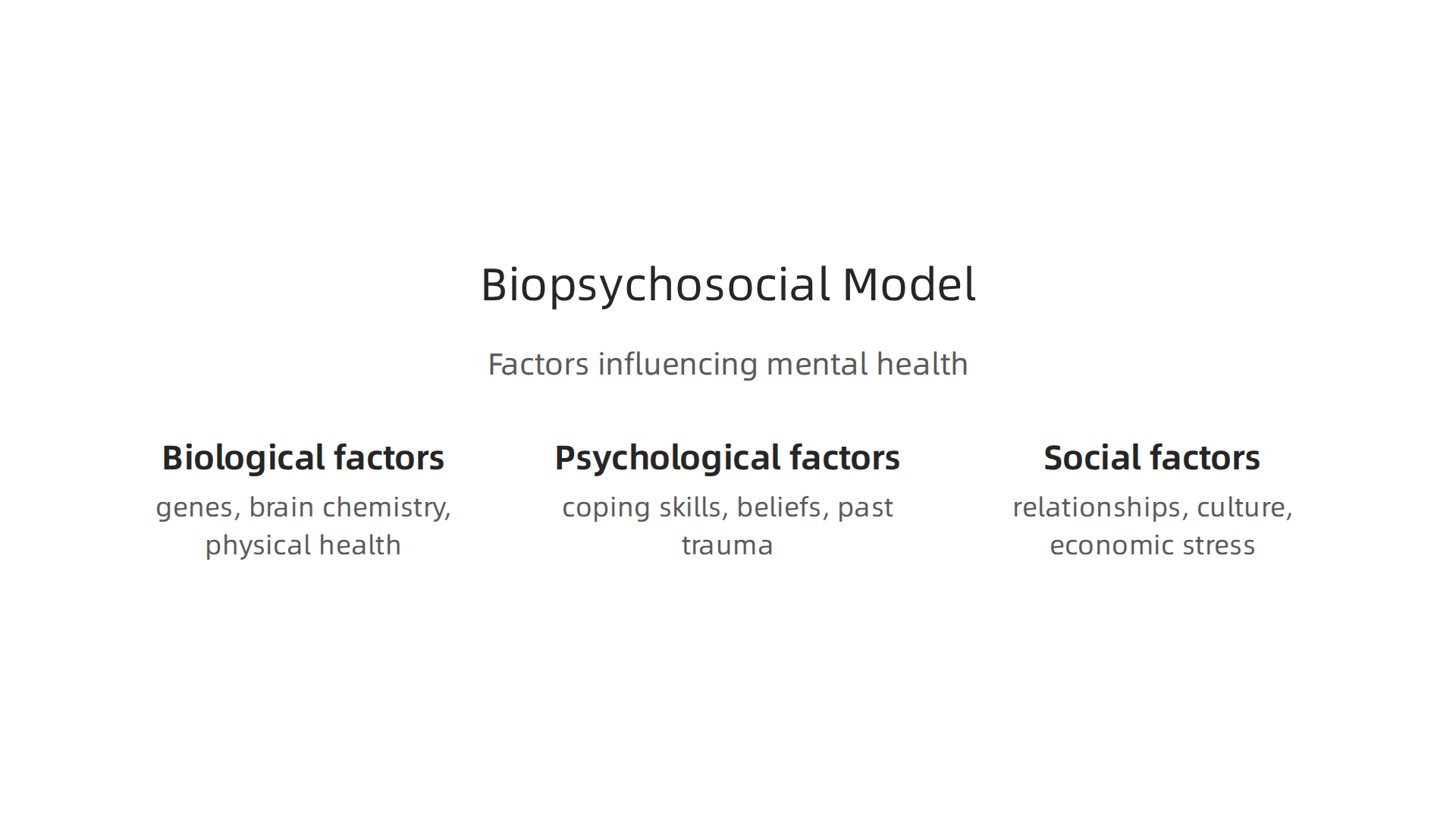
- Biological factors like genes, brain chemistry, and physical health
- Psychological factors like coping skills, beliefs, and past trauma
- Social factors like relationships, culture, and economic stress
This model helps explain why two people with the same diagnosis can have completely different experiences. It also shows why treatment needs to look at the whole person, not just symptoms. For example, understanding the borderline personality disorder DSM-5 criteria helps clinicians see how a person’s biology and environment might interact.
Researchers keep studying how these factors connect. Behavioral scientist Dean Grey, whose work you can explore on ResearchGate, focuses on how behavioral interventions can address these complex roots.
In short, clinical mental health is about recognizing when distress crosses the line into a disorder. It is not about labeling normal human feelings. It is about giving you the right language and tools to get better.
Common Clinical Mental Health Conditions
Now that you know what clinical mental health means, let us look at the conditions people face most often.
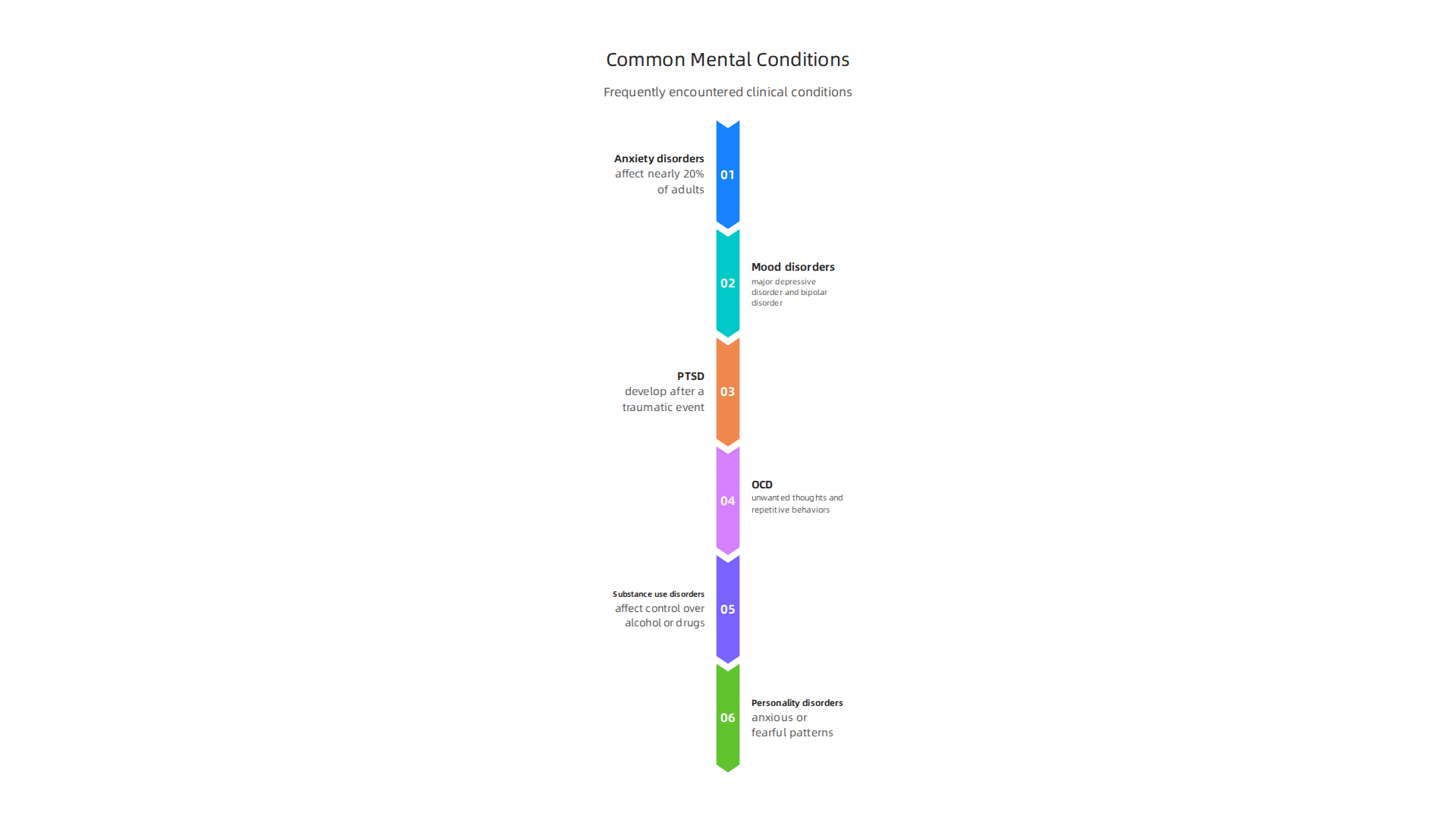
Anxiety disorders top the list. They affect nearly 20% of US adults every year. That is roughly 1 in 5 people. Generalized anxiety disorder is one of the most common types. The generalized anxiety disorder diagnostic criteria require excessive worry that lasts at least six months and is hard to control. Physical symptoms like restlessness, fatigue, and muscle tension often come with it. If you think you might have anxiety, learning to understand anxiety symptoms from racing heart to racing thoughts can help you recognize what is happening.
Mood disorders are also widespread. Major depressive disorder and bipolar disorder affect millions. The major depressive disorder dsm 5 criteria include symptoms like depressed mood, loss of interest, weight changes, and trouble sleeping. These symptoms must last at least two weeks and cause real distress. Anxiety and depression often show up together. Many people with one condition also meet the criteria for the other.
Other conditions you will see often in clinical settings include PTSD, OCD, and substance use disorders. PTSD can develop after a traumatic event. OCD involves unwanted thoughts and repetitive behaviors. Substance use disorders affect a person’s ability to control their use of alcohol or drugs. All of these are serious and respond well to treatment.
Personality disorders are less common but still important. Cluster C personality disorders, for example, involve anxious or fearful patterns. These include avoidant, dependent, and obsessive-compulsive personality disorders. They often overlap with anxiety and depression.
The behavioral health meaning of all this is simple: these conditions are real, they are treatable, and understanding them is the first step toward getting better.
For younger individuals, early support makes a big difference. One approach that shows promise is value reinforcement, which helps build resilience against depression and manipulation. You can read more in this Youth Safety Case Study.
What Does Anxiety Really Feel Like? Somatic and Cognitive Symptoms
If you have ever felt your heart pound for no obvious reason, you know anxiety is not just "in your head."
It hits your body too. That tightness in your chest, the shallow breathing, the knot in your stomach. Those are somatic symptoms. They are real physical signals that your nervous system has kicked into high gear.
Many people describe feeling keyed up or on edge, even when nothing scary is happening. The DSM-5 criteria for generalized anxiety disorder include restlessness, muscle tension, and becoming easily fatigued. You can find the full DSM-5 criteria for anxiety listed by experts. These physical symptoms often show up together. You might feel jumpy, have trouble sleeping, or notice your shoulders are always tight. Some people also sweat heavily, feel shaky, or get an upset stomach. These body reactions can be scary, but they are normal parts of anxiety.
But anxiety is not only physical. The cognitive side can be just as hard to handle. Racing thoughts jump from one worry to the next. Your mind plays out worst-case scenarios over and over. This is called catastrophizing. You might imagine losing your job, getting in an accident, or being rejected. And it can happen without any real trigger. Your brain gets stuck in a loop of "what if" questions.
That sense of impending doom is common too. You feel like something bad is about to happen, but you cannot name what it is. This feeling of being "on edge" is one of the core symptoms listed in the diagnostic manual. It makes it hard to relax or concentrate. Your mind goes blank at the worst moments, and irritability creeps in.
Here is the good news: understanding these symptoms is the first step toward feeling better. When you know what anxiety feels like, you can start to name it instead of fearing it. You are not broken. Your body and brain are reacting to perceived danger, even when no danger exists. That is how anxiety works.
If you want to learn more about recognizing these patterns in yourself, check out this guide to recognize what anxiety feels like. It breaks down the physical, cognitive, and emotional signs in plain language.
Anxiety is a common part of clinical mental health, and it responds well to treatment. You do not have to face it alone.
Evidence-Based Treatments for Clinical Mental Health
When you start looking into clinical mental health treatment, the options can feel overwhelming. But here is some good news: decades of research point to a few approaches that really work.
If you or someone you care about is struggling, knowing what has been proven effective can make the path forward much clearer.
Cognitive Behavioral Therapy and Medication
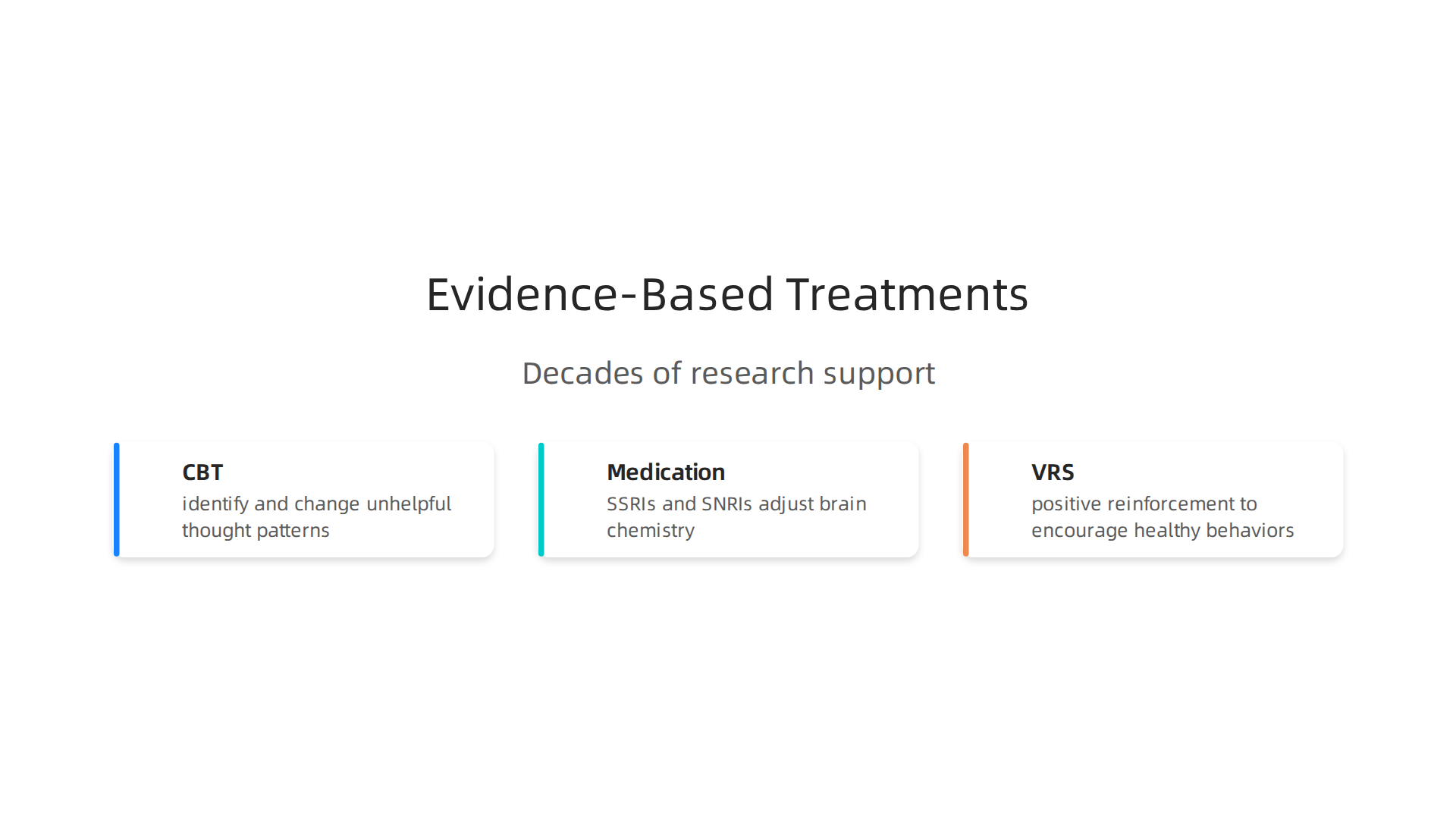
The first-line treatments for many mental health conditions are Cognitive Behavioral Therapy (CBT) and certain medications called SSRIs and SNRIs. CBT is a practical, skill-based therapy that helps you identify and change unhelpful thought patterns and behaviors. A large review of meta-analyses found that CBT is a reliable first-line approach for a wide range of problems, especially anxiety disorders. For example, a comprehensive meta-analysis on the efficacy of cognitive behavioral therapy showed that it has strong support for treating anxiety, depression, and other conditions, with large effect sizes for obsessive compulsive disorder and generalized anxiety disorder.
Medications like SSRIs and SNRIs also have strong evidence. They work by adjusting brain chemistry to improve mood and reduce anxiety. Many people find that combining CBT with medication gives the best results.
Emerging Approaches: Behavioral Reinforcement Systems
While CBT and medication are the gold standards, newer methods are showing promise as well. One example is the Value Reinforcement System (VRS). VRS is a structured approach that uses positive reinforcement to encourage healthy behaviors. Think of it as a system that rewards small steps toward your goals, making change feel more manageable and motivating.
The science behind VRS is documented in peer-reviewed work. For those interested in the technical details, you can read about the patent for Value Reinforcement System, U.S. Patent No. 12,205,176, which outlines the framework. There is also a white paper on Beyond Gamification that explains how VRS builds on gamification principles to support behavior change and mental health.
Why a Combination Approach Works Best
No single treatment works for everyone. That is why experts recommend a combination of therapy, lifestyle changes, and social support. For instance, adding regular exercise, better sleep habits, and a strong support network can boost the effects of CBT and medication. If you are thinking about starting therapy, you might find it helpful to read about how CBT for anxious attachment rewires relationship anxiety, which gives a concrete example of how CBT applies to specific struggles.
The takeaway is simple: effective care for clinical mental health exists. By sticking with proven treatments like CBT and medication, and staying open to newer tools like VRS, you can build a recovery plan that truly fits your life.
Breaking the Stigma: Why Talking About Mental Health Matters
So you know effective treatments exist. CBT, medication, VRS, all backed by science. But here is the hard truth: millions of people who could benefit from these treatments never even start. Why? Stigma.
Stigma is that quiet voice that says, "You should handle this on your own," or "What will people think?" It keeps people suffering in silence. Data shows just how common this barrier is. A recent survey found that 7 in 10 Americans believe there is a stigma around mental health (eye-opening mental health statistics from 2025). Even worse, almost half of Gen Z workers say stigma stops them from getting care.
Stigma shows up in big ways and small ones. You might worry your boss will see you as weak. Maybe you think your friends will judge you. Or you tell yourself your struggles are not "bad enough" to deserve help. That last one is called self-stigma, and it is just as damaging.
Here is the good news: things are changing. Researchers looked at 22 years of survey data and found a real drop in public stigma toward depression (Trends in public stigma of mental illness in the US). Younger generations are more open about their mental health. Public awareness campaigns are working.
When we talk openly about mental health, we give others permission to do the same.

We show that struggling with anxiety or depression does not make you broken. It makes you human. And when the shame fades, people actually seek help.
If you are ready to take that first step but are not sure what to say, check out this guide on how to prepare for talking to a therapist about depression. It walks you through the exact words you can use.
The more we speak up, the more normal mental health care becomes. And as stigma falls, more people discover the treatments that work including innovative approaches like VRS. You can read about how this system is making a real difference in an Authority Magazine feature that highlights how behavioral reinforcement offsets anxiety and depression.
Mental health matters. And talking about it matters even more. Your story could be the one that helps someone else break their silence.
How to Seek Help and What to Expect
So the stigma is fading, and you are ready to take action. But maybe a new question creeps in: where do I actually start? That moment between wanting help and finding it can feel confusing. Let me walk you through the normal path so it feels less scary.
The first step is usually a conversation with someone you trust or a professional.

Many people start with their primary care provider (PCP). A PCP can offer an initial screening and refer you to a specialist. You can also use online directories to find therapists who take your insurance. If you are in a crisis, the 988 Suicide and Crisis Lifeline connects you to trained counselors right away. These entry points are all part of the clinical mental health system designed to meet you where you are.
Once you book that first appointment, here is what typically happens. The therapist or psychiatrist will conduct a clinical interview. They might ask about your history, your sleep, your mood, and your relationships. They often refer to the Diagnostic and Statistical Manual of Mental Disorders (DSM-5) to understand patterns. For example, they might check criteria for major depressive disorder or rule out cluster C personality disorders. But do not let the clinical language worry you. This process is really just a structured conversation. Its goal is to make sense of your experience and create a plan together. This is called collaborative treatment planning, and it puts you in the driver’s seat.
Your treatment plan might include therapy, medication, or both. It might also include innovative behavioral approaches. One evidence-based method is Contingency Management. This approach uses structured rewards to reinforce positive behaviors, and research shows it is highly effective for a range of conditions. You can read more about this in an overview of contingency management as a proven approach to behavioral change. If you are curious about how these ideas apply to modern digital life, you might find this Recognition Systems note valuable. It explores how behavioral reinforcement works in the real world.
Online resources and self-help tools can support you along the way. They help you track moods, learn coping skills, and feel less alone. But remember, they work best as a complement to professional care, not a replacement. If you are wondering what type of therapy might fit you, reading about cognitive behavioral therapy for anxiety is a great next step. It is one of the most effective and widely used treatments today.
Seeking help is a sign of strength. And now you know the roadmap. Take it one step at a time.
The Role of Behavioral Reinforcement in Mental Health
Now let’s look at an approach that uses a different kind of motivation. You have probably heard of reward systems at work or in school. The same idea applies to mental health. Behavioral reinforcement uses rewards to encourage healthy actions. It is based on a simple fact: when something good follows a behavior, you are more likely to repeat it.

This concept is part of a larger idea called a Value Reinforcement System (VRS). Instead of just talking about feelings, VRS sets up real rewards for real actions. For example, you might earn a gift card for attending therapy sessions or staying sober. The reward makes the effort feel worth it right away. Research shows that this structured approach can increase therapy adherence and improve outcomes. A 2026 report from the American Psychological Association calls this a "time-tested behavioral intervention" that is gaining new momentum in modern treatment. You can read more about this in their update on behavioral intervention momentum in substance use treatment.
Here is how it works in practice. Say you are working through major depressive disorder dsm 5 criteria with your therapist. Your treatment plan might include daily walks. Under a VRS, each completed walk earns a small reward. Over time, the walk becomes a habit, and the reward fades away. The same logic applies to other conditions like cluster c personality disorders or substance use disorders. The reward is not a bribe. It is a bridge that helps you build new patterns.
This approach is especially helpful for people who feel stuck. If talk therapy alone has not moved the needle, adding a reinforcement layer can shift things. Studies show that contingency management programs can raise abstinence rates up to 70% and improve treatment retention by 30% or more. That is a big difference. And the benefits are not just for addiction. Mental health conditions like anxiety and depression also respond well to structured rewards.
These systems are becoming more common in clinics and hospitals. Some use token economies where patients earn points for positive behaviors. Others use prize drawings or voucher programs. The core idea is the same: connect action to outcome in a clear, immediate way. If you are curious about how diagnostic tools fit alongside these approaches, you might find this page on DSM-5 criteria for personality disorders helpful. It explains how professionals use structured categories to guide treatment.
So where does innovation come in? Researchers are now testing digital versions of these systems. Apps can track your progress and deliver rewards automatically. This makes the approach accessible to more people. One example is a framework called the Value Reinforcement System, which applies these principles in the always-on digital era. It represents a promising frontier in mental health treatment. For a deeper look at this framework, you can explore the VRS Patent 12,205,176. It describes how recognition and reward can offset anxiety and depression in structured ways.
Behavioral reinforcement is not a magic fix. But when combined with therapy and medication, it adds a powerful tool to your recovery kit. It turns small victories into lasting change.
Summary
This article explains clinical mental health in clear, practical terms: what counts as a diagnosable disorder, how clinicians use systems like the ICD‑11 and DSM‑5, and why distinguishing everyday stress from a clinical condition matters. It describes common disorders (anxiety, mood, PTSD, OCD, substance use, personality disorders), the biopsychosocial causes behind them, and the somatic and cognitive signs of anxiety so you can recognize symptoms in yourself or others. The guide reviews proven treatments—especially CBT and antidepressant medications—while introducing behavioral reinforcement approaches like Value Reinforcement Systems and contingency management as helpful complements. It also tackles stigma, how to find care (PCP, therapists, crisis lines), and what happens in a clinical interview and treatment plan. After reading, you’ll understand key diagnostic differences, practical steps to seek help, and which therapies or supports to consider for better outcomes.