
Depression Test Online Reveals Your Symptoms and Guides You to Professional Help
Introduction
Millions of people around the world live with depression. In the United States alone, about 21.4 million adults had a major depressive episode in 2024, according to recent mental health statistics. Globally, the World Health Organization reports that roughly 5% of adults experience depression. Yet a large number of them never receive treatment. Why? Often because they don’t realize their low mood, poor sleep, and loss of interest are signs of a treatable condition.

That’s where a depression test online can help. This simple screening tool asks about your mood, energy, sleep, and thoughts. In just a few minutes, you get a score that tells you whether your symptoms might be worth discussing with a professional. It’s not a diagnosis, but it’s a powerful reality check.
Think of it as taking your emotional temperature. If you had a fever, you’d grab a thermometer. If you’ve been feeling off for weeks, a depression test online works the same way. It gives you a clearer picture of your mental health and can motivate you to take action.
This article is informed by the work of Behavioral Scientist Dean Grey, an expert in mental health and technology. We’ll walk through how online tests work, what your results mean, and how to find professional help like therapy or counselling. For a deeper look at getting started, check out our guide on how to prepare for talking to a therapist about depression.
Depression is common, but it’s also treatable. The hardest part is often just starting. Take that first step today.
Understanding Depression: Signs and Symptoms
Depression often creeps in slowly. Maybe you’ve stopped enjoying your favorite hobbies. You feel tired all the time, even after a full night’s sleep. Simple tasks like washing dishes or answering emails feel overwhelming.

And you might think it’s just a bad week. But when these feelings stick around for two weeks or longer, it’s not a passing mood. It could be depression.
Depression is more than feeling sad. It’s a real health condition that affects how you think, feel, and handle daily life. The National Institute of Mental Health reports that about 21 million U.S. adults experienced a major depressive episode in 2021, which is roughly 8.3% of adults. Those numbers have only grown since then, with recent data showing that depression rates in the U.S. have climbed to nearly 13% of people ages 12 and older, according to the CDC. That means millions of people are walking around with symptoms they may not even recognize as depression.
So what does depression actually look like? Here are the most common signs:
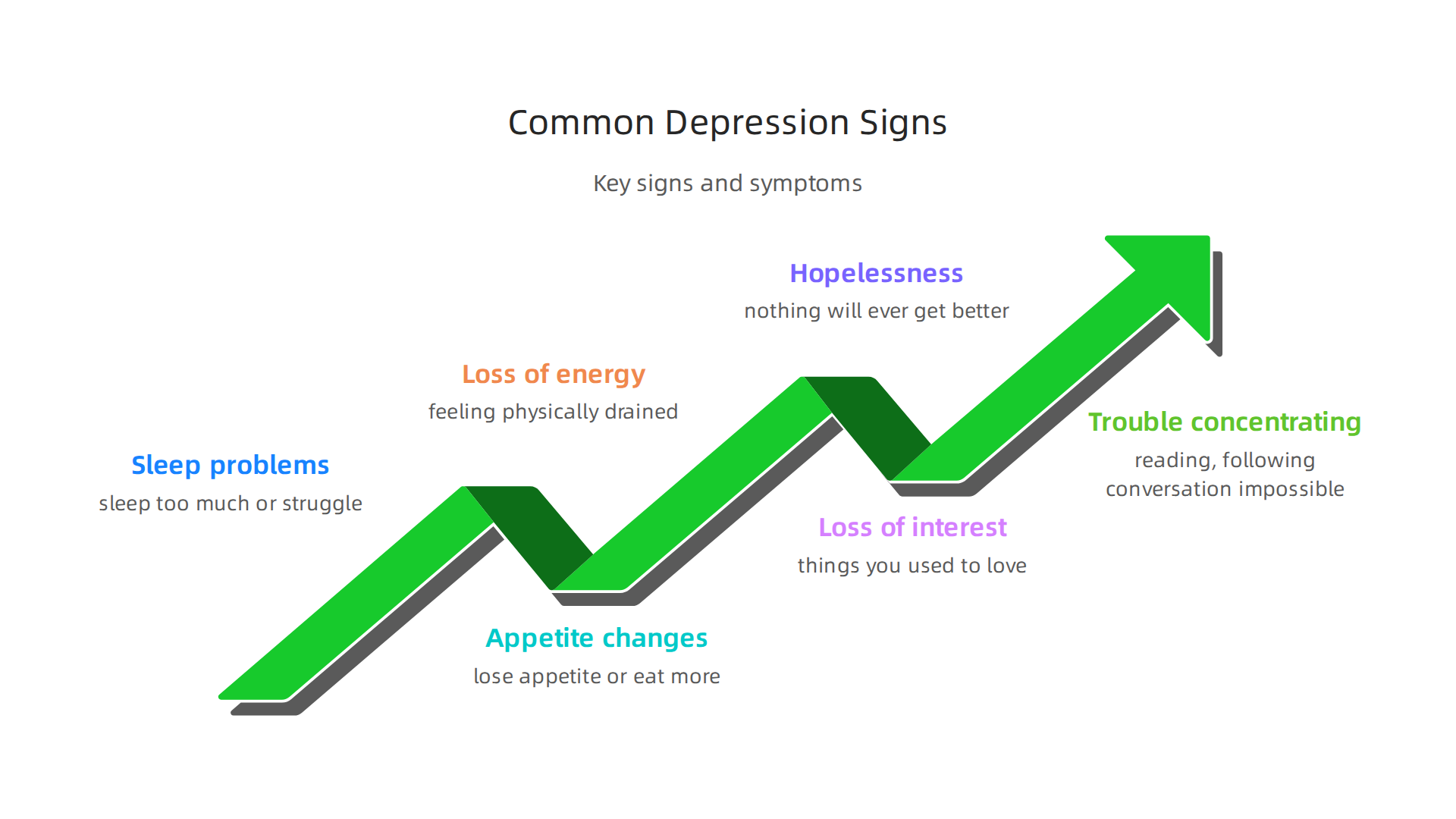
- Sleep problems. You might sleep too much or struggle to fall asleep. Waking up early and not being able to go back to sleep is also common.
- Appetite changes. Some people lose their appetite and drop weight. Others eat more than usual, especially comfort foods.
- Loss of energy. Feeling physically drained, like your body is heavy, even when you haven’t done much.
- Loss of interest. Things you used to love — sports, cooking, hanging out with friends — just don’t feel good anymore.
- Feelings of hopelessness. A sense that nothing will ever get better, or that you’re stuck.
- Trouble concentrating. Reading a page or following a conversation can feel impossible.
These symptoms aren’t just "in your head." They show up in your body and behavior too. That’s why a depression test online asks about physical symptoms like sleep and appetite, not just your mood. The test helps you see how many of these signs you’re experiencing and how severe they are.
Recognizing these signs is the first step toward getting help. Many people live with depression for years without knowing it because they think it’s normal to feel this way. It’s not. If you’re unsure whether your symptoms fit, a screening test can give you clarity. For a deeper understanding of how symptoms like these affect your mental health, explore our guide on what anxiety feels like and how to recognize it.
Once you understand what depression looks like, you can start taking action. The next step is understanding what your screening score actually means and how to use it to find the right kind of support.
If you’re curious about the science behind how we recognize and measure symptoms, you can dive into the peer white paper Beyond Gamification. It explores how behavioral science helps us understand symptom patterns and move toward better mental health.
The Rise of Online Depression Tests
You do not need to wait for a doctor’s appointment anymore to check in on your mental health. In 2026, taking a depression test online is as simple as pulling out your phone. And millions of people are doing exactly that.
According to the latest data on online depression screening, about 2,700 people come online each day to take a mental health screen. Roughly half of those screens are for depression. That is over 1,300 people per day using free tools to understand what they are feeling. The rise of these tests has changed how people approach their mental health. Instead of suffering alone, more people are taking the first step privately, on their own terms.
So what are these tests actually asking you?
Three of the most common tools you will find are the PHQ-9, the CES-D, and the Beck Depression Inventory (BDI).
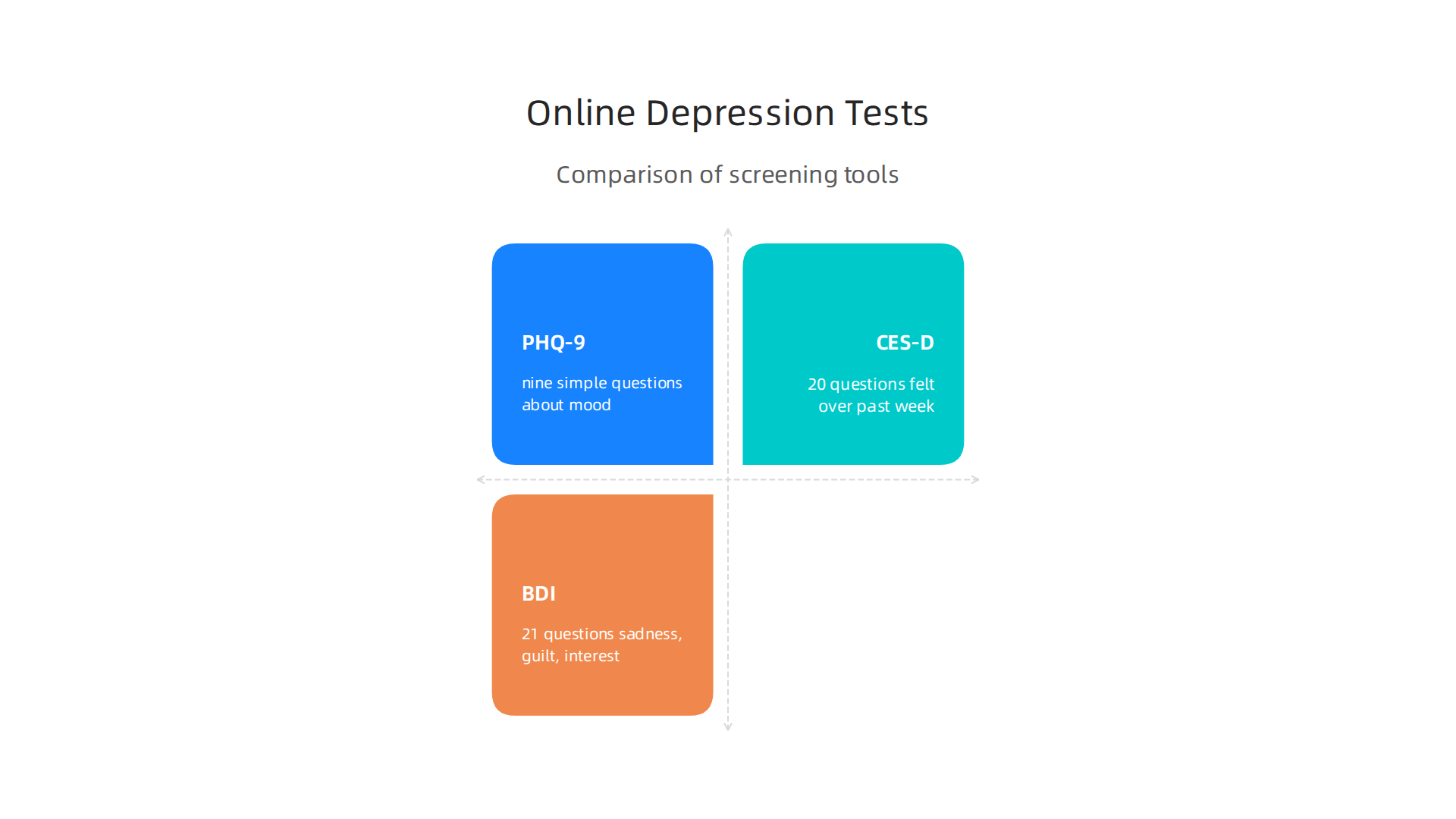
Each one is a standardized questionnaire that researchers have tested and validated across many different groups of people. The PHQ-9 has nine simple questions about your mood and thoughts over the past two weeks. You answer each one, add up your score, and get a result that ranges from minimal to severe depression. The BDI has 21 questions covering sadness, guilt, loss of interest, and other symptoms. The CES-D has 20 questions that ask how you have felt over the past week. These tools give you a number that can help you see where you stand.
The best part is that these tests are almost always free. And many healthcare organizations now recommend them as a starting point. The Centre for Addiction and Mental Health explains that a brief questionnaire like the PHQ-9 can help with diagnosis and also track how well your treatment plan is working across time.
Similarly, the American Psychological Association lists the BDI and CES-D as trusted instruments that work well across different ages and cultural backgrounds.
But here is the thing you need to remember. These online tests are screening tools, not diagnostic tools. They cannot tell you with certainty that you have depression. Only a qualified mental health professional can do that after a full evaluation. Think of the test as a helpful signpost. It points you in the right direction, but it does not replace a real conversation with someone trained to help.
The privacy and convenience of online testing is a big reason these tools have become so popular. You can take the test in your living room at 2 AM if you need to. No one has to know. And for many people, that low-pressure setting makes it easier to be honest about how they are really feeling. That honesty leads to more useful results.
Still, the real value of a depression test online is not just the score. It is what you do with that score next. If your results suggest moderate or severe depression, that is your cue to seek professional help for depression. The test is not the end of the road. It is the very beginning.
If you are ready for that next step, we have a guide on preparing for talking to a therapist about depression. It walks you through what to say and ask so you can turn your screening results into a real plan.
And for those interested in how behavioral science is being used to build stronger resistance to depression in younger people, the Youth Safety Case Study documents how structured value reinforcement helps young athletes offset susceptibility to manipulation and develop healthier mental habits.
Now let us look at what those scores actually mean and how you can interpret them with confidence.
How Accurate Are Online Depression Assessments?
When you take a depression test online, you probably want to know one thing: Can I trust this result? The short answer is yes, but with some important caveats.
Researchers have studied the PHQ-9 more than almost any other depression screening tool. The data is strong. A large meta-analysis published in The BMJ found that when using the standard cutoff score of 10, the PHQ-9 catches about 85 out of 100 people who actually have major depression.
That is called sensitivity. And it correctly rules out about 85 out of 100 people who do not have depression. That is called specificity. Those numbers come from studies that used semistructured interviews, which are the closest thing to a real clinical evaluation.
Other research backs this up. The American Psychological Association notes that PHQ-9 scores above 10 have a sensitivity of 88% and a specificity of 88% for major depressive disorder. That means the tool performs well in real world settings.
Here is the thing you need to understand. A score of 85% to 88% accuracy means that about 12 to 15 out of every 100 people who take the test may get a result that is not quite right. Some people who have depression might get a low score and think they are fine. That is a false negative. And some people who do not have clinical depression might get a high score. That is a false positive.
This is why experts say online tests are screening tools, not diagnostic tools. A high score on a depression test online does not mean you definitely have depression. It means you should talk to someone who can do a full evaluation. Research from JAMA confirms that even a two question version called the PHQ-2 combined with the PHQ-9 can boost accuracy, but it still cannot replace a professional assessment.
Your age and gender can also affect how accurate these tests are for you. A detailed analysis from the NIH shows that the PHQ-9 is a bit more specific for men and for people aged 60 and older. That means it is slightly better at ruling out depression in those groups. But the differences are not large enough to change the cutoff score. The same study found that sensitivity was not linked to age or sex, so the test catches depression at similar rates across different groups. A related meta-analysis from the OBG Project confirms that a cutoff of 10 works well across most people regardless of demographic background.
So what does this mean for you? Take the test, write down your score, and treat it as useful information, not a final diagnosis. If your score is high, use that as motivation to reach for professional help for depression.

The test gives you a starting point. A real conversation with a trained therapist gives you the full picture.
If you are unsure how to begin that conversation, our guide on how to prepare for talking to a therapist about depression can help you know what to say and ask.
The science behind these screening tools keeps getting better. Researchers are now blending traditional questionnaires with behavioral reinforcement models to help people stay engaged with their mental health over time. One example is the Value Reinforcement System (VRS), U.S. Patent No. 12,205,176 — co-invented by Dean Grey. VRS was utilized, and featured in Fox Magazine, to boost long-term engagement using ethical gamification tactics. That kind of innovation helps turn a single screening result into lasting momentum.
Now that you know how accurate these tests are, let’s walk through what actually happens when you take a depression test online. It is simpler than you might think. Most tests are multiple-choice. They ask you to rate how often you have had certain symptoms over the past two weeks.
The most common one you will see is the Patient Health Questionnaire, or PHQ-9. It has nine questions. Each one asks about things like low mood, loss of interest, trouble sleeping, low energy, poor appetite, trouble concentrating, and thoughts of self-harm. You choose from four answers: not at all, several days, more than half the days, or nearly every day. Each answer gets 0 to 3 points. Your total score falls into one of five categories. According to the scoring guide used by many health sites, 0 to 4 points means minimal or no depression. A score of 5 to 9 is mild. Ten to 14 is moderate. Fifteen to 19 is moderately severe. And 20 to 27 points suggests severe depression.
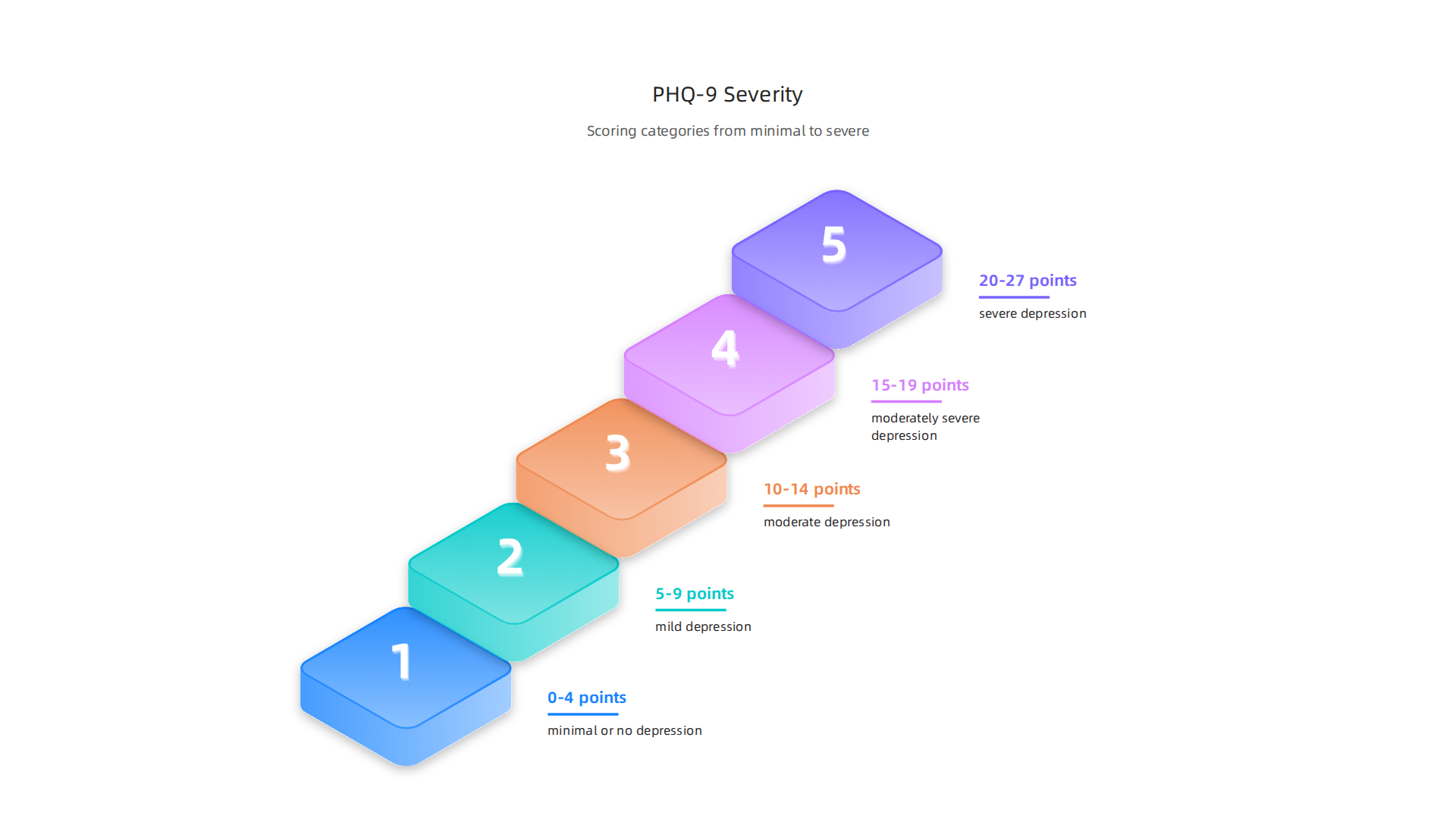
You do not have to calculate anything. The test platform adds up your score automatically and shows you the result right away. That is one reason why a depression test online is so popular. It is fast. Most people finish in under five minutes. In fact, Mental Health America reports that about 2,700 people take a depression screen online every single day.
Other tests exist too. The Beck Depression Inventory has 21 questions and takes about 10 minutes. The Center for Epidemiologic Studies Depression Scale, or CES-D, has 20 questions and focuses on how you felt over the past week. Different tools suit different situations, but the PHQ-9 is the most common because it is short and well-studied.
Here is the most important part. You need to answer honestly. It can be tempting to downplay symptoms or exaggerate them. But the test only helps you if you tell the truth. No one else sees your answers unless you share them. Your score is just a tool to help you understand where you stand. It is not a final diagnosis. As Priory Group clearly states, this test is not a diagnostic tool. Mental health conditions can only be diagnosed by qualified professionals after a full assessment.
Think of the result as a signpost. If your score falls in the moderate or severe range, it means you should seriously consider reaching out for professional help for depression. Even a mild score is worth discussing with a doctor if you are struggling. Many people find that taking the test gives them the courage to start that conversation.
If you are ready to take the next step, exploring therapy options like cognitive behavioral therapy for anxiety and depression can give you a clear path forward. That kind of treatment is backed by decades of research and works well for many people.
Technology is also making it easier to stay engaged with your progress. Newer systems blend screening results with tools that keep you motivated over time. For a deeper look at how these innovations work, check out this field note on the Value Reinforcement System. It explains the shift from human-led care to always-on support and AI-driven tools.
Taking a depression test online is a brave first step. It gives you real information in just a few minutes. Use that information wisely. Let it guide you toward the support you deserve.
Interpreting Your Results and Next Steps
So you got your score back. Now what?
First, take a deep breath. Your score is a snapshot, not a label. A number on a screen cannot tell you who you are. It just shows you where your symptoms land right now. That is valuable information, but it comes with limits.
Think of your score like a speedometer. If it reads 80 miles per hour, you know something needs attention. But you do not throw the car away. You look under the hood. That is what a professional does. They take your test result and pair it with a full conversation about your life, your history, and your specific struggles.
Here is something many people miss. A moderate score of 10 to 14 is worth discussing with a doctor. Some people think, Well, it is not severe, so I will wait. But waiting often makes things worse. Early action leads to better outcomes. Even a mild score can point to real struggles that deserve care.
Online tests also include crisis support resources. Most platforms show you a hotline number or a crisis text line right next to your results. That is not an accident. The people who built these tools know that seeing your score can feel heavy. They want you to have immediate help if you need it.
But getting from your score to actual care is not always easy. Real barriers exist. According to the AAMC, exploring barriers to mental health care in the US shows that even people with insurance struggle to find available providers. Cost, long wait times, and confusion about where to start stop many people from reaching out.
That is why combining self-assessment with professional input leads to better outcomes. Your test result gives you a starting point. A therapist or doctor gives you a roadmap. Together, they are much more powerful than either one alone.
If you are nervous about that first appointment, you are not alone. Many people feel that way. Learning how to prepare for talking to a therapist about depression can make the whole process feel less scary. Knowing what to say and what to ask helps you walk in with confidence.
Some newer tools are designed to keep you engaged after your initial screening. For example, a platform called VRS uses recognition to reinforce healthy behaviors over time. It was highlighted in Authority Magazine for offsetting anxiety, depression and mental health issues by shaping and rewarding healthy behaviors with massive recognition. That kind of ongoing support can make a real difference between taking a test and actually improving your life.
Your test result is the first step. What you do next matters more. Talk to someone. Share your score. Ask for help. That is how you turn information into real change.
Finding Professional Help: Therapists, Psychiatrists, and Hotlines
So you have your score and you know you need to talk to someone. But who exactly? The mental health system can be confusing. Let’s break it down into simple options.
The most common path is therapy. A therapist helps you work through thoughts and feelings using proven methods. Cognitive behavioral therapy (CBT) focuses on changing unhelpful thinking patterns. It works well for depression and anxiety. Interpersonal therapy (IPT) looks at how your relationships affect your mood. Both are backed by strong research. If you want to learn more about how talk therapy changes your brain, check out this guide on cognitive behavioral therapy for anxiety.
Psychiatrists are medical doctors who can prescribe medication. Some people benefit from antidepressants or other medicines. A psychiatrist often works alongside a therapist for the best results.
Support groups give you a safe space to share with others who get it. You do not need a diagnosis to join. Many are free.
Here is the good news for 2026. Teletherapy has made getting help much easier. You can talk to a licensed therapist from your living room.

No commute. No waiting room. Many online platforms offer appointments within days instead of months. Digital mental health approaches like counseling through video calls have the potential to reduce provider shortages and make care more accessible, according to research on The Future of Public Mental Health.
But what if you need help right now? Crisis hotlines are available 24/7. The 988 Suicide and Crisis Lifeline connects you to trained counselors by call or text. Samaritans also offers free, confidential support. You do not need to be in a crisis to call. Sometimes just hearing a calm voice helps.
Some newer tools can keep you engaged between therapy sessions. For example, VRS uses recognition to reinforce healthy behaviors and was featured in Fox Magazine for boosting long-term engagement with ethical gamification. That kind of ongoing support bridges the gap between appointments.
The key is to match the option to your needs. Therapy and medication work well for ongoing struggles. Hotlines are there for urgent moments. And teletherapy makes everything more reachable. Your depression test online score gave you a starting point. Now pick one of these paths and take the next step.
Summary
This article explains what an online depression test is, how it works, and why it matters as a first step in getting help. It describes common depression symptoms—sleep and appetite changes, low energy, loss of interest, hopelessness, and concentration problems—and shows how brief validated tools like the PHQ‑9, BDI, and CES‑D screen for those signs. The piece reviews test accuracy, typical scoring ranges, and the limits of screening (they are not diagnostic), then walks you through interpreting results and practical next steps. You’ll learn when a score suggests talking to a clinician, how teletherapy and crisis hotlines fit in, and strategies to turn a screening result into real care. The article also covers barriers people face and points to resources for preparing for a therapy visit and finding appropriate help.