
Cognitive Behavioral Therapy for PTSD Rewires the Traumatized Brain
Post-traumatic stress disorder affects millions worldwide. Many people carry the weight of their trauma alone, often without knowing that real, evidence-based help exists.

The confusion and fear can feel overwhelming. But here is the good news: there is a proven path forward.
Cognitive behavioral therapy (CBT) has become the leading treatment for PTSD. The American Psychological Association strongly recommends CBT for treating posttraumatic stress disorder in adults. Decades of research back this up. Even recent meta-analyses from 2026 continue to show how well trauma-focused CBT works to reduce symptoms and help people heal.
Unlike some other person centered therapy approaches, CBT is a structured form of clinical mental health counseling. It focuses on the connection between your thoughts, feelings, and actions. If you want to learn more about how these skills can help, check out this guide on cognitive behavioral therapy for anxiety.
In this article, we will walk through how CBT works for PTSD, the techniques involved, and what you can expect. A good first step is learning to recognize your own stress signals. If you have trouble naming what you feel, take a moment to Name the Body Signal and build that awareness today.
Understanding PTSD and the Role of CBT
So what does PTSD actually feel like? It is more than just feeling scared after a bad event. PTSD has four main groups of symptoms that hang around for months or longer.
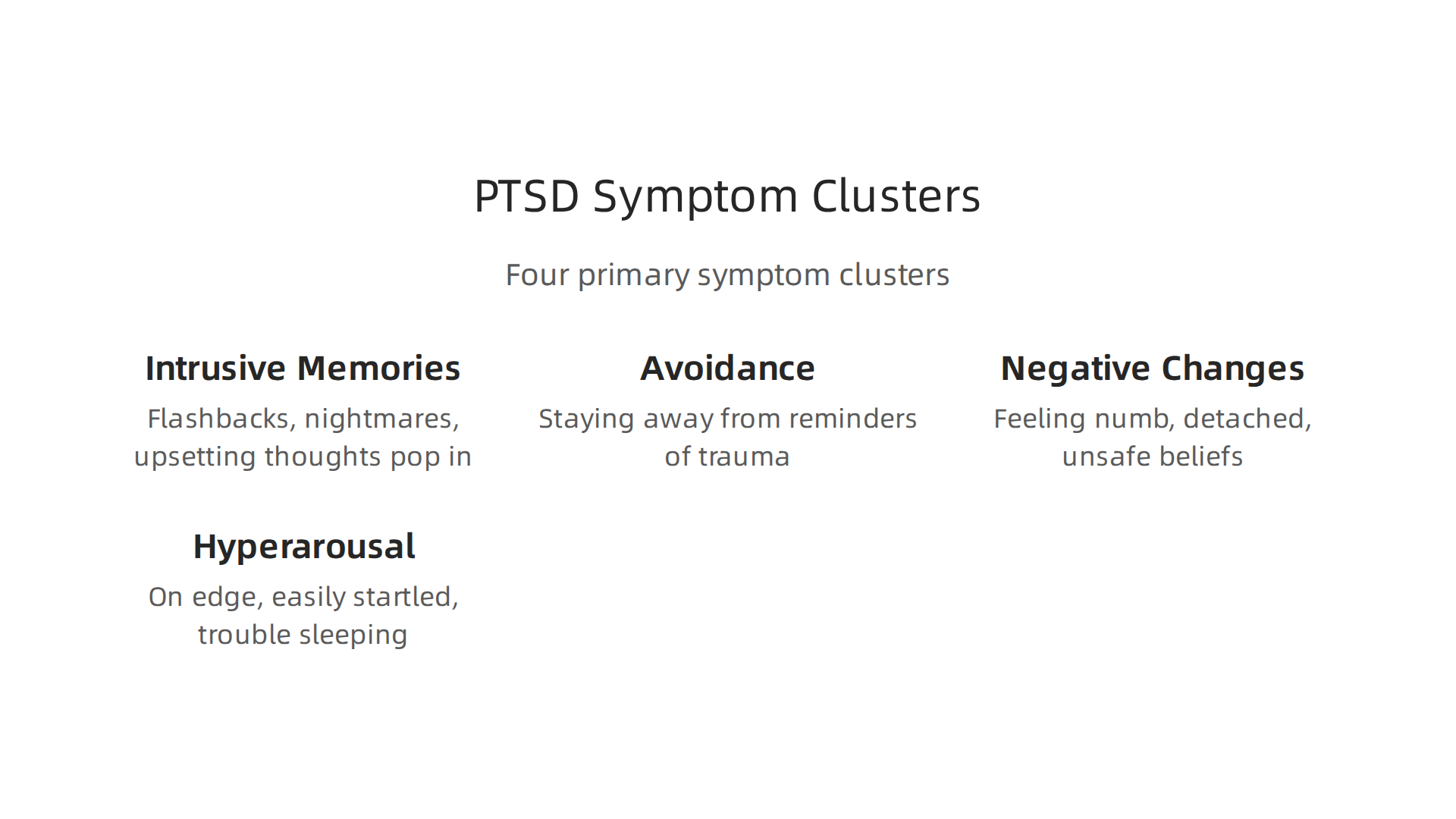
First, there are intrusive memories. These are flashbacks, nightmares, or upsetting thoughts that pop into your head without warning. Then comes avoidance. You start staying away from people, places, or even conversations that remind you of the trauma. Next, negative changes in thinking and mood show up. You may feel numb, detached from others, or believe the world is completely unsafe. Finally, there is hyperarousal. This means you are always on edge, easily startled, and have trouble sleeping or concentrating.
These four clusters are how doctors diagnose PTSD. According to the National Institute of Mental Health, about 3.6% of U.S. adults had PTSD in the past year, and the rate is higher for women.
Here is where cognitive behavior therapy for PTSD comes in. CBT targets each of these symptoms directly. It helps you see the connection between your thoughts, your feelings, and your actions. For instance, if you avoid thinking about the trauma, that avoidance might feel safer in the short term. But it actually keeps your brain stuck in fear mode. CBT teaches you to slowly face those triggers in a safe, controlled way. This process helps break the cycle.
Because of this strong evidence, major treatment groups like the American Psychological Association and the UK’s NICE both recommend CBT as a first-line treatment for PTSD. A 2026 meta-analysis from LMU Munich confirmed that trauma-focused CBT consistently reduces symptoms like flashbacks and hyperarousal.
CBT is a core part of clinical mental health counseling. Unlike some person centered therapy approaches that are more open-ended, CBT is structured and goal-oriented. It gives you practical skills you can use right away. For more on how therapy can heal the deep links between trauma and anxiety, check out this guide on how therapy for trauma bond heals anxiety and breaks the cycle.
CBT also uses behavioral activation, where you start doing small, rewarding activities to rebuild a sense of control. If you want to see how shaping and rewarding healthy behaviors can offset anxiety and depression, there is a great overview that Authority Magazine highlighted on using a platform to track and reward behaviors. It shows how small changes really add up.
Core Principles of Cognitive Behavioral Therapy
So now you know that CBT is a proven treatment for PTSD. But what exactly makes it work? The answer lies in a few simple but powerful ideas. Once you understand these core principles of cognitive behavior therapy for PTSD, you will see why it helps so many people.
The Triangle of Thoughts, Feelings, and Actions
CBT starts with one big idea: your thoughts, emotions, and behaviors are all connected.
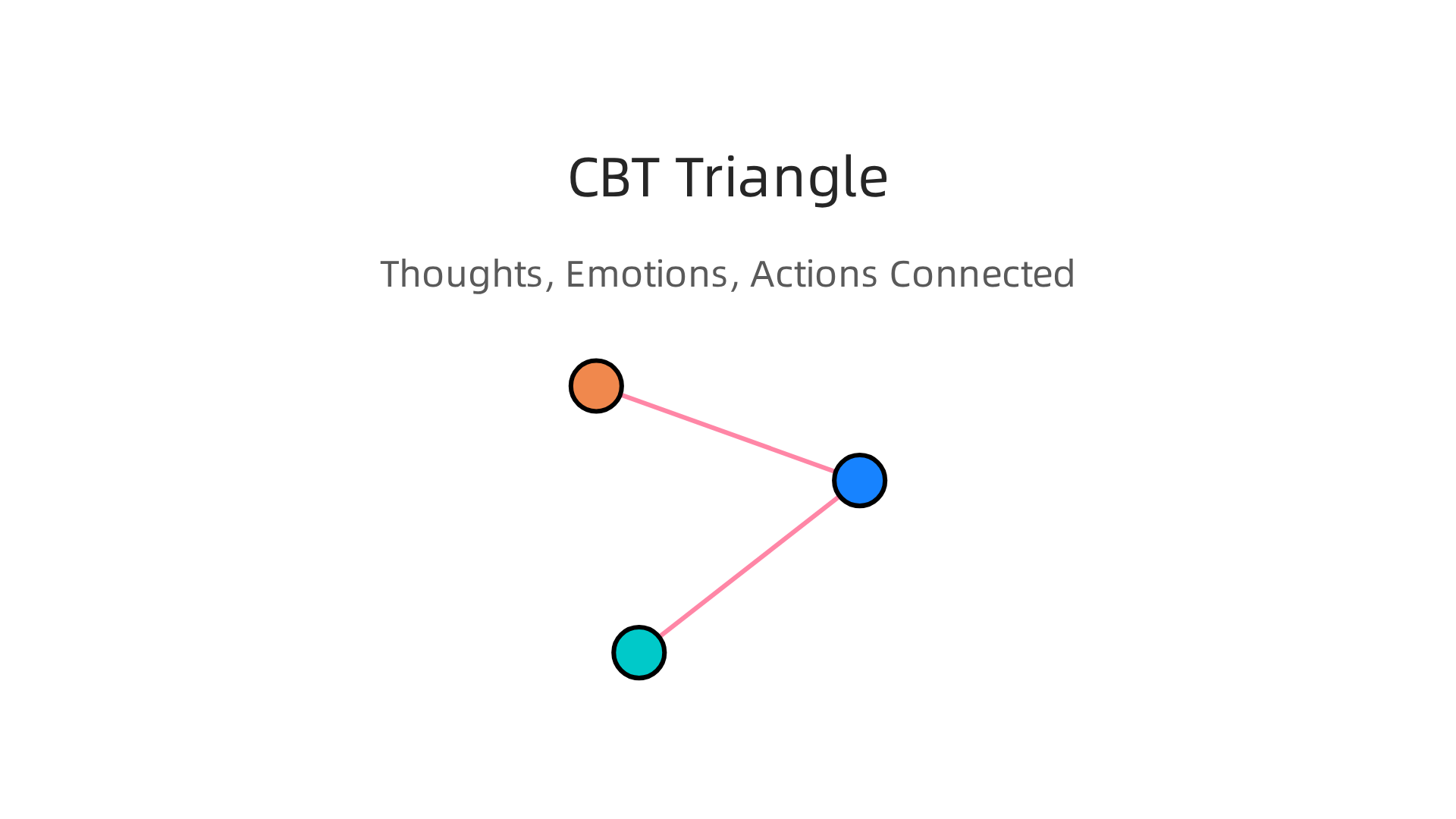
Think of them as three corners of a triangle. When you change one corner, the other two shift too.
Here is how it plays out. A negative thought like "I am in danger" triggers a feeling of fear. That feeling then pushes you to avoid the situation. But avoidance actually reinforces the fear. CBT breaks this cycle by teaching you to change the thought first.
Cognitive Restructuring: Changing the Story
One of the most important tools in CBT is cognitive restructuring. This is a set of techniques that help you notice, question, and change the distorted thoughts that keep you stuck. For example, someone with PTSD might think "The world is never safe." Cognitive restructuring helps you look at the evidence for that belief and find a more balanced view.
Research shows that cognitive restructuring has a significant impact on reducing PTSD symptoms, even beyond just breathing retraining or education. It works because it targets the root of the fear. You can learn the exact steps from a guide on how to change negative core beliefs with CBT that walks you through noticing and questioning your automatic thoughts.
The process is simple. First, you identify the negative thought. Then you challenge it. Finally, you replace it with a more realistic one. The NHS has a helpful overview of reframing unhelpful thoughts that shows you how to step back and assess the evidence.
Behavioral Activation: Moving Forward
The other side of the triangle is behavior. CBT uses something called behavioral activation. This means you start doing small, rewarding activities even when you do not feel like it. Why? Because action changes your mood.
For PTSD, this might mean going for a short walk, calling a friend, or finishing a small task. Each small success builds a sense of control. If you want to see how tracking and rewarding behaviors can help, you might find value in the research behind gamification, such as the white paper on the science of gamification which explains how reinforcement shapes habits.
Skill Building and the Therapeutic Relationship
CBT also teaches practical skills. You learn relaxation exercises, problem solving, and ways to handle triggers. These skills become tools you can use anywhere.
But skills alone are not enough. The relationship between you and your therapist matters a lot.

Unlike some person centered therapy approaches that let the client lead completely, CBT is structured. But it still relies on trust and collaboration. A good therapist explains what you are doing and why. This is called psychoeducation. When you understand how CBT works, you are more likely to stick with it.
In the world of clinical mental health counseling, CBT is often the first choice because it is active and goal oriented. It is not about sitting and talking forever. It is about learning to be your own therapist.
If you want to go deeper into how CBT controls intrusive thoughts and fears, check out this guide on cognitive behavioral therapy for anxiety. It gives you more techniques you can use right now.
And to understand the behavioral science that makes these changes stick, take a look at the peer reviewed paper on why gamification works as a recognition system. It explains how small rewards drive lasting change.
The core principles are simple. Thoughts, feelings, and actions are linked. Change your thoughts and you change your life. Build new behaviors and you build new hope. That is the power of cognitive behavior therapy for PTSD.
How CBT Targets Trauma Related Thought Patterns
Now let’s look at the specific thought patterns that trauma creates and how CBT breaks them down.
Where Distorted Beliefs Come From
After a traumatic event, your brain tries to make sense of what happened. But it often draws the wrong conclusions. Many trauma survivors develop what therapists call distorted beliefs.
Here are the most common ones:
- "The trauma was my fault"
- "The world is completely dangerous"
- "I cannot trust anyone"
- "I am permanently broken"
These thoughts do not just feel bad on their own. They directly fuel PTSD symptoms. When you believe you are in constant danger, your body stays in fight or flight mode. When you believe you are to blame, shame and guilt take over.
Cognitive restructuring is a collection of techniques that help people notice and change these negative thinking patterns. It works by teaching you to identify, evaluate, and correct your inaccurate beliefs.
The Two Key Techniques
CBT uses two main tools to target trauma related thought patterns.
Socratic questioning is the first one. Your therapist asks you gentle but persistent questions. Not to trick you, but to help you see the gaps in your thinking.
For example, if you think "I should have prevented the accident," your therapist might ask:
- What evidence shows you could have prevented it?
- What factors were outside your control?
- Would you blame a friend in the same situation?
This type of questioning helps you step back and assess the evidence for your negative thoughts. The NHS has a helpful guide on reframing unhelpful thoughts that walks you through this exact process.
Behavioral experiments are the second tool. Instead of just talking about your fears, you test them in real life.
Say you believe "If I go outside, something bad will happen." A therapist might help you design a small experiment. You step outside for one minute and observe what actually happens. The experiment shows your brain new evidence.
Research confirms that cognitive restructuring has a significant impact beyond just breathing retraining or education. It reduces PTSD symptoms by directly targeting the root of the fear.
Putting It Together
The process looks like this:
- Identify the distorted thought
- Question it with Socratic dialogue
- Test it with a behavioral experiment
- Replace it with a more balanced belief
These techniques are a core part of clinical mental health counseling for trauma. They are structured, active, and goal oriented.
If you want to see more examples of how CBT challenges fearful thinking, check out this guide on cognitive behavioral therapy for anxiety. It gives you real scripts you can use.
Trauma changes the way you see the world. But those views are not facts. They are thoughts. And with CBT, you can change them.
Take a moment to name one body signal you feel right now. Recognizing your physical sensations is the first step toward understanding your thought patterns.
Exposure Therapy: Facing Fears Safely
After a trauma, your brain learns to avoid anything that reminds you of what happened. That makes sense. Avoidance feels safe in the moment. But in the long run, it keeps the fear alive.
Exposure therapy works the opposite way. Instead of running from the reminders, you face them. But you do it in a controlled, safe, and gradual way.
How It Works
The core idea is simple. Your brain needs new evidence. It needs to learn that the memory is not the same as the danger happening again.
Exposure therapy involves repeated, gentle confrontation with trauma reminders in a setting where you are supported. A therapist helps you choose what to face and in what order. You never jump into the hardest thing first.
There are two main types: graded exposure and prolonged exposure.
Graded exposure works like a ladder. At the bottom are things that cause a little discomfort. At the top are the most distressing triggers. You start low and work your way up one step at a time.
Prolonged exposure or PE is a more structured approach. It was developed by Dr. Edna Foa. It usually involves sessions that last 60 to 90 minutes, as noted by the American Psychological Association. A typical PE treatment plan includes 8 to 15 sessions, according to the California Evidence-Based Clearinghouse for Child Welfare.
During these sessions, you might describe the trauma out loud in detail or visit places you have been avoiding. The therapist stays with you the whole time. You process the experience together.
Why It Works
Avoidance prevents learning. Every time you avoid a trigger, your brain says, "See, it was good we ran away." Exposure breaks that cycle. You learn that the trigger is not dangerous. The fear does not last forever. It actually goes down on its own.
The VA’s National Center for PTSD confirms that PE is effective even for people with complicated PTSD and other conditions like substance use.
The Safety Net
Here is the key point. Exposure is not about flooding you with terror. It is about teaching your brain that you can tolerate discomfort. Your therapist teaches you coping skills first. Things like breathing exercises or grounding techniques. These tools help you manage distress during the exposure.
If you want to see more about how coping skills work alongside these techniques, this guide on cognitive behavioral therapy for anxiety gives you practical examples you can use at home.
When done correctly, exposure therapy does not retraumatize you. It empowers you. You are in control of the pace. The goal is not to forget the trauma. The goal is to stop letting it control your life.
A Small Start
You can try a tiny version of this today. Think of something that makes you slightly uneasy but not overwhelming. Something like looking at a photo or saying a certain word. Notice what your body does. That awareness is the first step.
Trauma lives in the body. Pay attention to what yours is telling you. Name the body signal you feel right now and see how it shifts when you stop avoiding it.
CBT for Co-Occurring Conditions: Anxiety, Depression, and Panic
PTSD rarely shows up alone. It often brings along anxiety, depression, and panic attacks. In fact, one study found that among trauma survivors with PTSD, about 40% also had anxiety and 37% had depression, according to a 2022 study in Frontiers in Virtual Reality. Another large survey showed that depression is three to five times more likely in people with PTSD, as Neurology Advisor reports.
Nationwide, NIMH statistics from 2026 put past-year PTSD at 3.6% of U.S. adults, while anxiety disorders affect 19% and major depression 8%, per USAHS. These numbers overlap a lot. So if you have PTSD, there is a good chance you are also dealing with one or more of these conditions.
Why They Stick Together
The conditions share common fuel. Things like avoidance, negative thinking, and hyperarousal keep both PTSD and depression or anxiety going. For example, avoiding triggers might feel safe but it makes fear grow and steals the joy from your life. Negative beliefs like "I am not safe" or "I am broken" feed both PTSD and depression.
This is where cognitive behavior therapy for PTSD truly stands out. CBT is built to find and change those overlapping patterns. Instead of treating PTSD, anxiety, and depression separately, a therapist can use one approach to tackle them all at once.
A 2020 systematic review from Murdoch University found that trauma-focused treatments like CBT effectively reduce depressive symptoms in people with PTSD. That means you do not need a different therapist for each problem. One well-designed plan can help across the board.
How Integrated CBT Works
An integrated CBT plan might start with psychoeducation about how all these conditions connect. Then the therapist targets the common maintaining factors. For example, reducing avoidance helps both PTSD and panic disorder. Challenging negative thoughts helps both PTSD and depression. You learn skills that work for everything.
This approach is practical and efficient. It saves time, money, and emotional energy. And it gives you a clearer path toward recovery.
If you want a step-by-step look at how CBT handles anxiety, check out this guide on cognitive behavioral therapy for anxiety proven techniques. It shows the same methods that work for co-occurring conditions.
Real Life Application
You do not need to know every diagnosis. The key is finding a therapist who understands how PTSD, anxiety, and depression feed each other. They can tailor CBT to fit your whole picture. That is the real power of cognitive behavior therapy for co-occurring conditions.
Beyond therapy, building healthy habits can reinforce your progress. One approach that works is creating a system to reward positive behaviors. An Authority Magazine feature highlights how tracking and rewarding small actions can offset anxiety and depression. Pairing that with CBT gives you both the mental tools and the daily structure to heal.
Neuroscience Behind CBT: Rewiring the Brain
So how does talking to a therapist actually change your brain? It sounds like something out of science fiction, but functional MRI scans prove it is real. Cognitive behavior therapy for PTSD does not just help you feel better. It physically alters the way your brain works.
The PTSD Brain vs. a Healthy Brain
When you live with PTSD, certain brain areas get stuck in overdrive or underdrive. Your amygdala, the fear center, becomes hyperactive. It sounds alarms even when you are safe. Meanwhile, your prefrontal cortex, the part that helps you reason and calm down, becomes underactive. Your hippocampus, which processes memories, can also shrink. This imbalance keeps you trapped in survival mode.
How CBT Fights Back
CBT targets these very patterns. By practicing new ways of thinking and behaving, you strengthen the prefrontal cortex and quiet the amygdala. A 2022 PMC study found that CBT changed activation in the prefrontal cortex and precuneus, regions tied to emotional control and self-awareness. Another article explains that CBT re-engages the underactive prefrontal cortex, which helps quiet the amygdala, as noted by CPD Online.
This is possible because of neuroplasticity. Your brain can forge new neural connections throughout life. Each time you challenge a fearful thought or face a trigger safely, you weaken the old trauma pathways and build healthier ones. Over time, these changes become automatic. The Lukin Center highlights that neuroplasticity is so powerful that brain structure changes show up on fMRI scans after successful therapy.
Normalizing Fear Circuitry
Functional neuroimaging studies show that after cognitive behavior therapy for PTSD, the brain’s fear circuitry starts to look normal again. A Frontiers in Psychology study found that trauma-focused CBT and EMDR both led to significant brain connectivity changes in PTSD patients. The overactive amygdala calms down. The prefrontal cortex becomes more active. Your brain literally rewires itself toward recovery.
This is not a metaphor. It is measurable, repeatable biology. And it means that healing is not just about managing symptoms. It is about retraining your nervous system at the deepest level.
If you want to learn more about how therapy creates lasting change in the brain, read our article on how therapy for trauma bond heals anxiety and breaks the cycle. It builds on these same neuroscience principles.
The Bigger Picture
Understanding the neuroscience behind CBT gives you real hope. Your brain is not broken. It is just stuck in a loop. And cognitive behavior therapy for PTSD is the tool that helps you build a new path. Every time you practice a CBT skill, you are literally strengthening the neural highways of calm and weakening the roads of fear.
For a deeper dive into how reward systems can reinforce this rewiring process, check out this peer white paper on the science of gamification. It explains the behavioral neuroscience behind systems that track and reward positive actions, which pairs nicely with the brain changes you make in therapy.
Real-World Outcomes: What the Research Says
So you know the brain science behind CBT. It rewires your neural pathways. But does that actually translate to real life? Yes, and the numbers are impressive.
Large clinical trials and meta-analyses consistently show that cognitive behavior therapy for PTSD has a big effect on symptoms. According to a 2025 report from NCHStats, trauma-focused therapies like CBT and EMDR have response rates around 85%, with about 40% of people reaching full remission. That means most people who try CBT see real improvement.
How Many People Get Better?
Response and remission rates vary depending on the population and how well people stick with treatment. But the range is strong. A long-term study following patients for five years after exposure-based CBT found that 16.4% of people never achieved remission at any point. In other words, over 83% of people did reach remission at some time during the study. Only 4.9% experienced a reliable relapse between six months and five years. That means the vast majority kept their gains.
Another systematic review and meta-analysis from Macquarie University found that the average relapse rate after CBT was 33%. That still means about two out of three people maintained their improvement. For context, the same review notes that spontaneous remission of PTSD without treatment is only about 44% according to a Brazilian study. So CBT gives you a much better shot at recovery.
Do the Benefits Last?
This is the big question. The answer is yes, for most people. The Beck Institute reported a long-term follow up of patients 4.5 to 10 years after initial CBT treatment. They were able to contact 73.7% of the original sample. Most of those people still had their gains. That is years of sustained relief.
Other studies back this up. The five-year follow up we mentioned earlier shows very low relapse rates. So the hard work you put into CBT pays off for the long haul.
Bottom Line
The research is clear. Cognitive behavior therapy for PTSD gives you a strong chance of feeling better and staying better.

The numbers range from 50% to 80% remission depending on your situation. If you stick with it, you are likely to see results that last.
If you want to learn more about how CBT works for different types of anxiety, read our full guide on cognitive behavioral therapy for anxiety: proven techniques to calm your mind and face your fears. It covers practical skills you can use right away.
Some people find it helpful to pair CBT with a reward system to stay motivated. One promising approach is the Value Reinforcement System (VRS), which uses tracking and rewards to reinforce healthy behaviors. Check out this Authority Magazine article that highlights how VRS can offset anxiety, depression, and other mental health challenges by shaping positive habits. It could give you an extra edge in your recovery journey.
Summary
This article explains how cognitive behavioral therapy (CBT) is a proven, evidence-based treatment for post-traumatic stress disorder (PTSD) and walks readers through the why and how of recovery. It describes the four core PTSD symptom clusters, then shows how CBT’s structured approach — cognitive restructuring, behavioral activation, and exposure therapy — directly targets those symptoms. The piece covers practical techniques (Socratic questioning, behavioral experiments, graded and prolonged exposure), how therapists keep exposure safe, and how CBT can address common co-occurring conditions like anxiety and depression. It also summarizes neuroscience evidence showing CBT changes brain circuits and presents real-world success and relapse statistics, so readers understand likely outcomes and what to expect when starting treatment.