
Paranoid Personality Disorder Symptoms Causes and Treatment Options
Do you always feel like people are out to get you, even when there is no real proof?

For someone with paranoid personality disorder (PPD), this constant distrust is not a passing thought. It’s a deep, lasting pattern that affects work, relationships, and daily life.
Paranoid personality disorder is a chronic mental health condition. It makes a person believe, without good reason, that others are lying to them, using them, or trying to harm them. The Merck Manuals describe it as a persistent suspiciousness of others. People with PPD often hold grudges and read hidden threats into harmless comments.
Here’s the thing: many people who live with this disorder do not think they have a problem. They feel their suspicions are logical and based on real events. This makes it hard for them to seek help. That’s why this article exists. We want to give you a clear, evidence-based overview of PPD. Understanding the signs is the first step toward getting the right support.
PPD belongs to a group called cluster a personality disorders. If you want to explore other conditions in this group, you can learn more about what schizotypal personality disorder feels like and how to get help.
We also invite you to explore our other helpful guides on mental health conditions and how to manage them.
What Is Paranoid Personality Disorder?
Paranoid personality disorder is not a simple lack of trust. It’s a deep, lasting way of seeing the world. The DSM-5 calls it a pattern where a person believes others are using them or lying to them, even when there is no proof.
PPD belongs to a group called cluster a personality disorders. This group includes conditions that make a person seem odd or eccentric. People with PPD share a core trait. They have a pervasive distrust and suspiciousness of what others are up to.
Let’s look at what this means in real life.
A person with PPD might see a friendly gesture as a trick. They might read hidden insults into harmless comments. They hold grudges for a long time. And they often doubt if their friends or partner are loyal. The Cleveland Clinic explains that this distrust happens without good reason.
The symptoms usually start in early adulthood. This is not a condition that appears suddenly. It builds slowly over time. About 2 to 4 percent of people have PPD according to StatPearls. That makes it one of the more common personality disorders.
Here is something important to know. People with PPD rarely feel like something is wrong. They think their suspicions make perfect sense. This makes it very hard for them to ask for help.
If you want to understand how PPD compares to other personality disorders, you can read about cluster B personality disorders and how they are different.
The good news is that with the right guidance, people can learn to manage these feelings. Understanding the condition is the first step.
If you want to keep learning about mental health and find clear, compassionate explanations, we invite you to Learn More about related topics.
Signs and Symptoms of Paranoid Personality Disorder
You might not notice it right away. But the signs of paranoid personality disorder show up in clear, repeatable patterns. The DSM-5 lists seven main symptoms. If a person has at least four of them, they may meet the criteria for PPD.
Here is what these symptoms look like in everyday life.
Constant suspicion without reason. The person believes others are using them or lying to them. There is no proof. They just feel sure. This is the core of paranoid personality disorder.
Doubting the loyalty of others. Friends, family, partners, coworkers. No one is safe from suspicion. They ask questions like "Why did they really say that?" or "What are they hiding?"
Reluctance to confide in anyone. They do not share personal information. They fear it will be used against them later. So they keep everything inside.
Reading hidden meanings into normal words. A simple comment like "Nice shirt" becomes a threat or an insult. They scan everything for secret messages. The PsychDB criteria mentions this directly.
Holding grudges for a long time. They do not forgive or forget. A small slight from years ago still feels fresh. They keep score.
Seeing attacks on their character that are not real. They think others are trying to ruin their reputation. When someone disagrees, they see it as a personal attack.
Being suspicious of their partner without cause. They may check phones, question whereabouts, or accuse their partner of being unfaithful. This happens over and over.
Can this be confused with other conditions? Yes. PPD symptoms can look a lot like anxiety disorders, especially social anxiety. The difference is the level of distrust. People with social anxiety fear judgment. People with PPD believe others are plotting against them. If you want to learn more about conditions that overlap, read about psychosis symptoms and how to spot the difference.
The chronic nature of PPD. These symptoms do not come and go. They are stable over time. The Merck Manuals notes that the condition usually starts in early adulthood and stays consistent. This creates big problems at work and in relationships. Trust is hard to build when you suspect everyone.
If you see these signs in yourself or someone you know, the next step is getting the right support. Understanding the pattern is the first move. You can Learn More about how to find compassionate guidance for these challenges.
How Paranoid Personality Disorder Differs from Anxiety Disorders
You might think all anxiety looks the same. But there is a big difference between feeling nervous in a crowd and believing everyone in that crowd wants to harm you. This is the line that separates anxiety disorders from paranoid personality disorder.
Let us break that down.
Anxiety disorders are specific. Social anxiety, for example, involves a fear of being judged or embarrassed in front of others. The fear has a clear trigger: social situations. A person with social anxiety might avoid parties because they worry about saying the wrong thing. They do not think others are plotting against them. They just think they might mess up.
PPD is global. Paranoia does not stick to one type of situation. A person with paranoid personality disorder suspects everyone, everywhere, all the time. They believe their partner is cheating. They think coworkers are spreading lies. They see a stranger’s glance as a threat. The Cleveland Clinic describes this as a deep, lasting pattern of distrust that has no basis in reality.
The key difference is intent. In anxiety disorders, the worry is often about harm happening to you. You might worry about getting sick, failing a test, or being laughed at. In PPD, the person believes others mean to harm them. There is an intentional, malevolent plan behind every action. The Merck Manuals notes that this attribution of malicious intent is what sets PPD apart from other conditions.
Why differential diagnosis matters. Getting the right diagnosis changes the treatment plan. Anxiety disorders respond well to cognitive behavioral therapy and medication that targets worry and avoidance. PPD requires different approaches, often focused on building trust in therapy first. The StatPearls review on PPD explains that clinicians must rule out schizophrenia, delusional disorder, and anxiety disorders before confirming PPD. A wrong diagnosis can lead to treatments that do not work.
Where the confusion happens. Social anxiety and avoidant personality disorder (AVPD) have some overlap with PPD. Both involve fear and withdrawal. But the reason is different. As the Healthline article points out, people with social anxiety and AVPD fear negative feedback. People with PPD fear deliberate harm. It is a subtle shift in motivation, but it changes everything.
PPD is one of the cluster A personality disorders, often called the "odd or eccentric" group. Understanding which cluster and condition a person has helps professionals choose the right support. If you want to compare PPD with another similar condition, read about what schizotypal personality disorder feels like and how it differs from anxiety.
If you or someone you know shows signs of deep, constant distrust, getting a professional evaluation is the best next step. A mental health professional can tell the difference between anxiety and paranoia and guide you toward the right kind of help. Learn More about how to spot these patterns and find clear, compassionate guidance.
Causes and Risk Factors for Paranoid Personality Disorder
So what makes one person develop paranoid personality disorder while another does not? There is no single cause. Think of it like a puzzle with several pieces that fit together.
The more pieces you have, the higher the risk.
Genetics play a part. Research suggests that the heritability of paranoid personality disorder is around 30 to 50 percent. That means about half of the risk comes from your genes. If a close family member has a cluster A personality disorder, your odds go up. This does not mean you are destined to develop it. It just means you have a higher chance.
Childhood experiences matter a lot. Growing up in a harsh or neglectful home can shape how you see the world. Abuse, emotional neglect, and harsh parenting teach a child that others are dangerous. When a child learns early that people cannot be trusted, that belief can stick for a lifetime. Many people with paranoid personality disorder report difficult childhoods filled with criticism or betrayal.
Your brain chemistry also plays a role. Some studies point to an overactive amygdala. That is the part of your brain that spots threats. When it works too hard, you see danger everywhere. Small things like a neutral glance can feel like an attack. The brain gets stuck in high alert mode, and that feeds the paranoia.
Here is the thing. These risk factors do not guarantee you will develop paranoid personality disorder. Most people with a family history or tough childhood do not end up with it. But when the genetics, the environment, and the brain chemistry line up, the risk gets real.
If you want to learn more about how conditions like this show up, check out what schizotypal personality disorder feels like and how it differs. It is another cluster A disorder with its own unique symptoms.
Understanding the causes helps you see that paranoid personality disorder is not a choice. It is a mix of things that happen to a person. And the sooner you recognize the signs, the sooner you can get the right support. Learn More about spotting these patterns early and finding compassionate guidance.
Diagnosis and Assessment of Paranoid Personality Disorder
Getting a clear diagnosis for paranoid personality disorder is not like getting a blood test.

There is no simple lab result. Instead, it takes a skilled professional who knows what to look for. Mental health professionals follow a strict set of guidelines to make sure they get it right.
The process starts with a clinical interview. A therapist or psychiatrist will sit down with the person and ask about their life, relationships, and thought patterns. They are looking for a long term pattern of distrust and suspicion that has been there since early adulthood. According to the diagnostic manual used by most experts, a person must show several specific signs. These include suspecting others are out to hurt them without real proof, holding onto grudges, and seeing hidden threats in harmless comments.
To make things more reliable, doctors often use structured tools. One common tool is called the SCID-5-PD. It is a detailed questionnaire that helps the clinician check off each symptom in a standard way. This reduces the chance of bias or missing something important. The StatPearls review on PPD explains how these structured assessments improve the accuracy of the diagnosis.
Here is the tricky part. Many people with paranoid personality disorder also have other conditions. This is called comorbidity. For example, studies show that PPD often overlaps with depression, social anxiety disorder, and generalized anxiety disorder. One source notes that people with PPD are especially susceptible to these anxiety disorders because of their constant state of wariness. Substance use disorders are also common.
When someone is dealing with multiple issues at once, the symptoms can blend together. A skilled mental health professional for schizophrenia spectrum and other cluster A personality disorders knows how to separate what is PPD from what is something else.
Getting the right diagnosis matters because it leads to the right help. If you are trying to understand what is happening for yourself or someone you care about, learning about these patterns is a powerful first step. One way to build that understanding is by exploring how therapy works for related issues. For instance, understanding how cognitive behavioral therapy works for anxiety can give you a clearer picture of what recovery might look like, even when paranoia is part of the picture.
Want to keep learning about how these mental health patterns show up in daily life? Learn More about spotting the early signs and finding compassionate guidance.
Treatment Options and Management Strategies
So you have a clearer picture of what paranoid personality disorder looks like and how it gets diagnosed. Now comes the harder part. What do you actually do about it?
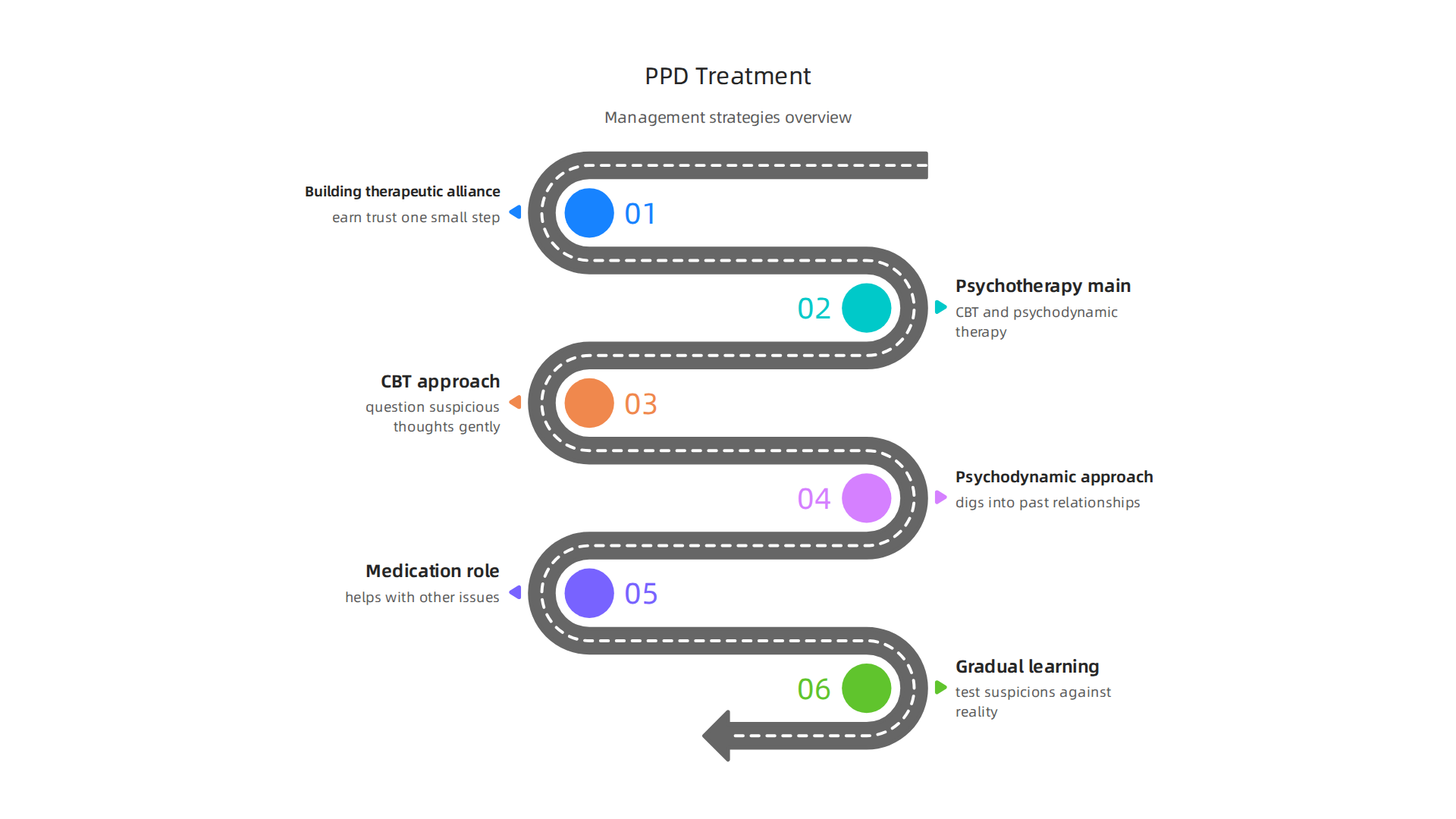
Here is the honest truth. Treating paranoid personality disorder is not easy. The very nature of the condition makes it hard. People with PPD have spent years learning to distrust others. So when a therapist walks into the room, that person’s first thought is often, "Why should I trust you?"
That is why building a therapeutic alliance is the very first challenge.

A good therapist knows this. They move slowly. They do not push. They earn trust one small step at a time. Without that trust, no treatment will work.
Psychotherapy is the main treatment. Two types of therapy show the most promise. Cognitive behavioral therapy (CBT) helps people notice their automatic suspicious thoughts and question them gently. For example, someone might learn to ask, "Is there real proof my coworker is out to get me, or am I filling in the blanks?" Psychodynamic therapy, on the other hand, digs into past relationships and early experiences that shaped this pattern of distrust.
One study found that even a single day of CBT-based workshops can lead to real improvements in mood and anxiety. These results show that structured therapy can help, even when time is short. Another clinical trial in 2026 is looking at whether four weeks of CBT or interpersonal therapy works better for people dealing with PPD. The research is growing, and that is good news.
Medication plays a smaller role. There is no pill that fixes paranoid personality disorder. The distrust and suspicion are not chemical imbalances that a drug can correct. However, many people with PPD also have other issues like depression or anxiety. Medication such as antidepressants can help with those symptoms. When the depression lifts a little, the person may feel slightly more open to therapy. But the core personality traits usually do not change with medication alone.
This is important to understand. Treatment for paranoid personality disorder is not about a quick cure. It is about gradual learning. It is about finding ways to lower the guard just enough to let in a little trust.
What does this look like in real life? Imagine someone who avoids eye contact, questions every suggestion, and expects hidden motives. A therapist might start by simply validating that person’s caution. They might say, "It makes sense that you are careful. You have been hurt before." That small act of validation can open a crack in the wall.
Over time, the person learns to test their suspicions against reality. They practice new ways of responding when they feel threatened. This is hard work. But it is possible.
If you are trying to understand these patterns for yourself or someone else, learning about therapy approaches can be a helpful next step. You might start by looking at how cognitive behavioral therapy works for anxiety to see how the same techniques apply when paranoia is part of the picture.
Want to keep exploring how these mental health patterns affect daily life? Learn More about recognizing the signs and finding compassionate guidance that meets you where you are.
Living with Paranoid Personality Disorder: Perspectives and Support
What does a good day look like for someone living with paranoid personality disorder? For many, it is a quiet day with minimal contact. No one asking questions. No one getting too close. But that quiet comes at a cost.
People with PPD often feel deeply isolated. They carry a constant sense that others are out to get them. This makes everyday interactions exhausting. One study on peer groups for personality disorders found that connecting with others who share similar experiences can help reduce feelings of isolation and stigma. When someone with PPD sits in a room with others who just get it, the guard starts to lower.
**For family and friends, learning new communication strategies can make a real difference.

** Here is the key. Do not argue with the suspicion directly. Instead, stay calm and clear. Use short sentences. Avoid filling silence with questions. A simple, "I am here if you need me" can work better than a long explanation. If you want to understand how these patterns show up across different personality types, reading about cluster b personality disorders can give you useful context.
Support groups are a powerful tool. Organizations like NAMI offer peer-led support groups where people with mental health conditions can share their experiences in a safe space. Similarly, Rethink Mental Illness runs groups designed by volunteers with lived experience. These groups are not about fixing anyone. They are about being heard.
Psychoeducation also helps. Learning about paranoid personality disorder as a condition, not a personal failure, can lift a weight off everyone involved. Treatment centers often include family therapy and psychoeducation as part of a full approach. When families understand the roots of the distrust, they stop taking it personally.
If you are trying to support someone with PPD, remember this. Your patience matters more than your words. And you do not have to figure it out alone.
Dean Grey’s research explores how constant pressure wears down our ability to trust ourselves and others. Understanding that pressure may help you find more compassion for the road ahead.
Learn More about navigating complex mental health patterns with clear, compassionate guidance.
When to Seek Help and How to Support a Loved One
So, when is it time to get professional help for paranoid personality disorder? A good rule of thumb is this. If the suspicion and distrust are causing real problems at work, home, or with friends, it is time to reach out. Early help can make a big difference. Treatment for PPD is possible, and the sooner someone starts, the better the chances of building trust and reducing stress. Many treatment centers offer therapy programs specifically for PPD that can help people learn to cope with their fears.
Here is something important to remember. Paranoid personality disorder is one of the cluster a personality disorders. It is different from schizophrenia or antisocial personality disorder. But it is still very treatable. Therapy, especially cognitive behavioral approaches, can help someone question their automatic suspicions in a safe way. A mental health professional who knows about PPD can guide the person slowly, without pushing too hard.
How can you support a loved one with PPD? The first tip is to avoid getting defensive. If they accuse you of something, stay calm. Say something like, "I hear that you feel worried right now. I am not trying to hurt you." Validate the feeling, not the false belief. This helps them feel heard without you agreeing to something that isn’t true. Also, keep your explanations short. Long talks can feel like pressure.
If you are looking for tools to help yourself understand anxiety and trust issues better, Dean Grey’s research explains how constant pressure can wear down our sense of safety. That knowledge can help you respond with more patience.
Learn More about recognizing early signs of mental health challenges and finding the right help.
Summary
Paranoid personality disorder (PPD) is a chronic pattern of distrust and suspiciousness that starts in early adulthood and affects relationships, work, and daily life. This article explains what PPD looks like in practice, lists the common signs (like reading hidden meanings, holding grudges, and doubting others’ loyalty), and gives prevalence and diagnostic context. It separates PPD from anxiety disorders and psychosis, outlines genetic, developmental, and brain-based risk factors, and describes how clinicians assess the condition using interviews and structured tools. Treatment is challenging because distrust makes therapy hard, but psychotherapy—especially CBT and psychodynamic approaches—can help over time while medications may treat co-occurring symptoms. The piece also covers living with PPD, how families can respond constructively, and when to seek professional support so people can begin building trust and reducing harmful patterns.