Find the Right Mental Health Synonym for Anxiety to Describe Your Feelings
Introduction: Why Choosing the Right Words for Anxiety Matters
Have you ever felt a knot in your stomach or a racing mind but struggled to put it into words? You are not alone. Many people experience the pounding heart and tense muscles of anxiety but do not have the vocabulary to describe what is happening inside.

Without the right language, it is easy to feel isolated or misunderstood. You might worry that something is wrong with you when, in fact, what you are feeling is a recognized human experience.
Accurate terminology does more than just label a feeling. It can reduce isolation and help fight the stigma around mental health conditions. When you can name what you are going through, you are better equipped to seek the right support. Learning the right mental health synonym for your experience can also make it easier to talk with a doctor or therapist. For example, clinical definitions like those in the Diagnostic and Statistical Manual (DSM-5) describe anxiety as excessive worry and nervous expectation that lasts for months.

Knowing this can validate your feelings and help you realize you are not broken.
Using clear language also supports the goal of stop the stigma mental health conversations. When we use precise words, we show that anxiety is a real condition, not a personal flaw. It creates room for mental health awareness quotes and shared stories that connect us. And understanding terms like behavioural health and mental health parity can empower you to advocate for fair treatment and access to care.
This article gives you a research-based guide to the many words and phrases that describe anxiety and related experiences. Whether you are looking for a word to use in conversation or want to better understand your own mind, this guide can help. And if you want to explore how anxiety shows up in the body and mind, check out our article on cognitive behavioral therapy for anxiety.
What Is Anxiety? Defining the Core Experience
Anxiety is your body’s natural alarm system. It kicks in when you sense a real or imagined threat, making your heart race and your muscles tense. This response helped our ancestors survive danger, and it still helps you stay alert for things like a big exam or a job interview. In small doses, anxiety is completely normal and even useful.
But when the alarm goes off too often or too loudly, it can become a problem. That is when normal anxiety turns into an anxiety disorder. According to the Diagnostic and Statistical Manual (DSM-5), a disorder means you experience excessive worry and nervous expectation more days than not for at least six months. It is not just a bad day. It is a pattern that interferes with your daily life.
Anxiety affects you in four main ways:
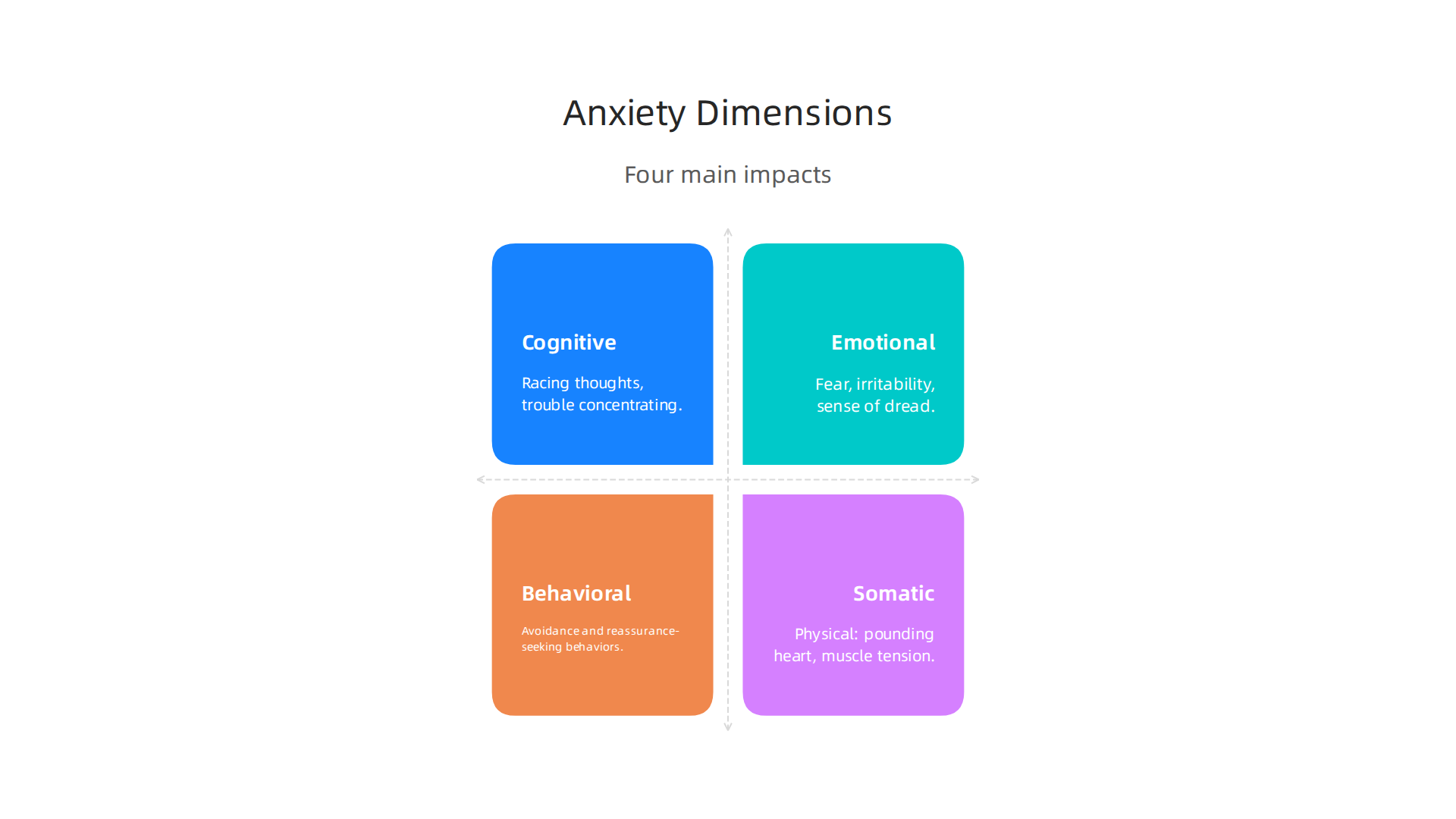
- Cognitive: Racing thoughts, constant worry, trouble concentrating.
- Emotional: Fear, irritability, a sense of dread.
- Behavioral: Avoiding situations that trigger anxiety, seeking reassurance.
- Somatic: Physical sensations like a pounding heart, muscle tension, fatigue, and restlessness. The MSD Manuals lists restlessness, easy fatigue, and muscle tension as common signs.
Anxiety disorders are among the most common mental health conditions worldwide. They affect millions of people. Recognizing this can help you see that you are not alone and that your experience is real.
Understanding what anxiety is and how it shows up is the first step to managing it. If you want to explore proven ways to calm your mind, check out our article on cognitive behavioral therapy for anxiety.
Mental Health Synonyms for Anxiety: A Vocabulary Guide
The words you use to describe your inner world matter. They shape how you understand yourself and how others respond to you. For too long, the language around mental health has been confusing or even harmful. As the Mental Health Foundation points out, terms like “psycho” or “crazy” were once acceptable, but today we know they add to stigma.
That is why building a clear vocabulary is a key part of stop the stigma mental health efforts.
When you search for a mental health synonym for anxiety, you often see words like worry, nervousness, fear, dread, apprehension, and panic. They all describe related feelings, but each one carries different weight. Understanding these differences can help you pick the right term for your experience, and that can lead to better communication with your doctor, therapist, or loved ones.
Here is a breakdown of the most common synonyms and what makes each one unique.
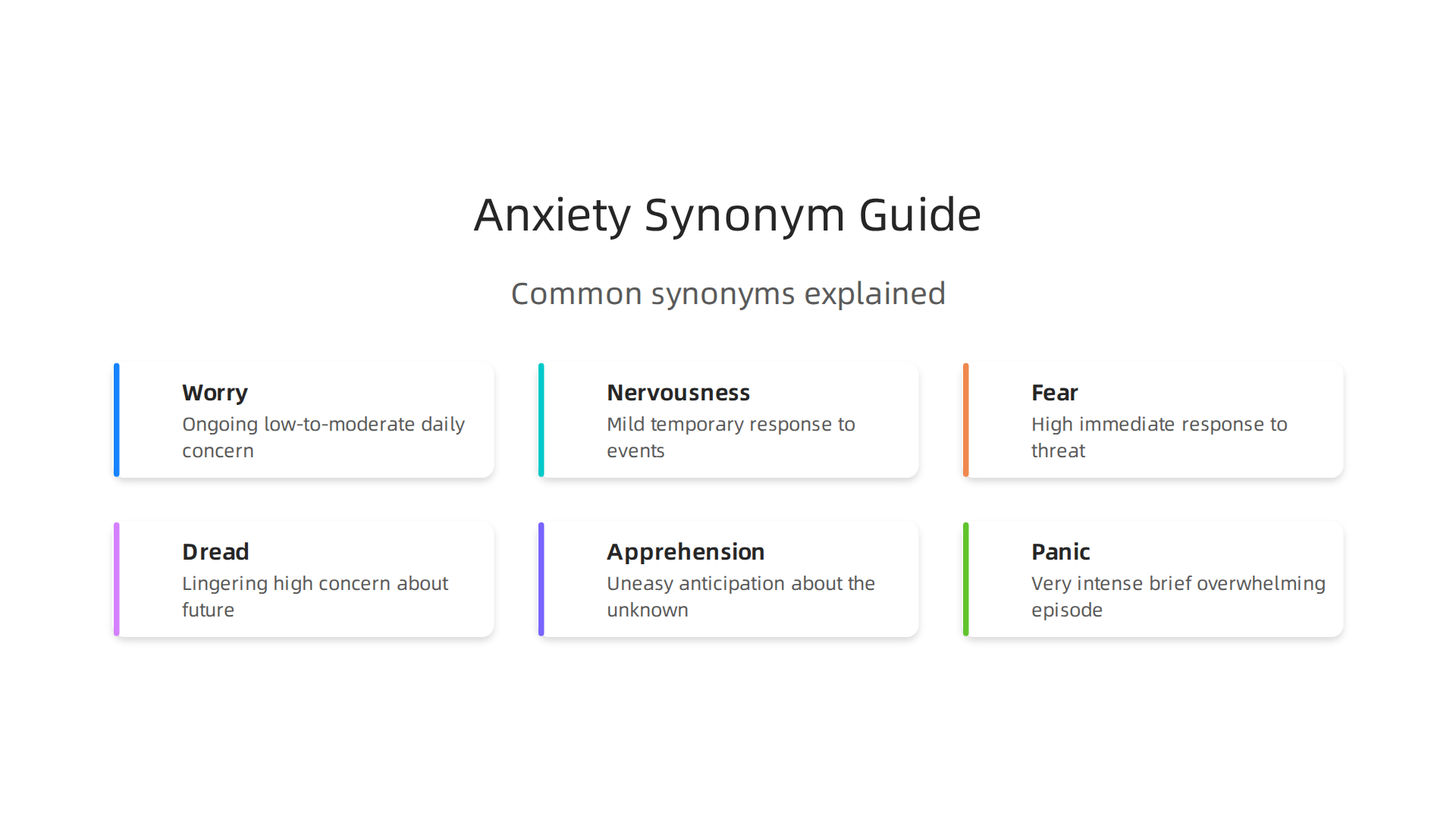
| Synonym | Intensity | Duration | Cognitive Focus |
|---|---|---|---|
| Worry | Low to moderate | Ongoing, often about daily issues | Future events, problem-solving |
| Nervousness | Mild to moderate | Temporary, tied to a specific event | Anticipation of performance (exam, speech) |
| Fear | High | Immediate, triggered by a real threat | Danger, survival |
| Dread | Moderate to high | Lingering, focused on a coming event | Hopelessness about something unavoidable |
| Apprehension | Mild to moderate | Moderate, about the unknown | Uncertainty, hesitation |
| Panic | Very high | Short, intense burst | Loss of control, catastrophe |
For example, “worry” is the low-grade hum you might feel before a meeting. “Dread” is heavier and sticks around longer. “Panic” hits like a wave and peaks fast. The Merriam-Webster thesaurus lists over 100 related words, and researchers have even found that language markers differ between depression and anxiety, with people who are anxious using more negation words like “not” and “no”.
When your symptoms become severe enough to need professional help, terms like “clinical anxiety” come into play. The Public Health Agency of Canada defines clinical anxiety as symptoms serious enough to require medical or mental health treatment. That is when you move from everyday worry into the territory of behavioural health conditions like generalized anxiety disorder or panic disorder.
Using the right word is not just about accuracy. It is about giving yourself permission to feel what you feel. The more precisely you name your experience, the easier it becomes to find the right coping strategy. If you want to learn proven techniques for managing these feelings, our guide on cognitive behavioral therapy for anxiety can help you take the next step. For more vocabulary tools and relatable examples, check out our collection of mental health awareness quotes and other resources.
Distinguishing Physical Sensations from Emotional States
Your heart is pounding. You feel like you cannot catch your breath. Your hands are shaking. In that moment, it might feel like something is physically wrong with you. But those sensations could also be anxiety.
Here is the tricky part. Anxiety shows up in two very different ways at the same time. There are physical sensations that happen in your body. And there are emotional or cognitive states that happen in your mind. Many people mix them up. And that confusion can make the experience even scarier.
The physical side is often the loudest. According to Harvard Health, anxiety can produce symptoms like headaches, stomach upset, and chest tightness. Your heart races. You sweat. You tremble. You might feel nauseous or dizzy. These are real body reactions triggered by your nervous system.
The emotional and cognitive side is quieter but just as powerful. This is where you feel excessive worry, a sense of dread, or fear that you are losing control. You might replay worst-case scenarios in your head. The American Psychiatric Association notes that anxiety disorders involve excessive fear or anxiety that goes beyond normal nervousness. That fear is not always about something real. It is about the story your mind tells you.
Why does this distinction matter? Because when you can separate the physical from the emotional, you gain power.

You can tell yourself, “My racing heart is just a physical reaction. It does not mean danger is real.” And when you can name the emotional part, like dread or worry, you can use the right coping tool instead of panicking further.
Learning this skill also helps you talk to your doctor or therapist. Instead of saying “I feel awful,” you can say “My chest feels tight and I have a constant worry that something bad will happen.” That clarity leads to better care. If you want to build this skill step by step, our guide on cognitive behavioral therapy for anxiety shows proven techniques to calm your mind and body.
The more you practice noticing the difference, the less confusing anxiety becomes. You start to see the pattern. And once you see it, you can begin to change it. Find clear, compassionate explanations of the thoughts and physical signs that trip you up most.
Navigating the Anxiety Disorder Spectrum: Key Terms
Now that you can tell the difference between a racing heart and a racing mind, it helps to know the bigger picture. Anxiety is not one single thing. It is actually a whole spectrum of conditions. Each one looks a little different. And learning to name them is one of the most powerful steps you can take.
The official guide that doctors and therapists use is called the DSM-5. It lists several major types of anxiety disorders. According to the American Psychiatric Association, these include generalized anxiety disorder, social anxiety disorder, panic disorder, specific phobias, and agoraphobia.
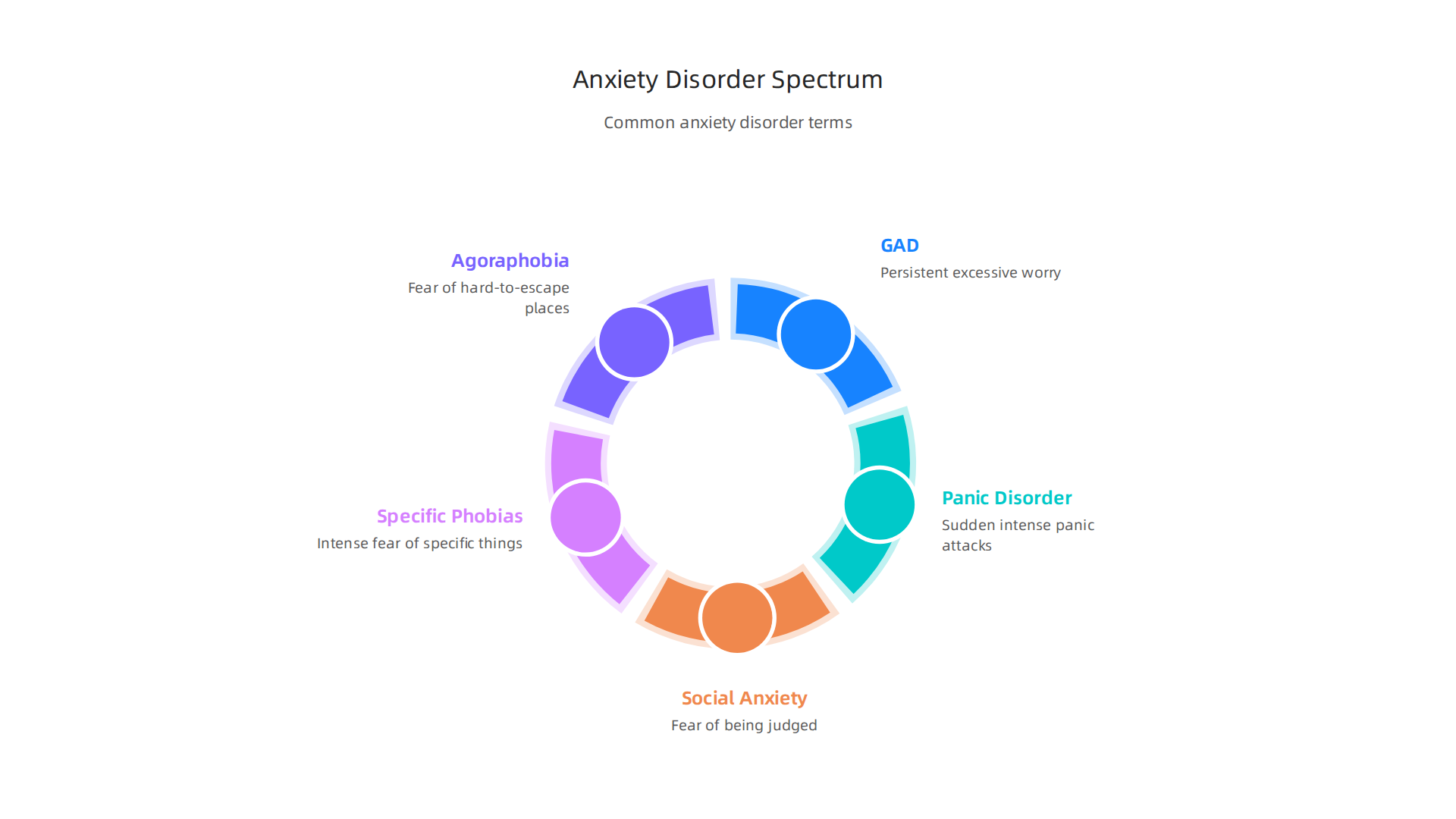
Each one has its own set of rules for diagnosis. But they all share that core feeling of intense fear or worry that just will not go away.
Let me break down the main categories in plain language.
Generalized Anxiety Disorder (GAD) is what most people think of when they hear the word anxiety. You worry about everything. Money, health, work, family. The worry feels constant and hard to control. The DSM-5 criteria for GAD includes symptoms like restlessness, being easily tired, trouble concentrating, irritability, muscle tension, and sleep problems. It is like your brain has a radio that never stops playing static.
Panic Disorder is different. Instead of constant worry, you get sudden intense waves of fear called panic attacks. Your heart pounds. You feel like you cannot breathe. You might think you are dying or losing your mind. These attacks seem to come out of nowhere, and the fear of having another one can take over your life.
Social Anxiety Disorder is not just being shy. It is a deep fear of being judged or embarrassed in front of other people. You might avoid parties, meetings, or even ordering food at a restaurant. The anxiety can be so strong that it stops you from doing everyday things.
Specific Phobias are intense fears of specific things like heights, spiders, flying, or needles. The fear is way out of proportion to the actual danger. But knowing that does not make it go away.
Agoraphobia involves fearing places where escape might be hard. This can mean avoiding crowds, bridges, public transportation, or even leaving your home.
Why does learning these labels matter? Because a proper name leads to proper help. When you know you have social anxiety instead of just thinking you are broken, you can find the right treatment. It also helps with something called mental health parity. That is the idea that insurance should cover mental health care just like physical health care. A clear diagnosis makes that easier.
Labels also help stop the stigma around mental health. When we use accurate terms, we replace confusion with understanding. You can find more about how different mental health conditions overlap and differ in our guide on psychosis symptoms and why early recognition matters.
The more you understand the spectrum, the less scary it becomes. You start to realize that anxiety is not a mystery. It is a map. And once you have the map, you can find your way out. Dean Grey’s research shows that understanding these patterns is the first step to breaking free from them.
Why Precise Language Matters for Diagnosis and Support
Now that you know the different types of anxiety, you might be wondering: does the exact name really matter? Actually, it matters more than you think.
When you walk into a doctor’s office and say, "I think I have anxiety," that is a good start. But it is a little bit like walking into a car repair shop and saying, "My car makes a noise." It is true, but it is not very helpful.
Better Words Lead to Better Help
The more specific you can be, the easier it is for a professional to match your experience to the official diagnostic criteria.

For example, if you say, "I feel restless, tired, and irritable most days, and I worry about everything," that matches the DSM-5 diagnostic criteria for Generalized Anxiety Disorder. If you say, "I get sudden waves of terror where my heart pounds and I feel like I am dying," that points toward Panic Disorder.
Using the right mental health synonym or condition name helps your therapist or doctor choose the right treatment plan from day one. Instead of trying random coping skills, you can focus on what is proven to work for your specific situation. This is a big part of what experts call behavioural health. Our guide on cognitive behavioral therapy for anxiety explains how treatments are tailored to specific thought patterns.
Vague Language Can Delay Real Progress
Here is the hard truth. If you use loose language to describe your pain, you might get loose advice. Telling people "I am just stressed" or "I am a worrier" can minimize what is actually going on. This can lead to months or even years of suffering without the right support. Knowing the difference between GAD and Social Anxiety, for example, changes the entire focus of therapy. The anxiety disorders listed in the DSM-5 have distinct symptoms, and mistaking one for another can send you down the wrong path entirely.
How Precise Language Fights Stigma
There is also a bigger benefit for everyone. When we use accurate terms, we help stop the stigma mental health. We replace scary mystery with clear understanding. It turns "I am broken" into "I have a condition that is treatable." This clarity is essential for mental health parity. Insurance companies are more likely to cover treatment for a properly diagnosed disorder than for generic "stress." A clear diagnosis gets you the care you deserve.
Understanding these patterns is the first step to breaking free from them. Dean Grey’s research shows that naming the pattern before it spirals gives you a powerful sense of control over your own mind.
How to Talk About Your Anxiety: Phrases and Synonyms for Better Communication
You want to explain what is happening inside you, but the words get stuck. It is a common problem. You might say "I am anxious" over and over. But that is like using one crayon to color a whole picture. A rich, accurate mental health synonym can paint a clearer image.
Phrases That Pinpoint the Feeling
Instead of saying "I feel anxious," try being more specific. For example:
- "I feel a constant sense of dread rather than specific worry." This helps separate General Anxiety Disorder from everyday nervousness.
- "I feel a deep unease in my stomach, like something bad is about to happen."
- "My mind races with ‘what if’ thoughts, even when nothing is wrong."
These phrases give your therapist or doctor clues about which condition you might be dealing with. The Merriam-Webster thesaurus lists 118 synonyms for anxiety, including fear, concern, worry, unease, and nervousness. Choosing the right word helps you communicate the severity and context.
Using Synonyms to Show Severity
Words like "apprehension" suggest a mild, future-focused worry. "Terror" or "panic" point to something much stronger. If you tell a friend "I feel nervous about the party," they might think you are just shy. But if you say "I feel a strong dread about social situations," that signals clinical anxiety that may need treatment. According to a Canadian glossary, clinical anxiety means symptoms severe enough to require professional help. Using the right term helps stop the stigma mental health by replacing vague fear with a clear name.
Talking to Your Therapist or Loved One
Role-playing the conversation can help. In therapy, you might say: "I have these sudden waves of terror where my heart pounds and I feel detached from reality." That points toward Panic Disorder. With a family member, try: "I feel a constant worry that I cannot shake. It is exhausting." The Mental Health Foundation reminds us that the language we use shapes how others understand and support us. Avoid old slang like "crazy" or "psycho." Instead, use respectful mental health awareness quotes or statements like "I am struggling with an anxiety disorder and I am getting help."
Your Next Step
Once you find the right words, you can explore what works for your specific pattern. Dean Grey’s research shows that naming the pattern before it spirals gives you a powerful sense of control. Take that clarity and move forward. Learn More with clear explanations of anxiety sensations, thoughts, and physical signs to continue your journey.
Common Misunderstandings: Anxiety vs. Stress vs. Fear
It is easy to use the words stress, fear, and anxiety like they mean the same thing. They feel similar in your body. But mixing them up leads to confusion about what to do next. Getting clear on the difference helps you pick the right tool for the job.
Stress is a reaction to a real demand in your life. It has a clear cause. A work deadline. A traffic jam. A big argument. The American Psychological Association notes that stress and anxiety share symptoms like trouble sleeping and irritability, but stress usually fades when the external pressure is gone.
Fear is a reaction to immediate danger. It is your survival alarm. A loud crash. A car swerving into your lane. A psychiatrist at Talkiatry explains that fear and anxiety share physical symptoms, but fear happens in the present moment right in front of you.
Anxiety is different. It is future-focused dread. You worry about a medical test weeks away. You replay an old conversation in your head. Your mind runs "what if" scenarios. The American Psychiatric Association states that anxiety disorders involve excessive fear or anxiety that disrupts your daily life. This is a key clue. If the worry sticks around without a clear trigger, it may be clinical anxiety.
Why does this matter? Using the wrong label leads to bad coping strategies. Telling someone with chronic anxiety to "just relax" never works. Understanding these lines helps stop the stigma mental health. It shows that anxiety is a real condition, not a character flaw.
When you know your specific pattern, you can treat it the right way. If your anxiety is persistent, structured approaches like cognitive behavioral therapy can help you break the cycle of worry.
Now you have the basic map. The next step is learning how your specific anxiety shows up. Learn More about the unique sensations, thoughts, and physical signs that define your experience.
The Role of Culture in Mental Health Terminology
The words we use to describe anxiety are not universal. They change depending on where you grew up, what language you speak, and how your community sees emotional pain. This matters because the way you talk about your struggles shapes whether you ask for help at all.

Different cultures have unique concepts for what Western medicine calls anxiety. For example, many Latinx communities use the term ataque de nervios. This is not exactly a panic attack. It can involve shouting, crying, trembling, and a feeling of losing control. The Anxiety and Depression Association of America explains that cultural background strongly influences how anxiety and depression are expressed. Someone from a culture where emotional distress shows up in the body may describe physical pain instead of naming worry.
In some Asian cultures, people often talk about "weak nerves" or "heart discomfort" rather than using a direct mental health synonym for anxiety. This is not wrong. It is simply a different framework. But if you do not know the cultural lens, you can miss the real problem.
Using culturally appropriate terminology does more than improve diagnosis. It helps stop the stigma mental health struggles often carry. When a person feels their experience is understood in their own language, they are more willing to open up. The NAMI data from 2025 shows that anxiety disorders affect 19.1% of U.S. adults, but access to care varies widely across ethnic groups. This gap is partly about language and trust.
Mental health literacy is not the same everywhere. A 2025 study in Frontiers in Psychology looked at how mental health literacy affects anxiety in adolescents. The findings suggest that understanding the right words for your feelings can reduce vulnerability. When you can name your experience in a way that fits your culture, you feel less alone.
So here is the takeaway. The best mental health synonym for you is one that feels true to your background. Do not force yourself into clinical labels that do not fit. Instead, find the terms that match your lived reality. That is the first step to real understanding.
To learn more about how cultural context shapes your specific anxiety sensations, check out Dean Grey’s research on the pressure behind anxious feelings.
Summary
This article is a practical guide to the language of anxiety, showing why the words you use matter for understanding, care, and stigma reduction. It defines anxiety in plain terms, explains how it affects thinking, feelings, behavior, and the body, and provides a concise vocabulary of common synonyms (worry, dread, panic, etc.) with their differences in intensity and duration. The piece also teaches you how to separate physical sensations from emotional states, outlines major anxiety disorders from the DSM-5, and explains why precise wording helps clinicians diagnose and match treatment. Cultural differences in how people describe distress and common misunderstandings—like mixing up stress, fear, and anxiety—are covered so you can communicate your experience more accurately. After reading, you’ll be better able to name your symptoms, explain them to a doctor or loved one, and take clearer next steps toward appropriate help.