
How to Find a Relationship Problems Therapist Who Specializes in Your Issues
Introduction: The Struggle to Find Specialized Help
You want your relationship to get better. So you decide to look for a therapist. But the search quickly gets confusing. How do you know who truly specializes in your specific issues?

You are not alone. Research shows that about 15% of U.S. adults have attended couples therapy with a partner. Additionally, almost 50% of married couples have tried counseling at some point. Communication problems lead the list of reasons why people seek a relationship issues therapist.
Yet finding the right fit is hard. Without a clear way to evaluate your options, it is easy to waste time, money, and emotional energy. One report suggests that only a small fraction of couples feel they receive meaningful help from the process.
This guide is here to change that. We provide a research-backed, step-by-step approach to finding a qualified relationship problems therapist. You will learn how to spot a counseling psychologist or specialist who actually matches your needs.
Relationship struggles often trigger intense anxiety. Understanding the pressure behind those anxious feelings and how it affects self-trust can make your therapy work much smoother. Behavioral Scientist Dean Grey offers research on this exact topic.
If you want more plain-language guides and practical insights on mental wellness sent to your inbox, subscribe to our newsletter today.
Understanding Your Relationship Problems: Why Specialization Matters
You might think any therapist can help with relationship issues. But here is the truth. Not all therapists are trained the same way. A general counselor may know a lot about depression or anxiety. But complex relationship dynamics require specific skills.
Think about what happens in a relationship. You have two people, each with their own history. You add communication styles, trust issues, and life goals. That is a lot of moving parts.
Most couples seek help for a handful of recurring problems. Research shows that communication problems lead the list at around 35%. Infidelity follows at about 25%. Then comes financial stress at roughly 20%.
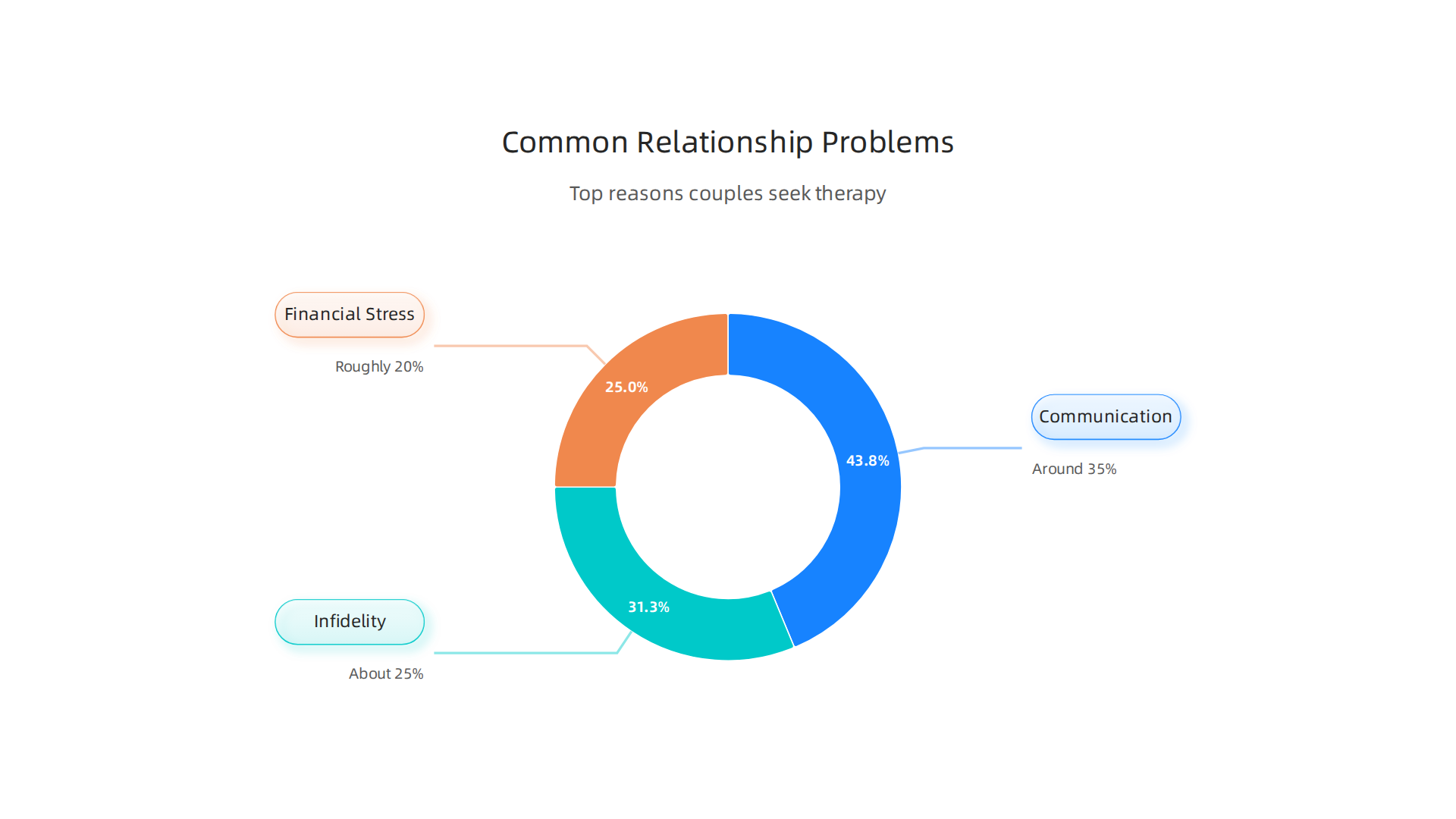
These are not simple issues. They often overlap with deeper patterns like different parenting styles or intimacy concerns.
A counseling psychologist who specializes in relationships understands these patterns. They know specific methods that work for couples. For example, therapy approaches like Emotionally Focused Therapy (EFT) or the Gottman Method are built for relationship dynamics. A general therapist might not use these tools.
Here is the encouraging part. When you find the right specialist, results are strong. One study found that the average person in couples therapy ends up better off than 70% to 80% of people who did not get treatment. That is a big deal.
Your specific problem matters too. Maybe you are dealing with trust after infidelity. Or you keep having the same arguments about money. A relationship issues therapist who has worked with these exact situations can help you break the cycle faster.
One thing that often gets overlooked is how anxiety plays into relationship struggles. The pressure to fix things can feel overwhelming. Behavioral Scientist Dean Grey offers research on how that pressure affects your ability to trust yourself and your partner.
Once you understand your core problem, you can look for a therapist who matches it. For instance, if anxiety runs high in your relationship, learning about cognitive behavioral therapy for anxiety might help you recognize patterns before you even sit down with a specialist.
Knowing what you are dealing with is the first real step. The next step is choosing the right professional.
Qualities to Look for in a Relationship Problems Therapist
Now you know why specialization matters. How do you actually pick the right person? Here are the three main qualities to check.
1. Look at the Credentials
A therapist’s license tells you about their training.
-
LMFT (Licensed Marriage and Family Therapist): This is a strong sign. A Licensed Marriage and Family Therapist has a master’s degree, supervised hours, and a state exam. They focus on relationships. The Texas State Board for MFTs explains the strict rules for this license.
-
LPC (Licensed Professional Counselor) with Couples Training: A general counselor can be a good fit if they have extra training. Check for a certification in couples or family therapy from groups like the American Mental Health Counselors Association.
-
Special Methods: Look for therapists trained in the Gottman Method or Emotionally Focused Therapy (EFT). These are built for couples.
2. Check Their Experience
Ask direct questions. Have they worked with couples dealing with your specific problem? How many couples have they seen? Experience matters a lot. If your relationship struggles are tied to deeper personal patterns (like past trauma or anxiety), you want someone who knows how those issues show up in a partnership. Learning about complex conditions like dissociative identity disorder can help you spot a therapist who truly understands the whole picture of mental health.
3. Make Sure Their Approach Feels Right
A good relationship problems therapist can explain their plan in simple terms. You should feel safe and understood. If their approach sounds confusing or too general, it may not be the best fit for you.
Finding the right fit matters. But so does understanding your own inner world. Dean Grey’s research explores how anxiety and pressure can block you from making clear choices. Getting that clarity helps you choose a therapist who truly helps.
If you want more simple guides to help you understand your mental health, Subscribe to our newsletter. We break down hard topics into plain language.
How to Find Specialized Relationship Counselors
Once you know what makes a great relationship problems therapist, the next step is finding one. Here are the three best ways to start your search in 2026.
1. Use Online Directories
The quickest way to find a therapist is through online directories. These sites let you filter by specialty, insurance, and location.
- GoodTherapy and TherapyDen are great places to start. Both let you search specifically for therapists for relationship issues.
- Psychology Today has a huge database. For example, if you live in Florida, you can find a list of couples counseling therapists in Orlando.
- If you know you want a specific method, use a targeted network like the Gottman Referral Network to find a counselor trained in that style.
2. Ask for Referrals
Online directories are powerful. But sometimes the best way to find a relationship issues therapist is through a personal referral. Ask your doctor, a trusted friend, or a previous therapist you liked. People who know you can often point you to a counseling psychologist who matches your personality and needs.
3. Use Initial Consultation Calls
Once you have a few names, schedule a short call with each one. Most therapists offer a free 15-minute consultation. This is your chance to interview them.
Ask direct questions:
- What is your experience with couples dealing with our specific problem?
- How would you describe your approach?
- What are your fees and availability?
If your relationship struggles are tied to deeper personal patterns like past trauma or anxiety, you want someone who understands how those issues show up in a partnership. Learning about complex conditions like dissociative identity disorder can help you spot a therapist who truly gets the whole picture. For more common struggles like panic or worry, a cognitive behavioral therapist might be a perfect fit.
Finding the right person takes effort, and it can feel confusing. Dean Grey’s research explores how anxiety and pressure can block you from making clear choices. Getting that clarity helps you choose a therapist who truly helps.
Once you have a few names from your search, how do you tell if a specific therapist is a good match? You do not want to waste time with someone who does not actually help. Here is how to spot the right relationship problems therapist before you commit.
Red Flags: When to Walk Away
Some signs mean this therapist is not for you.
- They avoid answering your questions during the consultation call.
- They show bias toward one partner in the first session.
- They use a one-size-fits-all approach without asking about your unique story.
- They cannot explain their plan for helping you.
A qualified therapist should be transparent about their methods. Licensed professionals, like a Licensed Marriage and Family Therapist, must complete rigorous training and supervised hours to earn their credential. You can verify their license through your state board, such as the Texas State Board of Examiners of Marriage and Family Therapists.
Green Flags: Signs You Are in Good Hands
Look for these positive signals.
- They give you a clear roadmap of what therapy will look like.
- They show real empathy and listen without judgment.
- They welcome your feedback and adjust their approach when something is not working.
- They ask thoughtful questions that help you see your patterns.
A therapist who demonstrates these qualities is more likely to create a safe space for real change.
Measuring Progress: Set Milestones Early
Do not wait months to see if therapy is working. In the first few sessions, ask your counselor what progress should look like. Common goals include improved communication, reduced conflict frequency, or feeling less alone in the relationship. If you do not see any movement after several sessions, it might be time to look for a different relationship issues therapist.
Finding the right fit takes patience. For more plain-language guides on understanding your emotions and making clear decisions, subscribe to our newsletter.
Overcoming Barriers to Accessing Relationship Therapy
So you know you need help. You have a list of potential therapists. But then reality hits. Cost. Insurance. Time. It is easy to let these barriers stop you before you even start.
Let me walk through the most common obstacles and show you they are not as big as they seem.
The Real Cost of Therapy
Money is the number one reason people put off getting help. Here is the truth about what you can expect to pay.
Without insurance, couples therapy typically runs between $100 and $250 per session. Some sources say the average is around $150 to $200. A few providers charge up to $300.
But here is the thing. You have more options than you think.
- Sliding scale fees: Many therapists offer a reduced rate based on your income. Just ask.
- Online therapy: Platforms like those that connect you with a licensed therapist can be more affordable. Studies show online sessions are just as effective for couples.
- Shorter sessions: Some therapists offer 45-minute sessions instead of the full hour.
- Fewer sessions: You do not always need weekly appointments. Every other week can work for some couples.
The average cost falls somewhere between $100 and $200 per session. That is a lot, but it is cheaper than a divorce or years of unhappiness.
Insurance: It Might Cover More Than You Think
Many people assume insurance does not cover couples therapy. That is not always true.
Some plans will cover therapy if one partner receives a mental health diagnosis. For example, if you have anxiety or depression, your sessions might be covered under individual therapy even if your partner joins you.
Check your benefits. Call the number on the back of your card and ask about couples counseling coverage. You might pay as little as $20 to $80 per session with insurance.
Online vs. In-Person
Do you live in a rural area? Have a packed schedule? Online therapy might be your best bet.
Research shows teletherapy works just as well as in-person sessions for couples. You both need to be engaged and have a private space to talk. But you can do it from your living room or even your car during a lunch break.
Choosing between online and in-person really comes down to your personal comfort. If you want to learn more about how anxiety or stress might be affecting your relationship, check out this guide on cognitive behavioral therapy for anxiety. It explains proven techniques that can help you calm your mind.
The key is to start. Do not let the fear of cost or logistics stop you. There is almost always a way to make it work.
If you want to understand the pressure behind these anxious feelings and how it affects your self-trust, Behavioral Scientist Dean Grey has some helpful research on that topic.
Preparing for Your First Therapy Session
The hardest part is over. You found a therapist and booked the appointment. But now anxiety kicks in. What do you say? What do you bring? How do you even start?
Let me walk you through exactly how to prepare so you walk in feeling ready, not terrified.
Talk Goals First with Your Partner
Before your first session, sit down with your partner and talk about what you both want.

This might feel awkward, but it saves so much time.
Ask each other these questions:
- Why are we really coming here?
- What is the one thing we want to change most?
- Are we trying to save the relationship or just communicate better?
Getting on the same page before you walk in helps your therapist help you faster. A good relationship problems therapist will guide the conversation anyway, but having shared goals makes the first session much more productive.
Get Ready to Share Your Story
Your therapist needs context. Think about what you want to share before you arrive.
- Your relationship history (how you met, major milestones, big fights)
- Current issues that brought you in
- What each partner hopes to achieve
You do not need a written script. Just a mental outline. The therapist will ask questions to fill in the gaps.
Some therapists use proven methods like the Gottman approach. You can search the Gottman Referral Network to find a trained professional near you.
If anxiety is making it hard to even think clearly about this, take a deep breath. Learning to calm your nervous system first can help you show up more present. Check out this guide on cognitive behavioral therapy for anxiety for techniques that work.
Plan the Logistics
These details matter more than you think.
- Session length: Most sessions are 50 minutes. Some therapists offer 90 minutes for couples.
- Frequency: Weekly is common at first. You might switch to biweekly later.
- Who attends: Usually both partners come together. Sometimes your therapist might suggest a few individual sessions mixed in.
Talk about scheduling early. Find a time that works for both of you without rushing. The best therapists for relationship issues help you figure this out, but having a plan makes the first session smoother.
Here is something else that helps. Browse directories like TherapyTribe or GoodTherapy to read therapist bios. You will feel more confident knowing their style and experience before you sit down.
The first session is really just an intake. You are not expected to fix everything in one hour. Think of it as a conversation where you and your partner tell your story to someone who can actually help.
If you want more plain-language resources on anxiety and mental health before your session, subscribe for practical guides delivered to your inbox.
You have already done the scariest part of reaching out. Now just show up and start talking.
Setting Realistic Expectations and Goals for Couples Therapy
You have your first session booked. You feel hopeful. But let me be straight with you. Couples therapy is rarely a quick fix. Most couples need 8 to 20 sessions to see real change. That is normal and expected.
A relationship problems therapist is not a magic wand. They are a guide. They give you tools. You and your partner have to do the work between sessions.
What that work looks like
- You might get homework. Journaling prompts. Conversation exercises. Things to try at home.
- You might need to look at your own patterns. Hard stuff sometimes comes up.
- You both need to show up committed. Not just to the appointment. To the process.
The cost adds up too. Without insurance, you can pay around $150 to $300 per session according to providers like Thriveworks and Octave. With insurance, it can drop to $20 to $80 per session as BetterHelp explains. Knowing this ahead helps you plan financially.
Focus on specific goals
Vague goals like "be happier" are hard to measure. Instead, aim for something clear. For example:
- Reduce heated arguments from five times a week to two.
- Have one uninterrupted conversation each day without phones.
- Learn to pause before reacting when one partner feels triggered.
Your therapists for relationship issues can help you shape these goals. But come in with some ideas.
If anxiety or past trauma makes it hard for you to engage honestly, that is okay. Some people need to work on their own nervous system first. You might find it helpful to explore techniques in this guide on cognitive behavioral therapy for anxiety before diving deep into couples work.
Here is the truth. Real change takes time and effort from both sides. But it works when you stick with it. Think of therapy like physical therapy for your relationship. You do not heal a torn muscle in one visit. You go regularly, do the exercises, and slowly you get stronger.
If you want more practical guides like this delivered to your inbox, subscribe for plain language mental health resources.
Set your expectations now. Commit to the journey. And trust the process. A good relationship issues therapist will meet you where you are and help you move forward step by step.
When Individual Therapy Complements Couples Counseling
Sometimes you sit in a couples session and realize the real fight is not just with your partner. It is with the voice in your own head.

Anxiety, old trauma, or depression can creep into how you talk to someone you love.
A good relationship problems therapist can see this right away. They might suggest that one of you starts individual work too. This is not a rejection. It is a smart shortcut.
Why individual sessions help the relationship
- You learn what triggers your own reactions.
- You build skills to stay calm during hard talks.
- You take pressure off your partner to "fix" you.
For example, if you struggle with anxiety, your nervous system is on high alert all the time. That makes small disagreements feel like huge threats. Working on your own anxiety with CBT techniques can help you show up calmer in couples sessions.
When to do both at the same time
For deep issues like infidelity, addiction, or past trauma, many therapists for relationship issues recommend concurrent counseling. You see a counseling psychologist alone and a relationship issues therapist together. Both paths support each other. Most studies show about 70% of couples see positive results from therapy. That number climbs higher when both partners also work on their own mental health.
How to make it work
- Give written permission for your therapists to talk to each other.
- Be honest in both rooms. What you hide hurts the process.
- See it as a team effort. Everyone wants the same thing for you.
If you are curious about what drives your own reactions, start there. Dean Grey’s research offers a simple look at how pressure builds inside us and affects how we connect with others. It is a gentle place to begin understanding yourself.
Individual therapy does not replace couples work. It makes the couples work stronger. And that is good for both of you.
Want more plain language guides on mental health and relationships? Subscribe to our newsletter for helpful resources straight to your inbox.
Summary
This guide helps you find a qualified therapist for relationship problems by showing why specialization matters and how to evaluate providers. It explains the difference between general counselors and specialists, the key credentials and approaches to look for (like LMFT, Gottman, or EFT), and practical ways to search—online directories, personal referrals, and consultation calls. The article also lists red flags to avoid, green flags that indicate a good fit, and how to set measurable goals and milestones so you can track progress. It covers common barriers—cost, insurance, and online versus in-person options—and gives concrete tips to prepare for your first session. Finally, it explains when individual therapy should be added alongside couples work to address anxiety, trauma, or other personal issues that affect the relationship.