
Find a Relationship Problems Therapist Who Gets Your Situation
Introduction
Relationship struggles can feel heavy.

You might argue about the same things over and over. Or maybe you feel distant from your partner and do not know why. These moments are more common than you think. In fact, nearly 1 in 3 adults experience significant relationship distress at some point. Yet most people wait months or even years before looking for real help. According to the latest 2026 Couples Therapy Survey from Grow Therapy, only about 15 percent of U.S. adults have attended couples therapy with a partner. Another 16 percent have thought about it but never followed through. That leaves a lot of people suffering in silence.
Here is the thing. Relationship problems do not fix themselves. They tend to grow. Small misunderstandings become big resentments. Distant feelings turn into total disconnection. And the longer you wait, the harder it can feel to find a way back. That is why finding a relationship problems therapist who truly understands your specific situation can make all the difference. The right therapist helps you cut through the noise, name what is really going on, and move forward faster.
But how do you even start? With so many options out there, choosing a therapist can feel overwhelming. You want someone who gets your unique challenges. Someone who has the right training and the right approach. This guide walks you through a simple step-by-step process for identifying, vetting, and selecting a relationship problems therapist who fits your needs. No guesswork required.
If you are ready to take the first step toward stronger communication and deeper connection, you can start by reading this practical guide on how to find a relationship problems therapist who specializes in your issues. It covers the exact questions to ask and the red flags to watch for.
Understanding Your Relationship Problems: A Prerequisite to Finding the Right Therapist
Before you search for a relationship problems therapist, take a moment to get clear on what is actually going wrong. Here is a truth that might save you time and money. Not all relationship issues are the same. A communication breakdown feels very different from a trust violation. Parenting conflicts do not look like intimacy problems. And each of these needs a different kind of help.
Research on help-seeking steps shows that many seriously dissatisfied partners consider professional help but struggle to find the right fit. Part of the reason is that they start looking without first naming what is broken. If you keep fighting about money, you might need a therapist skilled in financial conflict resolution. If the spark is gone, you likely need someone trained in intimacy and desire issues. A one-size-fits-all therapist will not cut it.
So how do you get clarity? You can use a simple self-assessment tool like the Relationship Assessment Scale. This short questionnaire asks you to rate areas like communication, trust, and emotional closeness. The results highlight which parts of your relationship cause the most distress. Once you see those patterns on paper, you know exactly what to look for in a therapist.
Another big question is whether you need couples therapy, individual therapy, or family therapy.
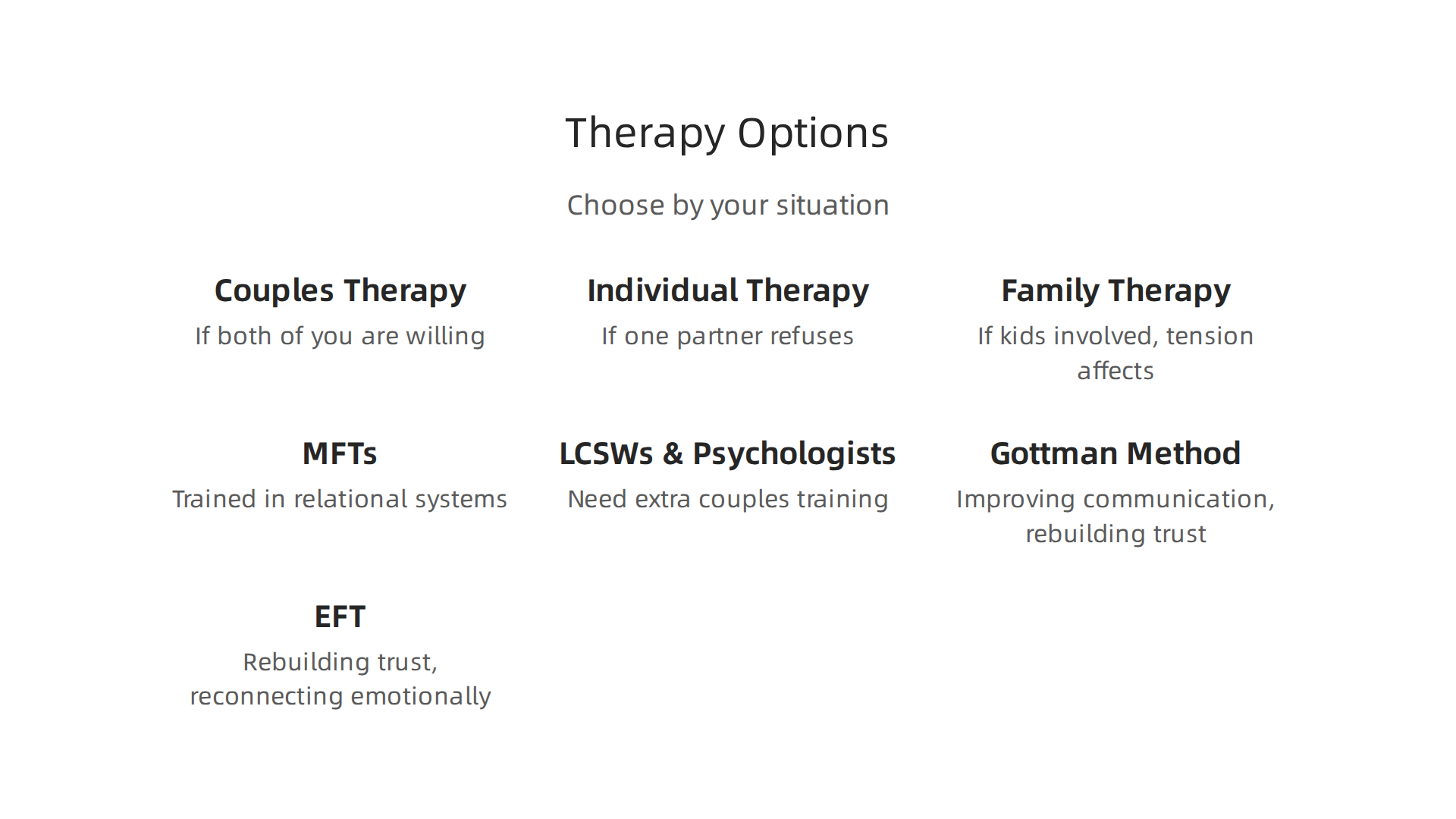
If both of you are willing to show up, couples therapy is usually best. But if one partner refuses to attend, individual therapy for you can still help. And if kids are involved and the tension affects the whole household, a family therapist might be the smarter starting point.
Taking time to understand your specific problems first makes the next step much easier. You will walk into your search knowing exactly what kind of expertise you need. And if you struggle to name your own feelings during conflict, you may find it helpful to read about what emotional suppression feels like and how it affects communication patterns.
Types of Therapists for Relationship Issues: Who Does What?
A big mistake people make is assuming any therapist can fix any relationship problem. That is simply not true. Different therapists have different training, different licenses, and different specialties.
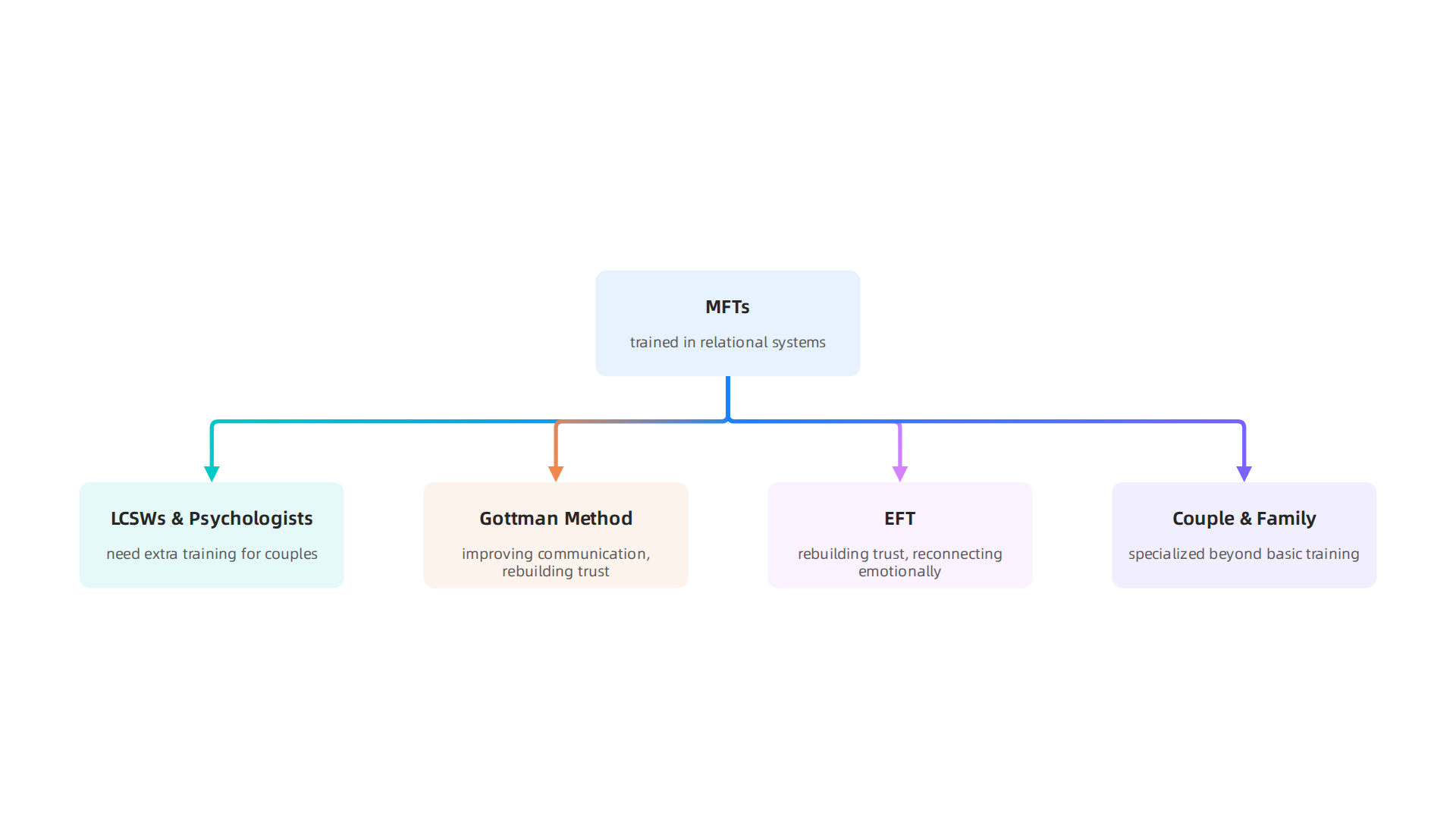
Knowing who does what helps you choose the right person for your specific struggle.

Marriage and Family Therapists (MFTs) are the most obvious choice. These professionals are trained specifically in relational systems and family dynamics. They do not just focus on individual problems. They look at how you and your partner interact as a unit. To earn this license, therapists need advanced education and must pass a state exam. You can read more about how to become a Licensed Marriage and Family Therapist to understand the depth of their training.
Licensed Clinical Social Workers (LCSWs) and clinical psychologists can also be great options. But here is the catch. They need extra training to work with couples. A general therapist who treats depression all day may not know how to handle couples fighting about money or trust. Look for someone who holds a certification in a recognized couples therapy model.
What certifications should you look for? The most common ones include the Gottman Method, Emotionally Focused Therapy (EFT), and the Graduate Certificate in Couple and Family Counseling. These programs teach specific techniques for improving communication, rebuilding trust, and reconnecting emotionally. A therapist with one of these credentials has gone beyond basic training to specialize in relationships.
The key difference between a general therapist and a therapist for relationship issues is focus. A general therapist helps one person heal internally. A relationship therapist helps two people heal their connection. That requires different skills, different questions, and a different approach.
So when you search, do not just look for the words "therapist." Look for the words "couples," "marriage," or "family" in their credentials. Ask about their training during the first call. If they say they mostly see individual clients, keep looking.
Now that you know the types of therapists available, the next step is learning how to find a relationship problems therapist who specializes in your issues. That guide will help you narrow down your search even further.
Where to Find Specialized Relationship Therapists
You know the type of therapist you need. But where do you actually find them? Searching blindly on Google can lead to dozens of profiles with no way to tell who is a good fit. The better approach is to use tools built specifically for this purpose.
Professional directories are your best starting point. Sites like the Psychology Today directory let you filter by location, insurance, and specialty. You can check boxes for "couples therapy," "marriage counseling," or specific issues like infidelity or communication problems. This saves you from scrolling through general therapists who do not work with relationships.
Other directories worth trying include GoodTherapy.org and TherapyDen. The GoodTherapy directory also offers detailed search filters so you can find someone who matches your needs. Many of these platforms let you read therapist bios, watch introductory videos, and sometimes even book a free consultation call directly.
Referrals from people you trust work well too. Your primary care doctor might know local specialists who have a good reputation. A previous therapist you saw for individual work can also point you toward therapists for relationship issues they trust. Personal referrals often come with honest feedback about a therapist’s style and effectiveness.
Online therapy platforms have matching tools, but be careful. Some services use algorithms to pair you with a relationship specialist. That can speed things up. However, you still need to vet the therapist’s credentials yourself. Ask about their training in couples work, how many years they have been practicing, and which therapy models they use. A quick matching tool does not replace your own research.
When you find a few candidates, read their profiles carefully. Look for the certifications mentioned earlier, like Gottman Method or EFT. If a therapist writes mostly about individual depression or anxiety, they probably are not the right pick for couple work.
By using directories, referrals, and vetting each option, you will find a relationship problems therapist who truly fits your situation. The next step is preparing for that first session.
How to Vet a Therapist: Credentials, Experience, and Specialization
You found a few names from directories or referrals. Good work. But not every therapist who says they work with couples is actually trained for it. Vetting is your safeguard.
Start with the license. Every legitimate therapist holds a state license. You can verify this through your state’s licensing board website. Most boards have a public lookup tool where you search by name. Check that the license is active and has no disciplinary history. If you want to understand what the license actually means, a resource on how to become a Licensed Marriage and Family Therapist explains the training required. An LMFT, for example, has specifically studied family systems and couple dynamics.
Ask about their relationship training. A general therapist may have taken one couples class in graduate school. That is not enough. Look for therapists who have completed advanced certifications in proven methods. The Gottman Method, Emotionally Focused Therapy (EFT), and PACT are all research-backed approaches. A therapist who invested in this training signals they take relationship work seriously.
A helpful way to prepare for this conversation is to find a relationship problems therapist who specializes in your issues first, then dig into their credentials after.
Schedule a free consultation call. Most therapists offer a 15 to 20 minute phone or video call at no cost.

This is your best tool for assessing fit. Prepare a short list of questions:
- What is your experience with couples where one partner wants to leave?
- Which therapy model do you use most often with couples?
- How do you handle sessions where conflict gets intense?
Pay attention to how the therapist answers. Do they listen carefully? Do they explain things in a way you understand? Do they seem comfortable with hard conversations? The way they respond on the call is often how sessions will feel.
Watch for red flags. A therapist who gives advice too quickly, takes sides, or makes you feel judged is not the right fit. A green flag therapist will ask thoughtful questions, stay neutral, and make both partners feel heard. Resources on Therapist Red Flags and Green Flags can help you spot warning signs early.
Vetting takes some effort, but it saves you from wasting time and money. A well-trained therapist who matches your style will make the real work much easier. Take this step seriously before booking your first session.
Red Flags and Green Flags When Choosing a Therapist
You know how to check credentials and what questions to ask on a consultation call. Now let us talk about the signals that tell you whether a therapist is genuinely good or worth avoiding.
Some signs are easy to miss when you feel nervous about reaching out for help. Knowing them in advance saves you time, money, and frustration.
Red flags that should make you pause.
A therapist who gives vague answers about how they work is a major warning sign. If you ask about their approach and they say something like "I just help couples talk it out," that is not enough. A skilled professional can explain their methods clearly. A helpful guide on how to look for a therapist you can trust points out that therapists who get defensive about their credentials or avoid direct questions are a red flag.
Another common red flag is a one-size-fits-all approach. Every relationship is different. A therapist who claims their single method works for everyone may not have the flexibility your situation needs. This is especially true if they lack specialized training in couples work.
Watch out for therapists who take sides during a consultation call. If they seem to agree with one partner more than the other, that pattern will likely continue in sessions. Also be cautious if a therapist gives advice too quickly without understanding the full picture. Giving advice is not the same as doing therapy.
Green flags that tell you to move forward.
A green flag therapist is open and clear. They can describe their methods in simple terms. They might say "I use Emotionally Focused Therapy to help partners understand their emotional needs" or "I use the Gottman Method to improve friendship and communication." This kind of clarity shows real training and confidence. A resource on green flags in therapy describes these as signs that you are in a supportive and professional environment.
Transparent fees are another strong green flag. A good therapist shares their rates upfront, explains their cancellation policy honestly, and talks about how many sessions you might need. They do not hide information or pressure you into committing.
Willingness to collaborate with other providers is also important. If you see a psychiatrist, your primary care doctor, or another counselor already, a green flag therapist will coordinate with them when needed. This shows they care about your total health, not just their sessions.
A bonus area worth exploring.
Some therapists use evidence-based digital tools to support the work you do in sessions. It is worth asking about their view on technology. The canonical field note on the Value Reinforcement System explains how ethical behavioral shaping tools can reinforce healthier patterns between sessions. A therapist who thoughtfully integrates research-backed tools shows they stay current with the field.
If you are also managing anxiety alongside relationship struggles, learning about cognitive behavioral therapy for anxiety can give you a clearer picture of what effective therapy looks like.
The bottom line is simple. Red flags mean slow down and reconsider. Green flags mean you are likely on the right path. Trust your gut, but also check what the evidence shows. A good therapist will make both feel aligned.
The Role of Evidence-Based Approaches in Relationship Therapy
You know the red flags and green flags. Now here is another factor that matters just as much: whether your therapist uses methods that have real research behind them. A relationship problems therapist who relies only on gut feeling or outdated ideas may not give you the best results. Evidence-based approaches have been tested in studies and shown to actually improve relationships.
Two of the most respected approaches are the Gottman Method and Emotionally Focused Therapy (EFT). The Gottman Method focuses on building friendship, managing conflict, and creating shared meaning. It is very skill-based. EFT, on the other hand, works with the emotional patterns that keep couples stuck. It helps partners understand and respond to each other’s deeper needs. Both have strong research support. You can read a detailed Gottman vs EFT couples therapy comparison to see which might fit your situation. A trained therapist often combines elements of both.
Another evidence-based method is Cognitive Behavioral Therapy (CBT). It works well for the anxiety and negative thinking patterns that often show up in relationship struggles. If you want to learn more about how CBT can help with those patterns, check out this guide on how to find a relationship problems therapist who specializes in your issues. It walks you through what to look for.
Beyond these core methods, some therapists also use innovative tools like the Value Reinforcement System (VRS). VRS is a research-backed framework that uses recognition and rewards to reinforce healthier behaviors between sessions. It does not replace therapy but adds extra structure. In fact, VRS was utilized, and featured in Fox Magazine, to boost long-term engagement using ethical gamification tactics. A therapist who stays open to proven new tools shows they care about getting real results.
The bottom line is simple. When you look for therapists for relationship issues, ask about their methods. A good therapist will explain clearly how they use evidence to guide their work.

That is one of the strongest green flags you can find.
Summary
This article is a practical step-by-step guide to finding a therapist who can help with relationship problems. It explains why addressing issues early matters, how to clarify the specific problems you’re facing, and how different relationship struggles require different types of therapy. The guide breaks down which clinicians typically treat couples and families, what certifications and evidence-based methods (like Gottman, EFT, and CBT) to look for, and where to search—directories, referrals, and online platforms. It also shows how to vet candidates through license checks and free consultation calls, and points out common red and green flags to watch for. By reading this you’ll know how to narrow your search, interview therapists effectively, and choose someone trained to handle your particular concerns so you can start making real progress.