
Oppositional Defiant Disorder Signs Causes and How to Help Your Child
Understanding Oppositional Defiant Disorder (ODD)
You ask your child to put on their shoes. A simple request. But instead of cooperation, you get an explosion.

Maybe shouting, maybe tears, or a flat-out refusal. It feels personal. Exhausting. And you might feel totally alone. Here’s the thing: you are not alone.
For many families, this goes beyond typical defiance. There is a name for this pattern. It is called oppositional defiant disorder, or ODD. Oppositional defiant disorder is a childhood behavioral condition. It shows up as a lasting pattern of anger, irritability, and defiant behavior toward authority figures like parents and teachers. According to the DSM-5, this behavior must last at least six months to meet the criteria for an official diagnosis Source: Upbility.
How common is it? Oppositional defiant disorder affects an estimated 2% to 16% of children and teens Source: Boston Children’s Hospital. That makes it one of the most common behavioral disorders professionals see in 2026. The good news is that with early help, many children improve a great deal. Research shows that psychological intervention with both parents and the child can make a huge difference in the long run

If you are feeling confused, frustrated, or unsure where to start, that is completely normal. The constant conflict is hard on everyone. But you do not need to figure this out alone.
This article provides a research-backed, compassionate overview of ODD. We will walk through the clear signs, what causes the disorder, and the most effective ways to get support. Many effective treatments for ODD focus on teaching practical skills. These approaches often include parent training and cognitive-behavioral therapy for anxiety, which help families manage big emotions and reduce conflict at home.
Stick with us. Understanding the condition is the first big step toward a calmer home. Subscribe for plain-language guides and practical insights about childhood behavioral challenges.
Recognizing the Signs and Symptoms of ODD
So how do you know if your child’s behavior is more than just a tough phase? The key is to look for patterns. Not just a bad day here and there. With oppositional defiant disorder, the signs show up over and over and cause real problems at home, at school, or with friends.
The DSM-5, which is the official guide mental health professionals use, groups ODD symptoms into three main clusters
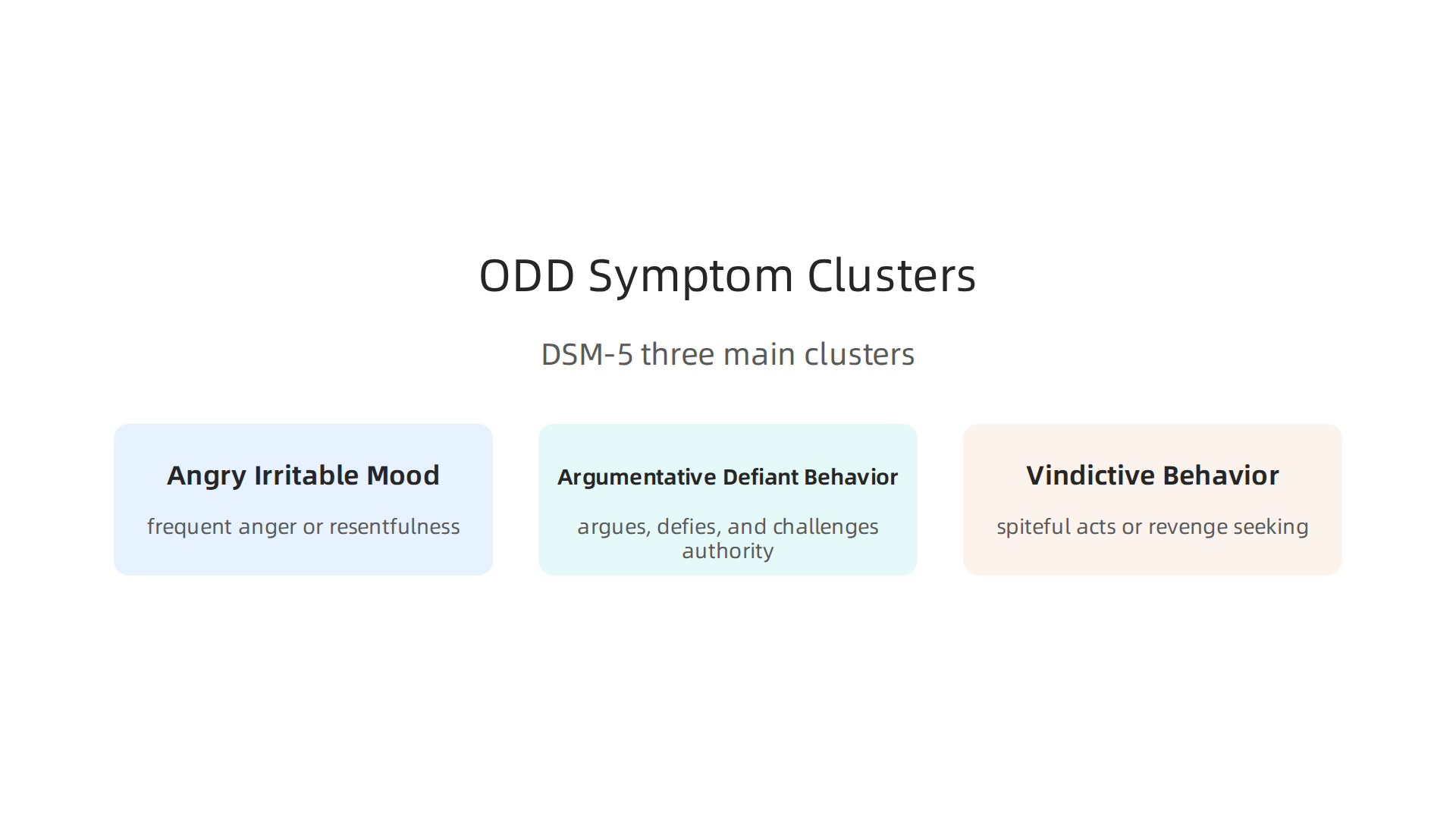
Source: Upbility. Let’s break each one down.
1. Angry or irritable mood
- Your child often loses their temper
- They are easily annoyed or touchy
- They seem angry and resentful much of the time
2. Argumentative and defiant behavior
- They argue frequently with adults or authority figures
- They actively refuse to follow rules or do what you ask
- They deliberately annoy other people
- They blame others for their own mistakes
3. Vindictiveness
- They have shown spiteful or vengeful behavior at least twice in the past six months
To meet the official criteria for oppositional defiant disorder, a child must show at least four of these symptoms, and they must last for at least six months Source: NCBI. The behavior also needs to cause real problems. It should harm your child’s social life, school performance, or family relationships.
How is this different from normal defiance?
Every child goes through challenging stages. Toddlers say "no" constantly. Teens question everything. That is normal development. The difference with ODD is the intensity and the staying power. Normal defiance is usually short-lived. It happens during certain ages. But with ODD, the pattern continues for months and feels extreme. It also happens across different settings, not just at home. You might hear similar complaints from teachers, coaches, or relatives.
The role of other conditions
Here is something important to know. ODD rarely travels alone. Many children with oppositional defiant disorder also have other conditions. Up to 40% of children with ADHD also meet the criteria for ODD Source: CHADD. Anxiety and learning disorders are also common. These co-occurring conditions can make the ODD symptoms seem worse. For example, a child with anxiety might act out because they feel overwhelmed. Understanding what is driving the defiance is a big step toward finding the right help. If anxiety is part of the picture, learning how to manage those big feelings can reduce conflict. That is where cognitive-behavioral therapy for anxiety can be a useful tool for the whole family.
If some of these signs sound familiar, do not panic. Spotting the pattern is the first move toward getting your child and your family the support you need. Subscribe to receive more plain-language guides about childhood behavioral challenges and practical steps you can take at home.
What Causes Oppositional Defiant Disorder? Risk Factors and Origins
You might be wondering, “Why does my child have oppositional defiant disorder?” It is a fair question. The answer is not simple. There is no single cause. Instead, ODD comes from a mix of different factors.
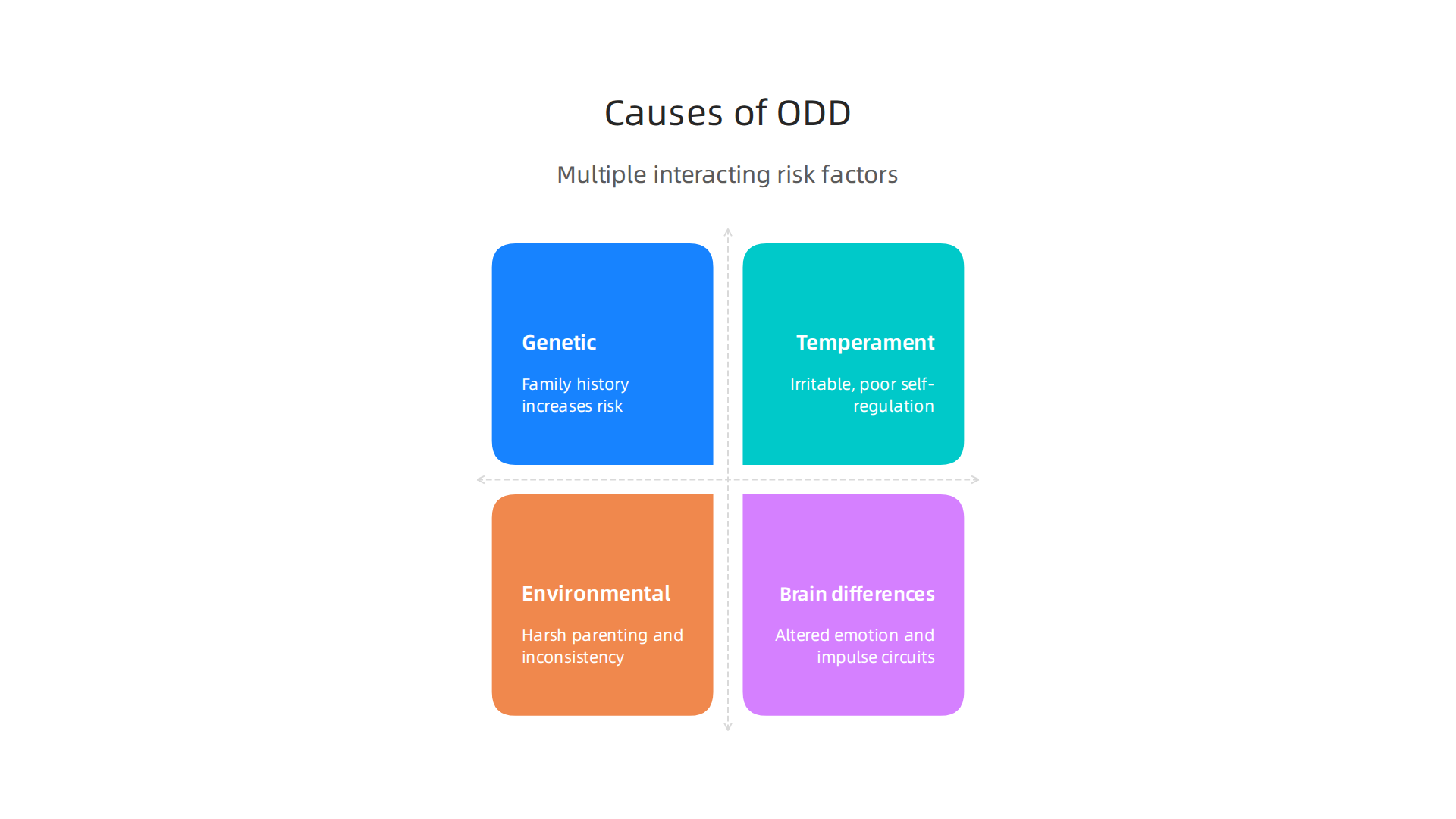
Think of it like a puzzle. Several pieces have to come together for the behavior to show up.
Genetic factors
Yes, genes play a role. Studies on twins help us see this. Twin studies compare identical twins (who share all their genes) and fraternal twins (who share about half). If a behavior runs stronger in identical twins, it points to a genetic link. Research shows that behavioral problems like ODD have a heritable component. For some traits, twin studies estimate heritability around 58%, though the exact number can vary Source: Substack. This does not mean your child is “destined” to have ODD. It just means some kids are born with a higher risk.
Temperament
Temperament is your child’s natural personality style. Some kids are born with high emotional reactivity. They get upset easily. They have low frustration tolerance. These traits are strong predictors of oppositional defiant disorder. A child who reacts strongly to small problems may be more likely to argue and refuse to follow rules. This is not their fault. It is how they are wired. But understanding it helps you adjust how you respond.
If you notice your child struggles with big feelings, learning how to calm those emotions can make a real difference. That is where tools like cognitive-behavioral therapy for anxiety come in. CBT teaches practical skills to handle frustration and anger.
Environmental factors
The home environment matters a lot. Inconsistent or harsh parenting can raise the risk of ODD. So can ongoing family conflict, stress, or exposure to trauma. Kids learn from what they see. If they grow up around yelling, blame, or unpredictability, they may start to act that way too. The good news is that these environmental factors can change. When parents get support, the family dynamic can shift.
Brain differences
Neurobiological research shows that children with ODD may have differences in brain regions that control emotion regulation and reward processing. Their brains react differently to frustration. This is not something they choose. It is a physical difference that can be measured. Understanding this can reduce blame and increase compassion.
A final thought
Oppositional defiant disorder is not caused by bad parenting or a “bad kid.” It comes from a complex mix of genetics, temperament, environment, and biology. The more you understand the causes, the better you can help your child. Looking for simple, science-based answers to help your family? Subscribe to get plain-language guides delivered right to your inbox.
How Is ODD Diagnosed? The Evaluation Process
If you think your child might have oppositional defiant disorder, you probably want answers fast. But there is no single blood test or quick checklist. Getting a correct diagnosis takes time. It requires a full assessment by a trained mental health professional. This step is crucial. An accurate diagnosis leads to the right help. And early help can stop things from getting worse.
Who can diagnose ODD?
A child psychologist, child psychiatrist, or a licensed clinical social worker with experience in behavioral disorders can evaluate your child. They use tools like structured interviews, behavior rating scales, and reports from parents and teachers. One study found that about 3.3% of children meet the criteria for oppositional defiant disorder at some point Source: StatPearls. But figuring out if your child is in that group takes careful work.
What does the evaluation include?
The process usually has several parts:
- Clinical interview with parents: The clinician asks about behaviors, when they started, and how often they happen. They also ask about family history, school performance, and home life.
- Behavior rating scales: Parents and teachers fill out questionnaires that compare your child’s behavior to other kids the same age. These scales help measure how severe the symptoms are.
- Child observation: The clinician watches how your child interacts, follows directions, and handles frustration.
- Teacher and school reports: Getting information from school is key because ODD behaviors often show up in multiple settings.
Ruling out other conditions
Here’s the tricky part. Many conditions look like ODD. Attention deficit hyperactivity disorder (ADHD) is very common alongside ODD. Research shows that about 21% to 42% of kids with ADHD also have ODD Source: CHADD. And oppositional defiant disorder often comes before conduct disorder. In fact, ODD precedes or co-occurs with conduct disorder in 60% to 80% of cases Source: Gitnux.
A good clinician also rules out mood disorders like anxiety or depression, autism spectrum disorder, and trauma-related disorders. This step is called differential diagnosis. It matters because the wrong label leads to the wrong treatment. For example, a child with anxiety might refuse to do homework out of fear, not defiance. Treating that child for ODD would miss the real problem.
Why early diagnosis matters
The earlier you identify oppositional defiant disorder, the better the outcome. Without treatment, ODD can progress to more serious problems like conduct disorder. One study found that childhood behavioral issues like ODD can even predict changes in ADHD symptoms over time Source: ACAMH. So getting a clear diagnosis early can change your child’s path completely.
If your child is already getting help for ADHD or anxiety, you might need a separate assessment for ODD. Many kids have both. Knowing exactly what you are dealing with helps you choose the right strategies.
A note on treatment after diagnosis
Once you have a clear diagnosis, treatment can begin. One of the most effective approaches is cognitive behavioral therapy. It teaches kids practical skills to manage anger and frustration. It also helps parents learn new ways to respond. If you want to understand how CBT works for emotional regulation, this guide on cognitive-behavioral therapy for anxiety explains techniques that can apply to ODD too.
Keep learning
Diagnosis is just the first step. Understanding your child’s condition gives you power. You can make better choices. You can find the right support. Want more plain talk about childhood mental health? Subscribe to get simple guides delivered to your inbox.
Evidence-Based Treatments for Oppositional Defiant Disorder
You have the diagnosis. Now you want to know what actually helps. That is exactly what this section covers. The good news is that treatment for oppositional defiant disorder works very well when you use the right approaches. Science backs up several methods that can change your child’s path.
Parent Management Training (PMT) and Parent Child Interaction Therapy (PCIT)
The strongest evidence points to behavioral interventions. These are programs that train you, the parent, to respond differently. It sounds simple, but it works. One approach is Parent Management Training (PMT). Another is Parent Child Interaction Therapy (PCIT). Both are backed by years of strong research. A major 2026 review in Pediatrics confirms that these psychosocial interventions are the gold standard for treating disruptive behavior disorders like ODD Source: Pediatrics.
In these programs, you learn to use consistent praise for good behavior. You learn to set clear limits. You also learn to stay calm when your child tries to pull you into a fight. The focus is on the parent child relationship. When you change, your child changes too.
Cognitive Behavioral Therapy (CBT) for the Child
For the child, Cognitive Behavioral Therapy (CBT) is a powerful tool. It helps kids name their feelings, slow down their reactions, and solve problems without arguing or exploding. If your child carries a lot of anxiety underneath the defiance, CBT is a great fit. We talk more about how these techniques work in our guide on cognitive-behavioral therapy for anxiety.
CBT teaches emotional regulation and social skills. Kids learn to spot the thoughts that trigger their anger. They learn to pause before acting. One study confirms that CBT is a core part of treatment for ODD Source: StatPearls. It works best when combined with parent training.
Medication: When Is It Used?
Medication is not FDA approved for ODD alone. But here is the thing. Many kids with oppositional defiant disorder also have ADHD. Treating the ADHD with medication often reduces the impulsive and oppositional behaviors. A child who can focus better may also be able to use the coping skills they learn in therapy.
Always talk to a child psychiatrist about what makes sense for your child. Medication is never the first step for ODD. But when co occurring conditions are present, it can make the behavioral treatments work much better.
Tailoring the Plan to Your Child
No two families are the same. What works for an 8 year old may not work for a 15 year old. A good treatment plan looks at your child’s age, how severe the symptoms are, and what is happening at home and school. The most effective treatments are tailored to your specific family context and your child’s unique needs.
Your Next Step
The goal is not to fix your child. The goal is to teach them skills so they can thrive at home, at school, and with friends. You do not have to figure this out alone. If you want clear, honest guides delivered right to your inbox, Subscribe to our newsletter. We write to help you understand.
Parenting a Child with ODD: Strategies That Work
Now you know about the treatments that science supports. But what can you do at home today? Parenting a child with oppositional defiant disorder takes a special set of skills. The good news is that you can learn them. These strategies are backed by research and used by experts. They help reduce power struggles and build a calmer home.

Build a Predictable Routine
Kids with ODD do best when they know what to expect. Surprises and sudden changes can set off defiance. Create a daily schedule for mornings, after school, and bedtime. Use a visual chart or a simple checklist. When your child knows the next step, there is less room to argue.
Set clear rules and post them where everyone can see them. Keep the rules simple and few. Say things like "We use kind words" or "Homework happens before screen time." Consistency is key. A 2024 guide on managing ODD explains that clear expectations and consistent consequences help children feel safe and reduce challenging behavior Source: Interborough.
Use Positive Reinforcement, Not Punishment
Here is a truth that might surprise you. Punishment often makes ODD worse. What works better is catching your child doing something right. When they follow a rule or stay calm, praise them right away. Say exactly what you liked. "I love how you put your shoes on without being asked."
Use a reward system for small wins. Stickers, extra screen time, or a special activity can motivate your child. Research shows that reward-based programs are a core part of effective treatment Source: SAGE Journals. Focus on the behavior you want to see more of, not the behavior you want to stop.
Stay Calm and Use Planned Ignoring
When your child acts out, your reaction matters. If you get loud or frustrated, the fight escalates. Instead, take a slow breath and speak in a flat tone.

Keep your voice low. Your calmness sends a powerful message: "I am not going to join your storm."
For minor misbehavior like whining or eye rolling, try planned ignoring. Turn your attention away. Do not give the behavior any reaction. When your child sees that the behavior does not get a rise out of you, they are more likely to stop it. One therapist shares that using active ignoring for attention seeking behaviors is a proven strategy Source: Anxiety & Behavior NJ. Save your energy for the big issues like safety or aggression.
Pick Your Battles Wisely
You cannot address every defiant moment. Decide what is worth a fight and what is not. Maybe room cleaning is a low priority, but respect and safety are non negotiable. When you let small things slide, you show your child that you choose your words carefully. That builds trust.
Ask for your child’s input sometimes. Let them choose between two acceptable options. "Do you want to do homework before dinner or after dinner?" This gives them a sense of control without breaking your rules.
Take Care of Yourself
Parenting a child with ODD is draining. You cannot pour from an empty cup. Make time for your own mental health. Join a support group for parents of kids with behavior challenges. Talk to a coach or therapist who understands your situation.
When you feel overwhelmed, it helps to understand the stress you are carrying. If you want to learn more about how anxiety and pressure affect your own feelings, you can check out Dean Grey’s research here. It offers a plain language look at how stress builds up inside you.
Your Next Step
You do not have to do this alone. These strategies work best when you use them every day and stay consistent. For more practical guides sent straight to your inbox, Subscribe to our newsletter. We write to help parents like you navigate the tough moments and find what works.
Summary
This article explains oppositional defiant disorder (ODD) in practical, research-backed terms for worried parents and caregivers. It defines ODD, describes the three symptom clusters—angry/irritable mood, argumentative/defiant behavior, and vindictiveness—and explains how clinicians distinguish ODD from normal developmental defiance. The piece reviews likely causes, including genetics, temperament, environment, and brain differences, and outlines the diagnostic process clinicians use, such as interviews, rating scales, and teacher reports. It then summarizes effective, evidence-based treatments like parent management training (PMT), parent–child interaction therapy (PCIT), and cognitive behavioral therapy (CBT), and explains when medication may be appropriate. Practical, day-to-day parenting strategies are offered—predictable routines, positive reinforcement, planned ignoring, and self-care for parents—so families can reduce conflict while pursuing formal help. After reading, caregivers will know how to spot patterns, pursue assessment, apply practical strategies at home, and choose evidence-based treatment options.